

Renault Duster Turbo TCe 100 first drive review: Is this the best 6-speed MT in the segment?
The Renault Duster now starts at ₹10.5 lakh, down from ₹13 lakh, and gets Kiger’s 1-litre turbo-petrol engine. We find out if it makes sense to buy the smaller engine over the 1.3-litre turbo-petrol unit
- 6-speed MT is easy to use
- Suspension and ride quality
- Competitive pricing
- Feature list
- Vibrations from the 3-cyl engine
- Down on power compared to rivals
- No electric seats or ventilation
The most-affordable Renault Duster is here, starting from ₹10.49 lakh, and we’ve driven it on roads we know like the back of our hands – Mumbai to Lonavala. The lower pricing is courtesy of a new motor that sits under the hood. A smaller 1-litre 3-cyl turbo-petrol engine from the Kiger, and it makes 99bhp and 166Nm. When we first drove the new Renault Duster in Rishikesh, it had a 160bhp 1.3-litre turbo-petrol engine which left us impressed. From the ride quality and handling to the cabin and road presence, it felt like the best comeback by one of India's most loved SUVs. If you missed that review, you can read our detailed Renault Duster Turbo 160 first drive here.
Renault has now started deliveries of the more affordable Turbo 100 version. The rest of the SUV remains largely unchanged, but under the bonnet sits a smaller 1-litre turbo-petrol engine paired with a new India-specific 6-speed manual gearbox. And after spending time behind the wheel, this might just be the version that makes the most sense for a lot of buyers.
Renault Duster Turbo 100 styling
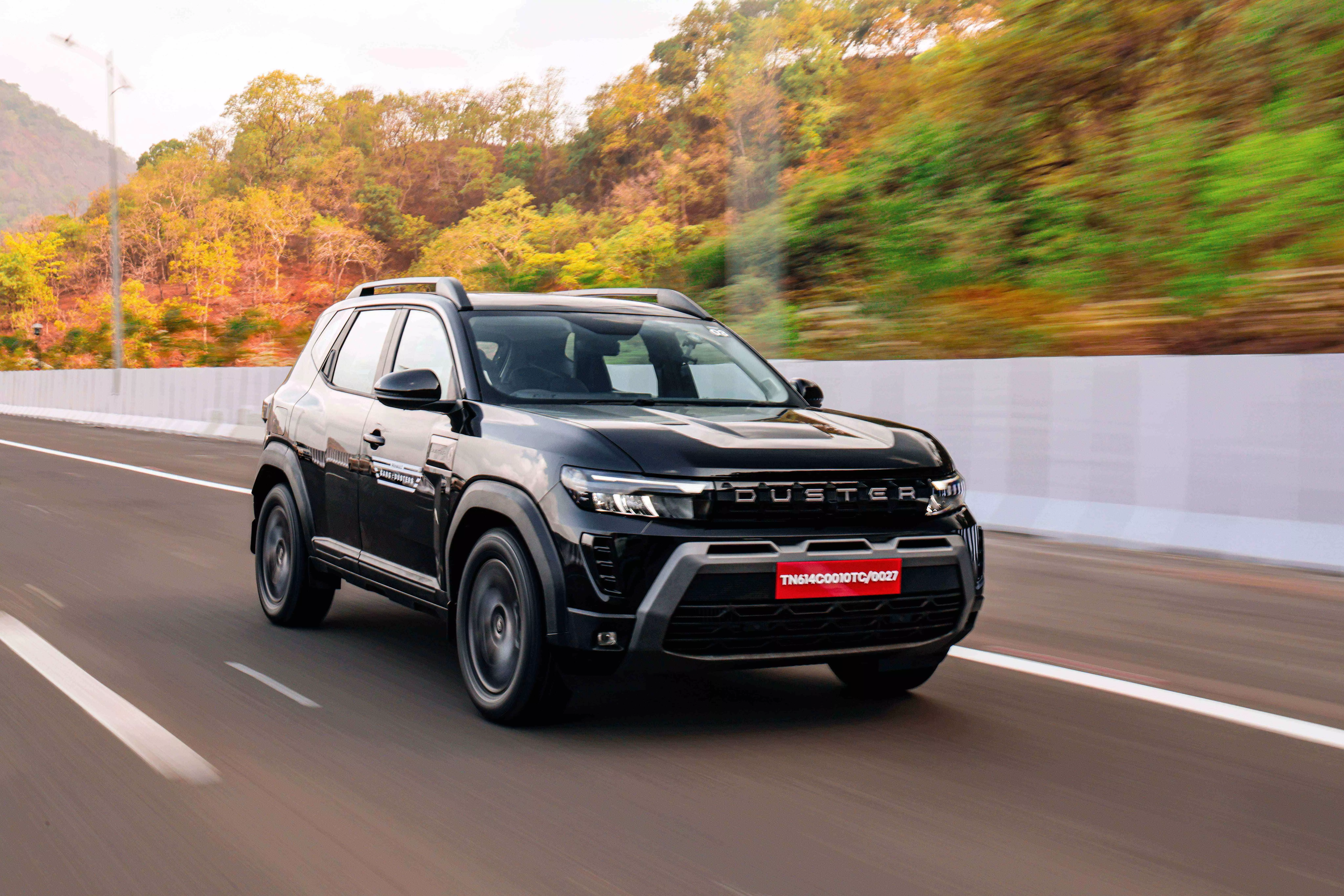
Renault has made sure that every Duster on the road looks good, no matter the variant or the engine. We drove the Techno variant this time with the 1-litre turbo-petrol engine. You continue to get the same face as the top-of-the-line Iconic variant – Duster written on the grille in bold, sculpted bonnet, chunky body cladding, LED headlamps and fog lamps. From the side, the changes are more apparent. The Techno variant gets 17-inch wheels as compared to 18-inchers in the Iconic. There’s disc brakes at the front and drum at the rear, Duster badging on the door instead of the Iconic badge and plain black roof rails with no decals, but these can still take a load of up to 50kg.
Like the front, things remain consistent at the back. There’s no visual changes except for the Turbo 160 badge being replaced by a badge that reads ‘Turbo’. The clear-lens LED tail lamps with a full-width lightbar, chunky bumpers, spoiler and powered tailgate continue to be a part of the Techno variant as well. Despite these minor changes, the Duster still looks as good in the Techno variant as it does in the Iconic.
Renault Duster Turbo 100 interior
Techno is the highest variant you can get with the Duster Turbo 100. We’ve had a taste of how the interior feels and let me tell you that it’s pretty good. The layout is same as the one in the Iconic, however Renault has changed the cluster screen, used different materials and colours, and toned down slightly on the feature list. But just slightly.
The biggest change in the cabin is the smaller 7-inch TFT cluster instead of the tech-loaded 10.25-inch unit in the Iconic. Here, you can get all your stats and it does the job well, but it’s not as aesthetically pleasing to look at as the bigger unit. I can go to that extent and say that this unit feels like baggage that has been carried over from some other Renault car, because the display quality is also not up to the mark and as good as the other screens in the car. Other changes are black and brown fabric upholstery, wood-like textured trim on the dashboard and door cards, instead of the faux carbonfibre like in the Iconic. There’s no ventilation feature and the front seats also have to be adjusted manually, but the steering wheel continues to get adjustment for both rake and reach.
The Duster Turbo 100 still remains to be a good option for buyers because it gets features like a 10.1-inch info screen (same as the Iconic), 360-degree camera, wireless charger with magsafe, auto-dimming IRVM, all-four automatic windows, automatic dual-zone air-conditioning, rear AC vents, panoramic sunroof, and a powered tailgate.
Renault Duster Turbo 100 engine and 6-speed MT (specially tuned for India)
You know the biggest struggle you have with a smaller engine? It’s having to downshift every time you need to overtake or need some power on the highway. That’s what puts me off the most whenever I have to drive a car with a small 1-litre 3-cylinder engine. That’s what I expected in the Duster too, only for Renault to burst my bubble first thing in the morning. Francisco Hidalgo, VP of sales and marketing at Renault India, was delivering the product briefing in the morning before the drive and he said that the 6-speed MT in this car is specifically tuned for India. What that means is that the gear ratios are taller and you will have to downshift much less. There will be more linear power throughout the power band instead of a surge of power coming in after the turbo spools, which is a characteristic of the 1-litre TSI and the 1-litre TGDi engines that the Kushaq, Kylaq, Taigun, Venue, Sonet, and Syros have.
The Duster Turbo 100 gets a 1-litre 3-cylinder engine from the Kiger, but in a slightly higher state of tune. It makes 99bhp (unchanged) and 166Nm (+6Nm) and can only be bought with a 6-speed MT. What Francisco said in the morning turned out to be absolutely true when I drove the car. The comfort this manual transmission delivers is class-leading and even better than the 6-speed MT in the Duster Turbo 160, because in that one, you have to keep downshifting.
Renault Duster Turbo 100 performance v rivals
Now, the Duster Turbo 100’s engine makes 99bhp and 166Nm. On paper, those figures are lesser than what the rivals get. The 1-litre TSI makes 114bhp and 178Nm and the 1-litre TGDi makes 118bhp and 172Nm. Now, I’ve come fresh off the heels of driving the facelifted Kushaq with the 1-litre TSI paired with the manual, and the power difference on paper between the Duster and rivals is quite apparent even out on the road.
The 99bhp peaks at 4500-5000rpm and the 166Nm peaks at 2000rpm. This means that you have more power in initial stages and the power delivery is linear throughout. Yes, it does go fast when you give it the beans, and there’s a kickdown switch in the gas pedal, even in the manual, which is a very cool thing to have. But it’s definitely not the most-enthusiastic in the segment. If you are someone that drives mostly in the city and takes the car out on the highway only two or three times in a year, then this car is perfect. Fuel-efficiency is also good enough, I managed to get 12.5kmpl on a 300km drive. But for someone that travels inter-city pretty often, the 1.3-litre engine is a masterpiece and miles ahead of this engine in terms of how it delivers power and how refined and smooth it feels.
Another big point that puts me slightly off is the engine vibrations. Yes, this is a 3-cylinder engine which has an inherent nature of being loud and having vibrations, but it could’ve been executed much better. At idle, the vibrations are too evident inside the cabin, especially when you keep your left foot on the dead pedal.
Renault Duster Turbo 100 ride and handling
The Duster’s RGM platform, dimensions, and characteristics remain unchanged. We called out the car’s brilliant dynamics and supple ride on bad roads in the last review, and that continues. The steering feels very direct, quick, and is responsive. In fact, it is one of the best in the segment. The ride is excellent on bad roads and a lot of the sharp edges are flattened. Through corners and twisties, the car feels well-balanced, body-roll is minimal, the steering works in synergy and inspires a lot of confidence for you to push harder. At higher triple-digit speeds, the car remains stable and composed.
The good ride quality is all credit to the brilliant suspension setup that has been engineered and tuned by Renault India guys specifically for the Indian market. At the front, you get stabilizer bars and MTV-CL dampers all around that help with flattening all the vibrations at lower speeds and also making the car more flat at higher speeds. At the rear, there’s a twist beam.
Renault Duster Turbo 100 price and rivals
The Renault Duster Turbo 100 with the 1-litre engine is the most-affordable in the lineup now. The Duster that started at ₹13 lakh before with the 1.3 turbo petrol is down to ₹10.5 lakh with the Turbo TCe 100. The range starts with the Authentic variant that costs ₹10.5 lakh, the Evolution that costs ₹11.7 lakh, and tops out with Techno that costs ₹13.5 lakh. The equivalent Techno variant in the Duster Turbo 160 costs ₹14.5 lakh. If you have that extra bit of dough, I think you should go ahead and purchase the Turbo 160 engine. If you are someone that drives mostly in the city, then you can save ₹1 lakh and buy the Turbo 100 because the manual feels very comfortable to use in the city.
The Duster rivals cars like the Skoda Kushaq and Volkswagen Taigun that gets a 1-litre TSI engine with a 6-speed MT. It also goes up against the Seltos and Creta that get a 1.5-litre naturally-aspirated engine with a 6-speed MT. More rivals include the Tata Sierra, Honda Elevate, Maruti Suzuki Grand Vitara, Toyota Urban Cruiser Hyryder, Maruti Suzuki Victoris, and the Citroen Aircross X.