

Bike Reviews
2026 Triumph Scrambler 400 X: Can the 350 engine carry forward the 400’s legacy
The 398cc TR Series engine has been replaced by a 349cc engine for the 2026 range of Triumph 400s. We got to test the new engine in the 2026 Triumph Scrambler 400 X
The government makes some interesting decisions. Some work for the general public, while some work for a very specific niche. One such decision from recent times was the new GST 2.0 policy that penalised any motorcycle that had an engine displacement more than 349cc. While Maybachs got more affordable (relatively speaking), bikes like the Triumph Speed 400, Scrambler 400 X, KTM 390 Duke, Royal Enfield Himalayan 450 and so on, got more expensive for the average joe to buy. For a while, Triumph absorbed the costs that were added to the price of buying any of its 400s post GST revision. But that is not something a manufacturer will be too happy to do for a long time. To rectify that and to make it easier for itself and the buyer to get on these machines, Triumph has tweaked its 398cc TR Series engines to now displace 349cc. This means that anyone buying one of these benefits from the 18 per cent GST tax slab. All of that is well and good, but does this come at the cost of performance? Let’s find out.
2026 Triumph Scrambler 400 X engine: What’s new?
The 398cc TR series has been bid adieu in favour of the more financially conducive 349cc engine. The engine is not an all-new unit and Triumph has achieved the lower displacement by making some choice modifications to the internals. Starting with the stroke. The 89mm bore remains untouched but the stroke has been shortened from 64mm to 56.1mm with a shorter con-rod. The valve timing and intake systems have been worked on as have the crank shaft. The idea was to retain the strong top-end punch without compromising on the low and mid-range performance too much. In terms of power, Triumph claims that dropping close to 50cc should usually result in a drop of around 5 horsepower for an engine of this sort. But in the case of the Speed 400 and the Scrambler 400, the power figure now stands at 36.4bhp at 8500rpm instead of 39.5bhp at 8000rpm, while the torque has gone down to 32Nm at 7000rpm from 37.5Nm at 6500rpm. The T4 sees a power drop of just 1.9hp with it making 28.6bhp at 7500rpm instead of 30.5bhp at 7000rpm. Torque now stands at 31Nm at 5500rpm instead of 36Nm at 5000rpm. The Thruxton 400 and the newly-launched Tracker, which have the engine in the highest state of tune now make 39.5bhp at 8750rpm instead of 41.4bhp at 9000rpm and 32Nm at 7500rpm instead of 37.5Nm at 7500rpm.
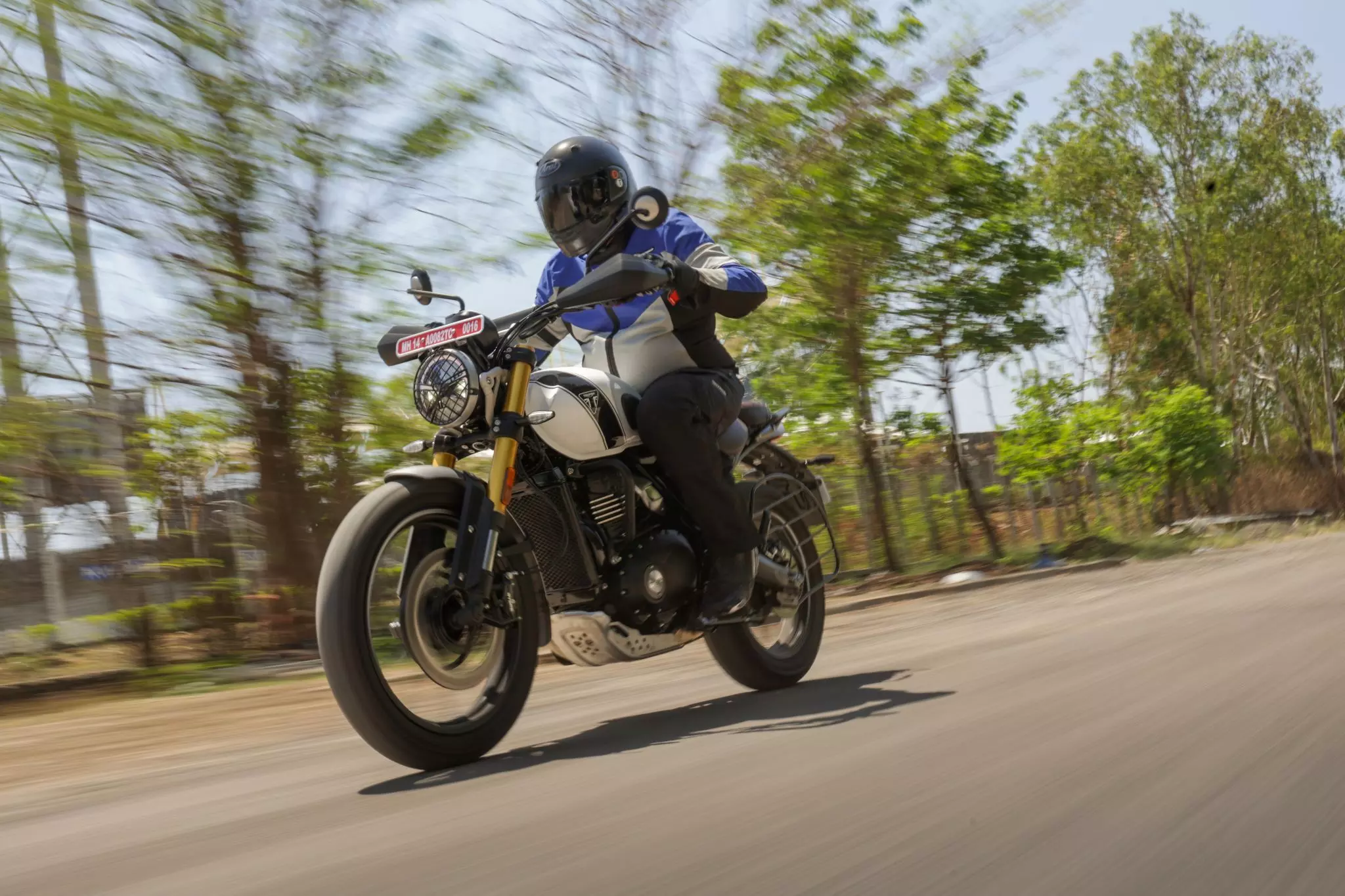
Despite the sizeable concession on displacement by 50cc, the 349cc engine feels negligibly different than the outgoing 398cc unit – Shot by Rohit G Mane for evo India
We got to ride the 2026 Scrambler 400 X with the new 349cc engine and right off the bat, I was mighty impressed. Triumph claims that the vast majority would not be able to tell the difference in performance unless they were to ride both bikes bike to back and really pay attention. To a large extent, I agree. The exhaust note sounds nearly identical as well. Setting off, the motor feels as peppy as it did and adds digits to the speedometer quite rapidly. Triumph claims that the difference in acceleration and speed is marginal, bordering on imperceivable. The claimed 0-60kmph time goes from 2.9s to 3.3s and 0-100kmph time goes up from 7.4s to 8.8s. Claimed top-speed drops from 146.5kmph to 144kmph.
Given that these aren’t race bikes, these times are honestly inconsequential. In my time riding the bike with the 349cc engine, I was hard-pressed to tell any major performance difference. The only real difference is in the low-mid-range tractability where the bike feels just a little quicker to react to roll-on acceleration when in a higher gear at a lower speed. This was confirmed after riding a 400cc equipped Scrambler 400 X. But the difference is honestly not night and day. It is still plenty tractable and you can still get away with running one gear higher, but it just doesn’t feel as immediate as the 400. But given the money I’d be saving if I were to buy one, this is a difference that I won't lose a second’s sleep over. The next big change, and this is a positive one, is refinement. The 349cc takes a big leap forward on the refinement front over the 398cc unit. The vibrations that were quite prominent with the 398cc at the pegs, seat and handlebar seemed to have disappeared to a large extent, especially at low and mid revs. What Triumph has achieved with the 349cc engine is truly remarkable.
2026 Triumph Scrambler 400 X chassis, ride and handling
I’m not going to bore you too much with these details because here is where zero changes have been made. The chassis setup is the same - the hybrid perimeter frame with the bolt-on trellis subframe that is suspended on a 43mm USD fork at the front and a monoshock at the rear. The wheel and tyre setup also remains unchanged with a 19-17-inch front and rear wheel shod in MRF rubber. The one aspect that I really hoped would’ve changed are the brakes, which sadly also remain unchanged. The bike rides and handles exactly in the same manner as the 398 did and that’s a great thing. The brakes still don’t inspire as much confidence as you would like them to, but a swap of the front brake pads from the ones on the Speed 400 is the easiest fix.
Triumph has remained resolute in this department and have changed nothing; I wish it had tweaked the brakes to inspire more confidence – Shot by Rohit G Mane for evo India
2026 Triumph Scrambler 400 X price and verdict
The features too, remain unchanged barring the removal of the immobiliser which is something that market research showed that us Indians weren’t too keen on to begin with. The 349cc engine is a master stroke in my opinion one that will quickly grow the ‘over one lakh units sold’ sales figure for Triumph in India. Coming to the actual reason Triumph went through all this trouble – price. The price of the Speed T4 remains unchanged at ₹1.95 lakh. The Speed 400 will cost ₹2.32 lakh instead of ₹2.39 lakh, the Scrambler 400 X will cost ₹2.59 lakh instead of ₹2.7 lakh. The Scrambler 400 XC will cost ₹2000 more at ₹2.98 lakh and that’s because of the components like the tubeless-spoked wheels. And finally the Thruxton 400 will now cost ₹2.65 lakh instead of ₹2.76 lakh. These are all ex-showroom prices and because of the 18 per cent GST benefit, on-road factors like insurance, road-tax and registration should also ideally cost less than they would. While the differences in prices don’t seem all that much, you have to take into account that for all this while Triumph has been absorbing the price difference that GST 2.0 imposed on the bikes. If it hadn’t, the difference would be a lot more. As demonstrated by KTM who recently jacked the price of the 390 Duke up by ₹40,000. The 400cc KTM and Bajaj bikes too will get the 350cc treatment soon. But as far as Triumph is concerned, what it has done with the 349cc engine is something that will not only benefit it but also the buyer. What you get apart from a stellar motorcycle is money left in your pocket to ride your new machine for that much longer. And that, in my humble opinion, is all that matters.