

Bike Reviews
BMW F 450 GS first ride review: Is this the shot of espresso the sub-500cc ADV market needed?
The BMW 450 GS breathes new life into the sub-500cc ADV segment with its parallel-twin engine and styling derived from its elder siblings. But is this what the market needed?
For years we’ve been stuck in the middle of go-anywhere performance. The single-cylinder ADVs like the KTM 390 Adventure and Royal Enfield Himalayan 450 are great at what they set out to do but lack the outright refinement and ability that comes with having a multi-cylinder engine. On the other end of the spectrum bikes like the F 900 GS, the R 1300 GS, Ducati Multistradas and Triumph Tigers are fantastic but are a lot to handle in our traffic and when riding on-road and are quite daunting when riding off-road. Unless you have the skill required and a small fortune set aside to keep up with the maintenance that comes with owning a big bike.
This is exactly where BMW aims to slot the F 450 GS in our market, by offering a machine that is as capable off-road as it is on it, A machine that is an ideal upgrade for those looking to upsize from a 200-300cc ADV or for those looking to downsize from a big and burly motorcycle. Does the BMW F 450 GS meet these expectations or is it one of those unicorn bikes that’s just too good to be true?
BMW F 450 GS engine
Powering the F 450 GS is a brand new 420cc, parallel-twin engine that puts out 46.9bhp at 8750rpm and 43Nm of torque at 6750rpm. It also gets a very unique 135-degree crankshaft firing order. BMW claims that this firing order has been designed to offer a healthy spread of power and torque all across the rev-range. The engine is mated to a six-speed gearbox and in the case of the Trophy variant that we rode, the ‘Easy Ride Clutch’ or ERC as BMW calls it. It is essentially a centrifugal clutch that is fitted on to the existing clutch and it eliminates the need for you to use the clutch altogether, but more on that later. When you crank the engine, you’re greeted by a rather quiet exhaust note. But it’s one that immediately lets you know that there’s more than one piston firing away inside the engine. It doesn’t sound like a typical twin with a 180 or 270 degree crank. Somewhere in between is the best way I can describe it. As promised, the mid-range and top-end power is quite potent and the F 450 GS quickly accelerates past triple digit speeds. Most importantly, it does so effortlessly. Refinement levels are quite solid too, with the only real buzz that I encountered coming closer to redline. 100kmph comes in at around 5500rpm and at that point, everything works rather nicely. Even post 100kmph, you never feel like you’re running out of steam with the engine eager to accelerate even beyond 140kmph.
The power delivery is steady as expected from a two-pot motor; ERC takes some getting used to
Then there’s the Easy Ride Clutch. It’s been designed to kick in post 2700-odd rpm and you don’t need the clutch to set-off or even when coming to a halt. That coupled with the bi-directional quick shifter that comes on the Trophy variant makes the clutch lever almost redundant. The way it’s calibrated, you can’t use the clutch, even if you wanted to, below 2700rpm. The first few times you ride it, it feels very unnerving. The fact that you can slot the bike in gear, with the engine running, without pulling the clutch in and you not jolting forward to taste the chin bar of your helmet takes some getting used to. But credit where it’s due, you get used to it quite easily and its functioning is quite smooth. Just gently roll the accelerator past 2700rpm and it’s business as usual. Almost scooter-like. This is great for when you want to relax and ride or just putter around town. Makes things very convenient. But this convenience comes at a cost. Because of the nature of the centrifugal clutch system, if you find yourself on an incline, even when in gear, it will roll back even with the clutch out. This makes tacking trails a little challenging. If you stop when on a hill climb or something of the sort, and you want to stall the bike for it to hold its place, this won’t do that and will just roll back. This issue is compounded further when you factor in that there isn’t a hill hold assist or brake lock feature either. This is something that really should have been considered. Then there’s the matter of riding slow and tight trails. Because you can’t modulate the clutch when the engine speed is below 2700rpm, you can’t rely on the clutch to navigate through them. You need to re-calibrate the way you ride and keep the revs above 2700rpm at all times. And no matter how you try it, the bike will rev, but won’t accelerate until 2700rpm, voiding you of what I feel is a potent low-end. Now my biggest problem with the ERC is that it’s on the Trophy variant which in BMW speak is the most capable, off-road oriented variant of this model. The benefits of the clutch system are multifold, but these few drawbacks especially when riding off-road does hold you back from realising the full potential of the bike. Which is exactly why I’m really looking forward to sampling a variant of this bike without the ERC clutch.
BMW F 450 GS chassis, ride and handling
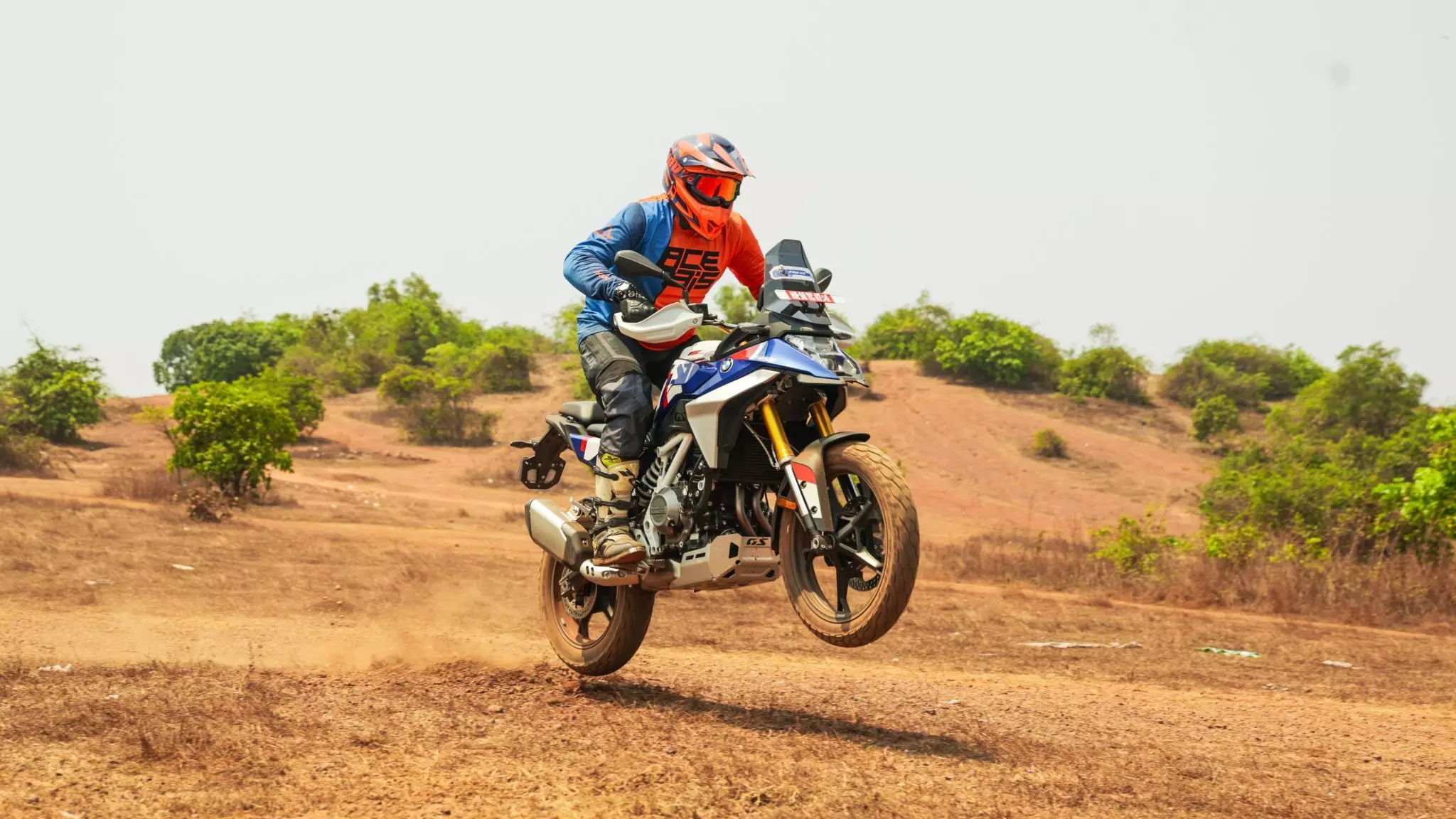
The new engine is cradled in a new split-trellis frame which uses the engine as a stressed member of the entire setup. The swingarm is a hollow, cast aluminium swingarm. The frame is suspended off a 43mm KYB fork at the front and a monoshock at the rear. Both offer 180mm of wheel travel. The monoshock is adjustable for preload and rebound across variants and also features BMW’s progressive damping system. The Trophy variant that we rode also had the Sport suspension which introduces compression and rebound adjustment. The seat height is set at 845mm and you reach out to a wide, tall handlebar, very similar to that of the bigger GS models. The 845mm saddle height might seem daunting, but the bike is narrow in all the right places, making it more accessible than the number suggests. The footpegs are also in a neutral, mid-mounted position, making for the ideal riders triangle for seated long-distance cruising and transitioning to the stand up riding position is very easy too. The stand up riding position too, is spot on. You can grip the bike with your knees naturally and the handlebar position allows you to get into an attack stance with ease. People of most sizes will find a lot of comfort on this bike. The ride quality on the Sport suspension, in stock setting too, is a little on the firmer side and ripple and undulations on the road do make their presence felt. Don’t get me wrong. It's not harsh, just firm, notifying you of its sporty intent. While I would like a slightly more plush overall setup, I’m going to reserve my judgement on whether or not that is actually achievable with this setup, once I get the bike for a longer duration and can tweak the suspension settings. The seat is quite comfortable too, even after spending close to three hours on the saddle, I didn’t have any sore spots to complain of.
The suspension is on the firmer side even in its default setting, but its not harsh; the seating position is well-adjusted for a comfortable ride nonetheless
The chassis on this bike oozes BMW magic. The frame is communicative, it enjoys taking long corners and when you take it off the road, you realise that there is genuine off-road ability. It isn’t one of those poser bikes that just wears the uniform but can’t actually fire a bullet. Yes the 19-inch wheel is not ideal for more hardcore stuff, but as BMW says, this isn’t meant to be a hardcore off-roader. It is meant to be a 50-50 motorcycle and I feel BMW has nailed that brief. In the narrow bylanes of Goa, on the open highways and on dirt, the bike felt equally competent. Braking performance is solid with a 310mm disc chomped onto by a Brembo calliper and a single-piston ByBre calliper on a smaller disc at the rear. Bite is strong, but easy to modulate and with Enduro Pro mode, you can turn off ABS at the rear as well. The handling on the road and off of it, in typical BMW fashion is very linear and predictable and sharp when you want it to be. The chassis setup on the whole ties the bike together rather nicely. The bike doesn’t feel top-heavy and feels inherently stable. Then when you factor in the kerb weight of 178kg, the deal is that much sweeter.
BMW F 450 GS variants and features
The F 450 GS will be available in India in three variants. Standard, Exclusive and Trophy. The striking red coloured Sport variant, isn’t on the cards for India at the moment. The Base variant gets a bunch of kit as standard. Three ride modes – Road, Rain and Enduro. Standard features and electronics include the 6.5-inch colour TFT screen and the rotary wheel selector button on the left switch cube lifted straight off of the bigger GS models. Standard rider aids include ABS Pro, engine brake control, Dynamic Traction control and heated grips. The base variant misses out on a windshield, a sump guard, hand guards, adjustable front suspension and quick shifter. The Exclusive variant introduces a bi-directional quickshifter, the Enduro Pro riding mode, offroad footpegs, a plastic sump guard, black hand guards and a clear windscreen. The Both the Base and Exclusive variant are available in a single black colourway.
The Trophy variant gets everything that the Exclusive variant gets and adds the adjustable front suspension, swaps out the plastic sump guard for an aluminium one, gets a black Rallye wind screen, the Easy RIde Clutch system and the Trophy colour scheme with the frame painted white and and the handguards finished in white too. In my opinion, heated grips are quite a pointless feature in India, unless you frequent the mountains. 9/10 riders would prefer having a quick shifter over heated grips and that is a big miss in the base variant. Cruise control is another feature that’s becoming a staple in the ADV segment, another feature the F 450 GS misses out on altogether. The Sport suspension too is exclusive to the Trophy variant and I really feel that BMW should have gotten the Sport variant to India too. The ERC clutch should have been an optional extra, or there should have been a hill hold or a brake lock feature at least, given that the Trophy is meant to be the most off-road oriented variant of the lot. But apart from these things, the level of kit on the F 450 GS is quite comprehensive.
BMW F 450 GS prices and verdict
Ex-showroom prices for the BMW F 450 GS start at ₹4.7 lakh for the base variant, ₹4.9 lakh for the Exclusive variant and ₹5.3 lakh for the Trophy variant that we rode. At these prices, there’s no denying that the F 450 GS is positioned as a premium product. Credit where it is due, the prices are lesser than I anticipated them to be. Price of purchase aside, servicing the bike will also be considerably pricier than its single-cylinder rivals. BMW does have some service and maintenance oriented finance options that should make the ‘buying’ and ‘living with’ process easier. As far as the bike itself is concerned, BMW has, to a large extent, delivered what it has promised. The Trophy variant with the ERC clutch, wasn’t all roses and rainbows. But barring the eccentricities of the clutch, it was quite a commendable machine. It offers the ease of performance that is associated with a twin-cylinder engine without adding the layer of difficulty and heft that comes with a big bike. The styling and design, inspired quite strongly from the R 1300 GS, in my books, immediately makes it a winner. It also has a lot of premium features, despite missing out on a few features that would have added more value to the product. But all that aside, the F 450 GS is a genuinely capable machine that will serve as a good upgrade for someone coming off of a 250-300cc bike and will also be entertaining enough for someone who rides a larger motorcycle as well. Yes it isn’t perfect, but it is the first motorcycle in a very long time that does bridge the gap between the sub-500cc single-cylinder ADV bikes and the big and burly multi-cylinder adventure machine. So if you’re in the market for exactly that sort of bike, definitely take one of these out for a test ride.