

Triumph Tracker 400 first ride review: More than just a new name on the tank?
The Triumph Tracker 400 is the fifth motorcycle based on the 400 platform. Does it stand on its own? Or is it too similar to its brethren?
- Aggressive styling, punchy performance
- could do with road-focused tyres
A motorcycle is a sum of all its parts, and more often than not, manufacturers reach into the same parts bin to make different motorcycles. Sometimes, this creative parts-bin engineering pays off, and sometimes it just doesn’t. Triumph has had a fair bit of success in this regard, especially with its 400 range of motorcycles. We got the Speed 400, the Scrambler 400 X and XC, the Speed T4, the Thruxton 400 and the latest addition to the lineup is the Tracker 400. Is the Tracker 400 just another bike from the Triumph 400 range? Or does it do enough to stand on its own?
Triumph Tracker 400: What’s new?
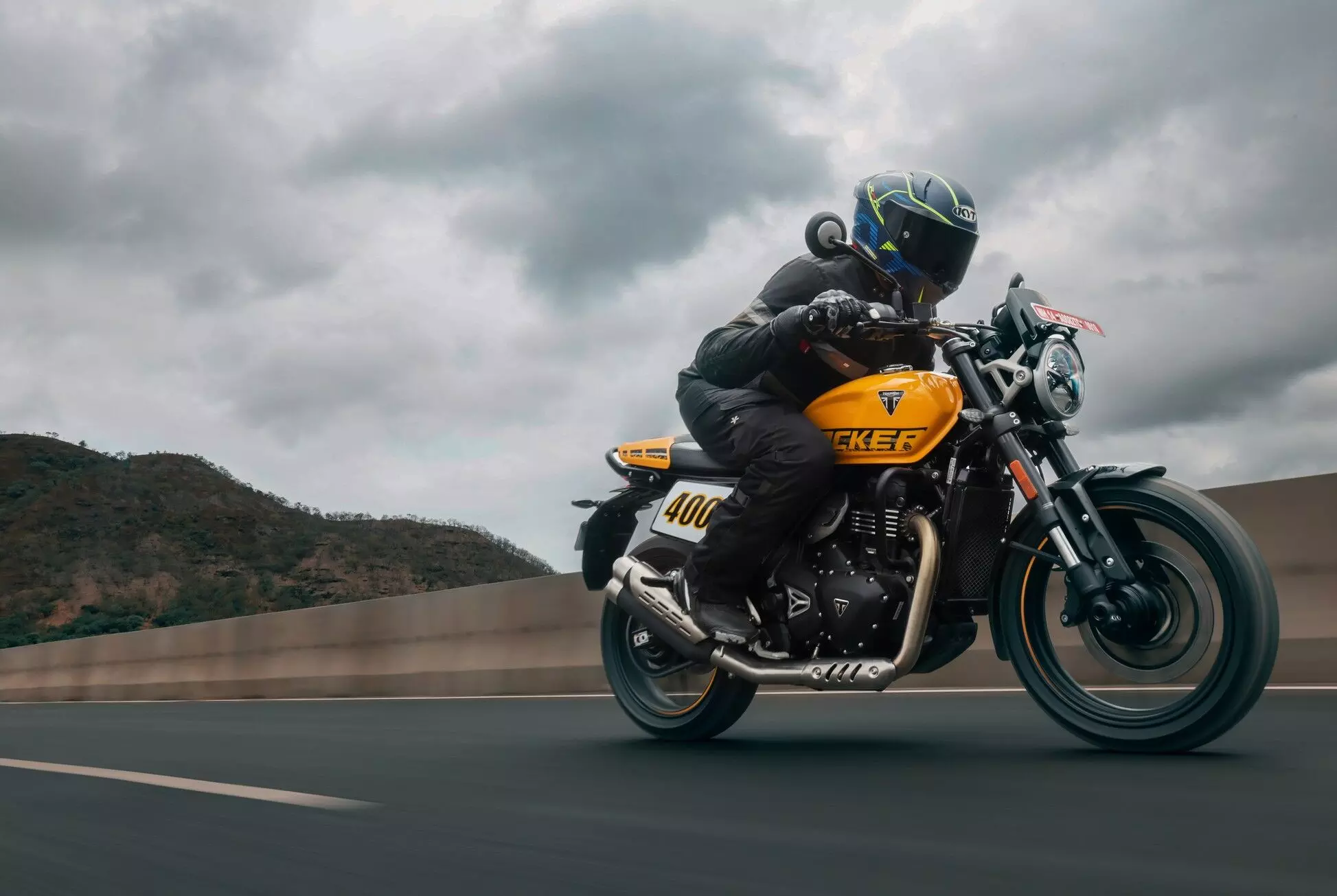
The Triumph Tracker takes the Speed 400’s softer, curvier design and chisels it with lithe, aggressive lines that suggest a much sharper design with a similar silhouette. Starting from the front, you get the same round headlight with a new, almost square fly-screen. Then there's the new aluminium hydroformed handlebar that is 23mm wider and 134mm lower, and the footpegs, which are 86mm more rearset and 27mm higher than on the Speed 400. The fuel tank, too, has a sharper, flatter design. The seat, similar to that of the Thruxton 400, gets a flatter design and also benefits from a seat cowl which, as you would expect by now, has a sharper design. The entire rear subframe is similar to that of the Thruxton 400 and also gets the same boxy taillight as well. Look at the bike from the side, and you will see a panel like you would on flat track machines that would house their race number. Albeit, on the Tracker, it reads 400. It would be nice if you were offered the option to customise this from the factory. The other difference you’ll see is the exhaust, which is the dual-barrel unit from the Scrambler 400 X and XC with a new heat shield. The next difference is the engine, which is the same 349cc, liquid-cooled single but is in a higher state of tune like the Thruxton 400. While the Tracker 400 is inspired by flat trackers and has all the design cues to suggest that, that is just the visual direction that Triumph has taken with the bike. Functionally, it is a street bike through and through.
Triumph Tracker 400: Performance, ride and handling
As soon as you swing a leg over the Tracker 400, you will feel that, ergonomically, it offers that sweet spot between the relaxed, upright stance of the Speed 400 and the more committed, racy stance of the Thruxton 400. The 805mm seat height is accessible and will allow riders of most heights to comfortably get their feet down because of how narrow it is at the mid-section. The more committed ergonomics doesn’t come at the cost of comfort, and that’s a good thing. Yes, longer days in the saddle might result in a little weight felt on the wrists, but it is hardly anything to complain about. The suspension setup is identical to the Thruxton 400, meaning it gets 140mm of front wheel travel and 130mm of rear wheel travel, 10mm more at both ends than the Speed 400. The ride quality is quite enjoyable. It soaks most undulations rather well. It is slightly on the stiffer side, and that’s exactly what helps with its dynamics. It isn’t so stiff that it won’t cope with mid-corner undulations; at the same time, it isn’t so soft that it feels squishy under the loads of cornering. Braking too, handled by the 300mm disc and four-piston calliper at the front and 230mm rear disc and single-piston calliper, is solid, offering plenty of bite and feedback.
The Tracker 400 uses a 349cc engine good for 39.5bhp at 8750rpm and 32Nm at 7500rpm. Shot by Rohit G Mane for evo India
When it comes to actually taking corners, the Tracker 400 feels every bit as sharp as it looks, with the only chink in its armour being the dual-purpose MRF REVZ-D1 tyres. While they handle most everything with grace, they aren’t as sorted as the MRF Steel Brace or Apollo Alpha H1’s. Despite having a sharper rake than the Speed 400 (24.5º on the Tracker vs 25.1º on the Speed 400) it didn’t feel all that much sharper to handle. A change of tyres to more road-focussed ones should help in that department.
Coming to the heart of the matter, the Tracker 400 deploys the 349cc engine in the same state of tune as on the Thruxton 400 which is 39.5bhp at 8750rpm and 32Nm at 7500rpm. That is 3.1bhp more at 250rpm higher in the rev range and the same peak torque but 500rpm later in the rev range. As you would expect, the Tracker 400 does feel punchier and in fact it reminded me of the Speed 400 with the larger 399cc engine. Refinement levels are great with hardly any buzz felt in the revs that you would actually use the bike in. Tractability is great too, and you can be quite lazy with your gearshifts getting away with being a gear and in some cases two higher. It may not feel as punchy as the 399cc engine did. But it’s plenty nonetheless.
Triumph Tracker 400: Is it more than just a new name on the tank?
Equipment-wise, you get everything that we’ve gotten accustomed with from Triumph in the 400 lineup. Ride-by-wire, dual-channel ABS (without the ability to switch it off at the rear) and switchable traction control. The instrument cluster is the same as well, although I still urge Triumph to swap the speedometer with the tachometer. The Triumph Tracker 400 is priced at ₹2.46 lakh, ex-showroom, making it around ₹12,000 dearer than the Speed 400. For that you’re getting styling that is more aggressive and an engine that is in a higher state of tune. Answering the original question, the Tracker 400 does feel like more than just a sticker job. It, in my opinion, offers the best of the Speed 400 and the Thruxton 400 in a package that looks stunning. The Speed 400 looks great, don’t get me wrong there, but is a little more retro and curvy and more importantly very common now. The Tracker on the other hand, looks fresh, more aggressive and offers more performance, without too significant a bump in price. It would definitely be my pick of the two. So, in short, the Tracker 400, is yet another success in the making in Triumph's stables. One that certainly deserves your attention.