

Car Reviews
Bentley Torcal First Look: Inside Bentley's First Electric SUV
Bentley's CEO calls the Torcal “the most considered car in our history.” It's the most powerful Bentley ever built, and it's confirmed for India.
Back in 2020 every indicator pointed to the automotive world switching wholesale to EVs. Every manufacturer, Bentley included, announced grandiose plans to go full electric by 2030, committed billions to electrification, and subsequently walked back from those plans upon realising car buyers weren’t tripping over themselves to go electric. The wheels though, were already set in motion; the money was already spent, and there was no going back. Bentley revised their Beyond 100 strategy, pushing full electrification to 2035 and setting the first EV reveal for 2026. And now, on schedule, comes the Bentley Torcal, which Martin Page, the Torcal's product line director, insists is not the electric Bentayga.
The Torcal is the fourth model line, after Continental, Flying Spur and Bentayga – a standalone car, Bentley's first sport SUV – and one which Frank-Steffen Walliser, the company's chairman and CEO, describes as “the most considered car in our history.” Named after El Torcal de Antequera, a stack of limestone pillars in Andalusia carved by the winds of time, Torcal also doubles as wordplay on torquere, the Latin root of torque, of which the electric SUV has plenty, as we'll get to.
Bentley Torcal Design: A Grille With Nothing to Cool
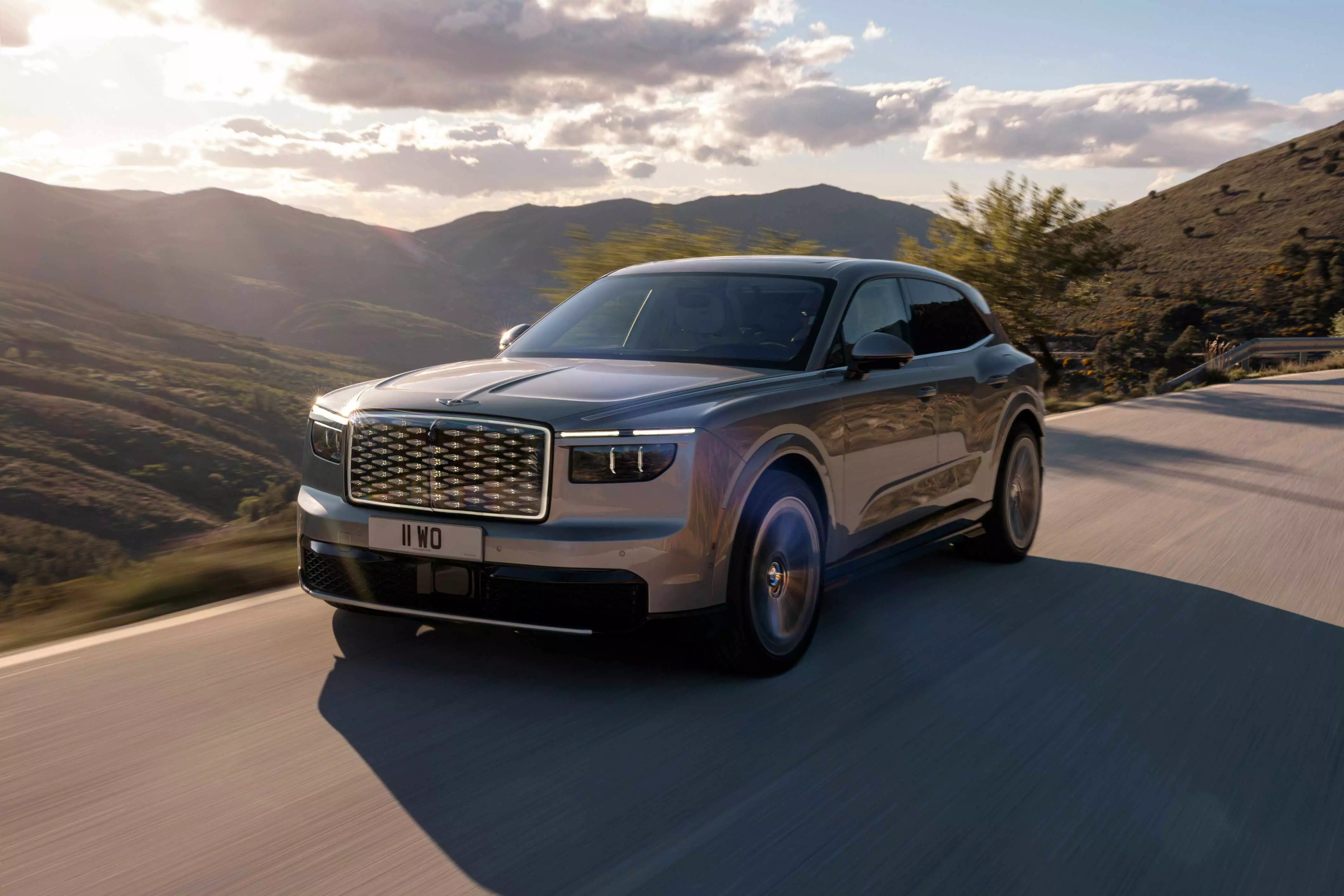
Yasu Sato, on Bentley's design team since day one of this project five years ago, draws attention to the black spine that runs the length of the bonnet, visually stretching it the way a good tailor uses a single seam to make a jacket look longer than it is. Bentley calls it the endless bonnet, and it is there to deliver presence which, Sato argues, comes from length and proportion, not merely badges. The illuminated grille is filled with diamond crystals encased behind glass like jewellery, there purely to give the car a face and an identity in somebody's rear-view mirror
The grille tells another story. An EV doesn't need one – there's nothing under that bonnet to cool, just a frunk – but blanking it off like other EVs would have left it looking, says Sato, faceless. Instead, they built a grille with no function except ornamentation: lit around its edges, filled with diamond crystals encased behind glass like jewellery, there purely to give the car a face and an identity in somebody's rear-view mirror. The rear end of the Bentley Torcal features the slimmest taillights Bentley has ever made
Around the back, the 'resting beast' haunches carry the energy through to a rear defined by the 'prestigious shield' motif and the slimmest LED tail lamps Bentley has built. 22-inch wheels wear hubcaps weighted to stay upright regardless of how fast the wheel is spinning. Pull the handles, and the doors whirr open electrically, because apparently the last remaining chore for Bentley's clientele was opening their own car doors.
Inside the Bentley Torcal: Wool, Aluminium and No Passenger Screen
Inside there's an opulent blend of restraint. There is no passenger screen; Bentley maintains that screens aren't luxury and an over-abundance of them undercuts rather than announces wealth. What you get instead is exquisite trim: carbon fibre veneer engineered to be under a millimetre thick, wool from Fox Brothers, a mill in Somerset in the UK that's been weaving cloth since 1772, and a new finish Bentley calls Sunburst Aluminium. The drive-mode selector, start-stop button, and volume knob are all cold-to-the-touch metal, tactile, unmistakably clickety-clack buttons
The switchgear survives the digital age better than most. The drive-mode selector, start-stop button, and volume knob are all cold-to-the-touch metal, tactile, unmistakably clickety-clack buttons rather than a menu you smudge a screen to access. Even the indicator makes a sound engineered specifically for it: a craftsman's leather hammer striking leather, not a generic electronic click.
The centrepiece is a curved, vertically oriented digital instrument cluster that shares architecture with Porsche's Cayenne Electric – Bentley isn't hiding the family relationship – but is a single-plane design rather than Porsche's floating screen. It includes a small piece of theatre: a hand animation that places a crystal-glass motif on the display, but only once every couple of weeks, and a light-refraction pattern on a 72-hour cycle so the display never looks quite the same twice. The electrochromic glass roof has a built-in IR layer that darkens on demand and needs no physical cover
Look up, and there's an electrochromic glass roof with a built-in IR layer that darkens on demand and needs no physical cover. There are cameras built into the A-pillars for what Bentley calls a wellness feature, and you can log in by key, phone, screen or your own face.
The Sound of an Engine That Isn't There
Fire up the Bentley Torcal and you will be surprised by the strident whump that does an accurate enough impression of a big V8 firing up. What you are hearing is a recreation of the 6.75-litre V8 – the longest-running engine in Bentley's history. But rather than stick microphones up the tailpipes of the Continental R that ran this engine through the 1990s, Bentley brought in drummers and had them physically perform the rhythm, tone, beat and volume. A live human performance carries natural imperfections that a perfect digital loop doesn't, and Bentley has decided those imperfections are what make a sound feel authentic rather than synthetic. The Torcal's V8 soundtrack is not tied to the pedal, but rather, it is mapped to torque demand, so it stays in the background on part throttle and only announces itself when the motor is being properly exercised.
This is not tied merely to the travel of the accelerator pedal. The sound is mapped to torque demand, so it stays in the background on part throttle and only announces itself when the motor is being properly exercised. It is a deliberate piece of engineering, Page argues, because silence in an EV makes it harder to sense the limits of grip, and makes motion sickness worse for passengers with no engine note to anchor against.
Switch into Sport, and the volume steps up, and the mood lighting turns blue. Bentley commissioned neuroscience research that told them blue sharpens concentration, whereas the industry-standard red for sport modes lets the mind wander. Comfort mode glows a warm amber; the wellness setting turns green, a nod to nature.
Bentley Torcal Specs: Power, Battery and 0–100kmph Time
The Torcal sits on Volkswagen Group's Premium Platform Electric, the same as the Porsche Cayenne Electric, though the tuning and the body on top are entirely Bentley's own. The Torcal puts out 876bhp and 1350Nm from a 113kWh battery on an 800-volt architecture. With launch control engaged, the 0–100kmph sprint takes 2.9 seconds.
That makes it the fastest-accelerating Bentley ever, but those numbers still sit below the Porsche Cayenne Turbo Electric, built on the same platform, and Bentley are candid that this isn't an accident. They say they're not interested in the horsepower arms race that's turned every performance EV into a spec-sheet contest. The Torcal sits on Volkswagen Group's Premium Platform Electric, the same as the Porsche Cayenne Electric, though the tuning and the body on top are entirely Bentley's own
The chassis carries the same philosophy. Two-stage active dampers can raise or lower each corner independently to deliver what Bentley calls a 'magic carpet ride'. There are no physical anti-roll bars, the fully active suspension doing that job electronically. Ride comfort is benchmarked to Bentley's own Flying Spur, handling to the Continental GT, with Bentley highlighting the breadth of capability they’ve managed to engineer in. The Torcal's 113kWh battery pack charges at up to 400kW DC, doing 10 to 80 per cent top-up in under 16 minutes
Other key figures: 2.7-tonne kerb weight, 3025mm wheelbase, 5m long, 2m wide and 1.7m tall, with standard rear-wheel steering. Top speed is 260kmph, charging tops out at 400kW DC (a 10-to-80 per cent top-up in under 16 minutes), and the WLTP range target is north of 600km. Bentley says 80 per cent of all Bentleys ever built are still on the road today, and the Torcal should maintain that trend – to enable that, they claim the battery will retain over 90 per cent of its health after eight years and 160,000km.
Bentley Torcal Price and India Launch Date
Bentley are targeting customer deliveries in the second quarter of 2027, with pricing expected to land 10 to 15 percent below the Bentayga SWB. India pricing is anybody's guess for now, since the new India-UK free trade agreement that's supposed to make imported British cars cheaper carves electric vehicles out of its tariff reductions entirely. What is confirmed is that the Torcal is coming to India regardless of what happens with the FTA.
The only question left to answer: is the world ready for the onslaught of very expensive electric cars?
