

Car Reviews
2026 Mercedes-Benz CLA 250+ Electric first drive review: Is this the best electric Mercedes?
The new CLA 250+ heralds a new era for Mercedes-Benz EVs, with a headline range figure of 792km
As most global carmakers recalibrate their electric ambitions, Mercedes-Benz is doing the exact opposite. It is doubling down. Hard. This is the latest car to join Mercedes-Benz’s India lineup – the CLA Electric. The CLA Electric is underpinned by Mercedes’ latest MMA platform, which can support both EV and ICE powertrains. More importantly, the CLA brings in entirely new design language, new interior architecture including heavy AI integration, and a massive bump in range.
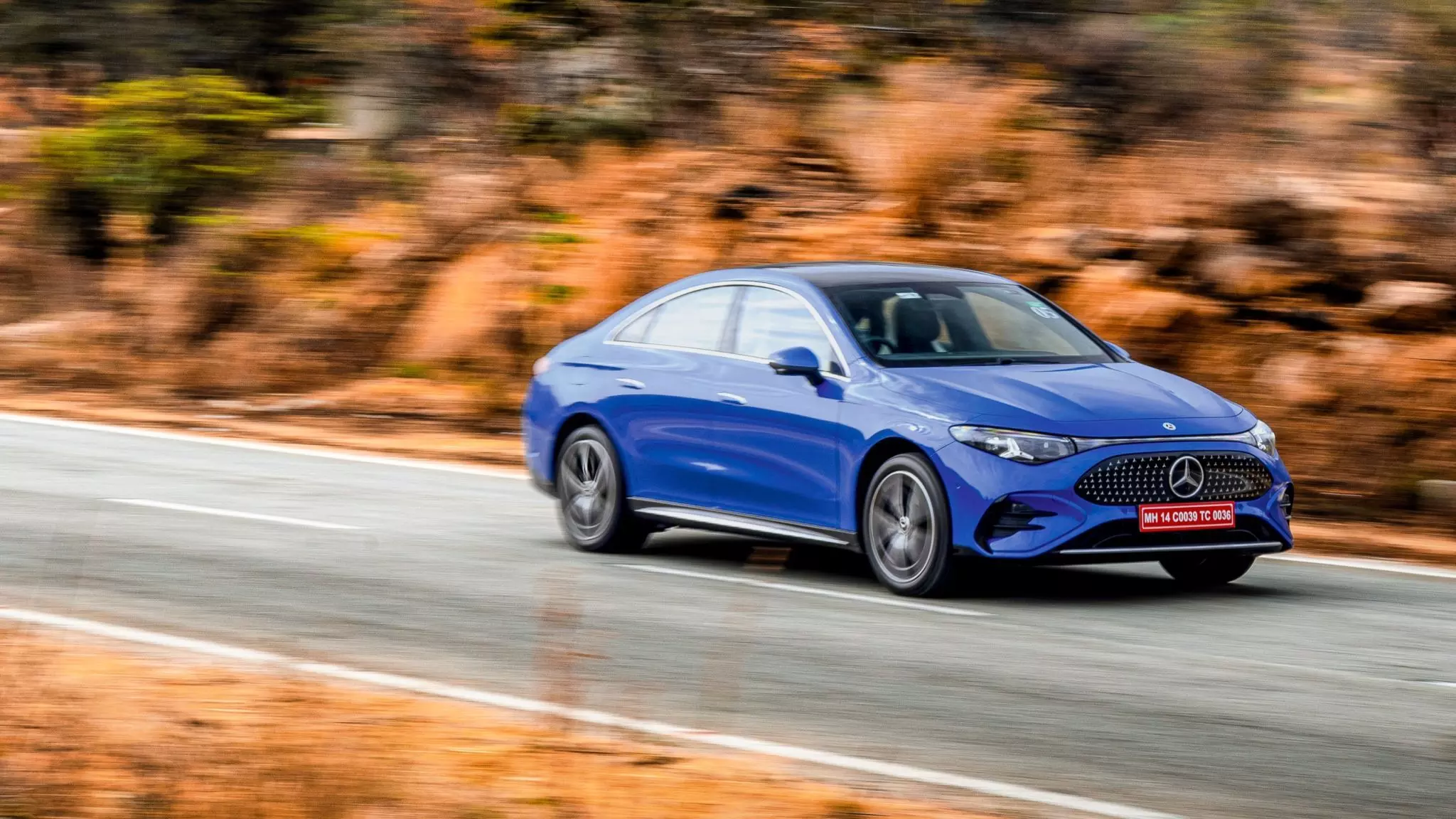
The one you see in the photos is the top-spec CLA 250+ trim. It boasts up to 792km of WLTP range and up to 320kW of DC charging. Moreover, the performance is commendable as well, with 0-100kmph being achieved in 6.7 seconds. All these factors make the new CLA Electric a very important car for Mercedes-Benz India. Especially since it hasn’t exactly seen much success in the entry luxury EV segment. Rivals like the BMW iX1 LWB, Volvo EX30, BYD Seal and Kia EV6 will give tough competition. Let’s find out if Mercedes has done enough to win the battle this time.
2026 Mercedes-Benz CLA 250+ Electric underpinnings
MMA (Mercedes Modular Architecture) is the most significant part of this story. It is compact, flexible and essentially a ground-up electric skateboard with a battery pack integrated into the floor, operating on an 800V architecture. The high-voltage architecture means lower cooling requirements and faster charging. At the heart of this platform are also in-house-developed motor, transmission, and power electronics. When the CLA Electric was revealed globally, the headline figure was almost unbelievable – an WLTP range of 792km. The car you see in the photos is the 250+ variant boasting those headline figures. But Mercedes will also bring the CLA 200, which it refers to as the ‘Standard Range’ featuring a 58kWh battery. That model will offer 542km of WLTP range, with 240kW DC charging allowing it to get 320km worth of juice in 20 minutes. With the 250+ variant, 240kW DC charging adds 400km of range in 20 mins.
These cars will also be heavily software-led. AI, supercomputers, sensors, cameras, the works – all this enables a lot of customisability, and also more advanced ADAS capabilities. The system is dubbed MB.OS – a new in-house operating system powered by Nvidia’s Orin chip, capable of processing up to 508 trillion operations per second using four supercomputers managing everything from infotainment to automated driving. Globally, the CLA is the first car to be born on this new platform, and yes, like all modern Mercs, you will have a harder time counting the stars on this one.
This level of innovation means this is a very important car. As Santosh Iyer, MD & CEO of Mercedes-Benz India, says, “This is a change in a generation of cars that we are getting. This is proof of the next 140 years. The amount of technology and intelligence packed in the car shows our superiority in EV technology. This is a defining car for us.” Defining is a strong word, but the launch presentation did showcase the leaps the brand has taken. Now let’s see how the car actually feels.
2026 Mercedes-Benz CLA 250+ Electric design
Stars have been generously used throughout the exterior of the new CLA. The grille features 142 illuminated stars scattered across a gloss-black panel. The headlights and taillights themselves are star-shaped and connected by a light bar. It’s unmistakably a modern Mercedes. But not in a way people like. The front design has got strong reactions from people – violent on social media, milder in real-life – but ultimately more nays than yays. Personally, I’m conflicted. I don’t dislike it. But I don’t love it either. It feels softer than its predecessor. It lacks the sharpness of the older CLA and even the premium appeal of a C-Class. The AMG-Line kit adds flared bumpers, while chrome accents add some oomph, but neither does enough to make it stand out. It’s somewhat better from the sides, and the roofline flows elegantly into the rear. The CLA has always been swooping and compact, and while the swoopiness continues, it does look large in the flesh.
At 4723mm long and 1855mm wide, it is almost C-Class-sized – slightly shorter (by 28mm), but wider (by 35mm). It’s got enough storage space as well. A 405-litre boot is accompanied by a 101-litre frunk – significant, as none of the older EVs had a bonnet that could open, and this marks the first time front storage is available in a Merc in 90 years.
It is 4723mm long and 1855mm wide, but its shorter than the C-Class by 28mm, yet it packs a 405-litre boot – Shot by Rohit G Mane for evo India
Aero has a huge role to play in the range. With a Cd value of 0.21, the CLA is incredibly slippery through the air, and that’s what allows it to achieve those headline range figures. The smooth design is intentional; it doesn’t catch and disturb air anywhere. There are no breaks or seams in the face, even around the grille, and that was done so that air flows past the nose and not into it. There are plenty of other functional aero bits: vents in front bumper to create air curtains, smaller ORVMs and flush door handles to reduce drag, a sloping roofline and aero-optimised 18-inch rims. There are even wheel spoilers – plastic tabs that sit in front of every tyre – to break airflow and prevent turbulence in the wheel arches. The level of detail that Mercedes has gone to to hone aero is unreal: even the rear diffuser has been designed separately for cars with and without a rear toe hook.
2026 Mercedes-Benz CLA 250+ Electric interior
Open the door, and you realise more work has been put into the CLA’s interior. The dashboard houses a flat end-to-end panel featuring a 14-inch central touchscreen and a 10.25-inch digital cluster, along with a star-studded illuminated panel ahead of the co-driver. International markets get a third screen option, though it’s not offered to us yet.
Right below the infotainment are the new central AC vents, and further down is your centre console with cupholders, and storage under, and behind it. On the sides, you have the redesigned switches for seat adjustment and window switches. Seat adjustment has more of a new design, but it works well. The window buttons are redesigned – and instead of four buttons, there are only two, with a button to toggle between front and rear. Cost saving on a Mercedes? Okay.
The cabin is full of digital luxury cues with its 14-inch central touchscreen and a 10.25-inch cluster and a star-studded panel – Shot by Rohit G Mane for evo India
The steering is a flat-bottom piece seen on recent AMGs, and an upgrade from the older ICE CLA. One thing of relief is the updated steering-mounted controls, which are far easier to use. Behind it sit redesigned stalks. The left controls indicators and wipers. The right is a multi-function unit incorporating the start/stop button at the end, gear selector via up/down motion, and regen adjustment via push/pull. It’s designed well, and you get used to it pretty quickly.
The materials inside feel premium. Brushed aluminium trim runs across the centre console and in places on the doors. Even the pedals are aluminium. AMG seats in black and white with red stitching look sporty and are made out of recycled materials. Everything feels very Mercedes – very opulent and with superb tactility. The material finishes are top-notch, right from the AC vents to the brushed aluminium trim. These guys really know how to make an “entry” luxury car feel super special, and that continues here.
The seats offer heating and even massaging (as an option), but oddly, no ventilation. It’s a sore miss in our country. Especially since the glass panoramic roof doesn’t get a cover but a heat-shield film. This is not Europe, Mercedes! While the film does cut some heat, it isn’t as effective as a proper cover and doesn’t do much to cut the glare of an overhead sun either. Another compromise is the rear seats. Despite being EV-first, the knee-up seating posture is present, and while space – both kneeroom and headroom – is enough, you’re not going to be very comfortable here. If you’re looking to be chauffeured around, you’re better off with the C-Class.
2026 Mercedes-Benz CLA 250+ Electric AI integration
MB.OS is how the CLA Electric is trying to be future-proof. This is the fourth-gen MBUX system and completely overhauls the settings and icons. A big part of the overhaul is a voice assistant with integrated ChatGPT, Gemini and Microsoft Bing. The folks over at Mercedes say that this system is always learning, and thus, eventually would be able to engage in human-like conversation skills. Also, the native navigation system now uses Google Maps. It can search for places on route, just like you would on Google Maps and add them to your navigation as stops – all with voice control. During our time with it, it could easily search for supermarkets and even a florist while talking to it. The system also plans the routes by looking for chargers on the way, and curates a route that suits you best – and even gives you information about the availability of the chargers, the speed of the charger, and how long you have to stop, right on the infotainment screen. No need to fumble about with a million phone apps. Charging is taken care of through Merc’s native app or with an RFID card that they give you, again saving the need to use many apps. The new UI is slick; however, the AI isn’t as conversational as some of the others we have experienced, and commands needed to be repeated occasionally. However, if it is learning, it should be better in time.
2026 Mercedes-Benz CLA 250+ Electric drivetrain and performance
As for the numbers, the CLA 250+ Electric uses an 85.5kWh battery paired with a single motor at the rear, producing 268bhp and 335Nm of torque. 0-100kmph time is claimed at 6.7 seconds with a top speed of 209kmph. The CLA 200, in comparison, produces 221bhp and has a claimed 0-100kmph time of 7.5 seconds.
It packs a 85.5kWh battery and its rear-mounted single motor churns out 268bhp and 335Nm; 0-100kmph time is claimed at 6.7 – Shot by Rohit G Mane for evo India
The numbers are a good indication of this car’s focus. It’s a proper electric executive car, and isn’t trying to be overtly sporty. And I’ll say it right at the start – it’s a lovely car that can be entertaining when you want it to be. At full throttle, there’s a strong surge of power. It’s not breakneck like a lot of Mercedes EVs, but more linear and piles on the acceleration smoothly. It almost encourages you not to be a hooligan. Regen works flawlessly, ranging from coasting to one-pedal, where the braking is more aggressive. Coasting is where I felt the most comfortable, but obviously higher regen setting will also get you more range.
An interesting technical highlight is the two-speed transmission. The first gear, with an 11:1 ratio, is designed for acceleration. Beyond roughly 100-110kmph, it shifts into a taller second gear with a 5:1 ratio. You won’t easily quantify the difference purely by feel, but this setup contributes significantly to achieving the high range figures by making the motor work less at cruising speeds.
2026 Mercedes-Benz CLA 250+ Electric ride and handling
The suspension has been raised (though they won’t quote a ground clearance figure) and retuned for India. It rides with the kind of composure I usually associate with larger Merc sedans. It’s got a good balance between comfort and control, and handles Indian roads impressively well. Smaller and larger potholes are absorbed without fuss, and it remains plush over undulated surfaces. There’s a hint of firmness to the ride, but that would be expected with its two-tonne weight. Yet, there’s no sense of uncontrolled vertical movement. Even under hard braking or acceleration, body movement is well contained. It didn’t bottom out anywhere on our test drive, except one place where I took on a speed bump a little too enthusiastically. Drive sensibly, and you’ll be fine.
The ride quality is generally plush and balanced but there's a smidgen of firmness, a product of the near two-tonne weight – Shot by Rohit G Mane for evo India
Turn-in isn’t razor sharp, but the car follows your inputs faithfully. The chassis feels nimble enough, and there’s a strong grip in the corners. The steering is also not as direct as I had hoped. Switching into Sport mode sharpens things slightly. The brakes, on the other hand, are very good – strong stopping power and good pedal feel, despite being a by-wire system. Overall, the driving experience feels natural and involving. You don’t feel disconnected from what’s going on beneath you, the car responds with a natural fluidity that makes it a great steer, and you can actually enjoy your time behind the wheel of this car. EVs traditionally have felt a bit vague and numb, but that isn’t the case here, and the CLA is all the better for it. While not being an overtly sporty machine, it doesn’t shy away from spirited driving while also settling into a comfortable cruise if that’s what you want.
Can the 2026 Mercedes-Benz CLA 250+ Electric do 792km in one charge?
Definitely not, but it comes very close. When we started the day at 100 per cent charge, the cluster was showing 684km of range. We drove for an hour and a half straight for some 65km in the morning – a mix of highway and countryside roads – and the CLA 250+ returned a real-world range of 8.1km/kWh. This translates to a real-world 693km of range. Of course, driving conditions and driving style play a huge role here, but 700km on a single charge seems entirely doable.
Mercedes-Benz claims a range of 792km, we could only manage a range of 684km at 100 per cent of charge – Shot by Rohit G Mane for evo India
That really is one of the strengths of the CLA. Powering up an EV and seeing a solid number like this on the dash really does something to your brain. It pretty much exorcises any semblance of range anxiety and opens up all sorts of avenues in terms of where the car can reach in a single charge. It’s a hugely liberating feeling for the mind while sitting in an EV, almost ICE-like, in its ability to cover more ground than you physically can in one go. 700km in Indian conditions is anywhere between 12-14 hours of driving in average Indian conditions, and most people don’t bother doing more than that in a single day. Which implies that the CLA can do a single day on the road without the need for a top-up. Game-changing!
2026 Mercedes-Benz CLA 250+ Electric ADAS
The software suite includes multiple driving assistance features. Hardware includes cameras, radars, and ultrasonic sensors. With that, the CLA offers ADAS Level 2 features like adaptive cruise control operational even in stop/go traffic, brake assist, lane keep assist and even emergency corridor function where the car will move to let emergency vehicles pass. What’s interesting is that you can upgrade to Level 2+ through an OTA update, which will add steering assist and optional MB.Drive assist. Abroad, Mercedes also offers MB.Drive Pro, which has self-driving capabilities just like Tesla’s FSD.
It’s claimed that the system has been developed with Indian traffic conditions in mind and knows how to respond to billions of possible scenarios. The calibration is good because I never felt like turning off ADAS. There was no moment where ADAS behaved unpredictably. On the highway, the car was monitoring traffic ahead and adjusting descent accordingly, even with adaptive cruise control off.
Why didn’t Mercedes-Benz EVs work before?
Mercedes-Benz was an early mover into the EV space in India, but it's no secret that its electric products haven’t landed well. It started with the EQC – an SUV that didn’t do ground clearance. Then came the EQS sedan and SUV – neither of which offered the same levels of comfort that an S-Class could. There is even a Maybach EQS, and the G-Class went electric at the top end, while the EQA and EQB attacked the entry-level space. The product portfolio was vast, but it seemed like BMW had got the strategy right with its multi-powertrain solution rather than separate model lines. Think 7 Series / i7 – the same car, just with a different drivetrain. Mercedes-Benz has reacted with the new CLA Electric.
Is the 2026 Mercedes-Benz CLA 250+ Electric the best Mercedes EV?
It might well be. The thing is that despite not being the fastest or the most luxurious, the CLA Electric comes across as the most cohesive product from the brand’s EV lineup. It brings in their cutting-edge global architecture, it debuts with a genuinely impressive range, the interiors feel special, and most importantly, it is a nice car to drive.
It’s not without flaws. I’ll complain about the glass roof leaving me tanned. My friends would crib in the rear seats, and about the missing seat ventilation. My colleagues will try to drive it like a racecar, and realise it’s not an AMG. And the design will not appeal universally.
Yet taken as a complete electric sedan for Indian conditions – with its strong real-world range, brand confidence and integrated software ecosystem – this is arguably the most well-rounded electric Mercedes currently on sale here.
As for the price, Mercedes has revealed tentative pricing for the top-end ‘250+’ spec to be ₹59 lakh, while the current base variant – CLA 200 ‘Standard Range’ will have a ‘tentative ex-showroom price’ of ₹55 lakhs. The final pricing will depend on the forex rates at the time of launch, around mid-April 2026.
It’s not going to be localised, or even come as a CKD, as Santosh Iyer had made clear to us. However, despite being a CBU, he stressed on the fact that this would be priced like a CKD, to be able to compete with the EVs from BMW. Expect it to be at a premium compared to the other entry-level EVs from the BMW iX1 LWB to the BYD Seal, but in the same breath, expect it to be the most sophisticated one as well. This is just the start of Merc’s latest push towards electrification. There’s more in the pipeline, and modern architectures like the MMA will be at the heart of them.