

Car Reviews
2026 Tata Punch EV driven: More value per rupee spent
The 2026 Tata Punch EV has more range, more power, and a substantial price reduction. But is it that straightforward? We find out
From whatever angle you look at it, the Punch EV has been a success for Tata Motors. It brought in a lot of customers and even helped the brand reach the top spot in India’s electric passenger vehicle sales. It was also the car that introduced us to the Acti.ev architecture back in 2024. That is the brand’s dedicated electric vehicle architecture, and since then, it has spawned several more cars, including the new Punch EV facelift.
The Punch EV has returned in a way most would appreciate. Contrary to how facelifts work, Tata Motors has actually done a ground-up revision of the powertrain and has given the design and interior only the required changes. With that, the EV now offers more range and more power, but for a substantially lower price, with prices coming down by nearly two lakh at the top. Tata Motors has also introduced the BaaS (battery-as-a-service) option. That allows you to rent the battery and pay a small amount as you use the car, resulting in a drastically reduced initial cost of acquisition. Before we get to that, let’s talk about what’s changed.
2026 Tata Punch EV powertrain, range, and power
The facelift has brought in several changes, some more substantial than others. Starting with the most important, the Punch EV now has a new powertrain. Gone are the older 25kWh and 35kWh battery packs, and in come newer 30kWh and 40kWh options. These batteries feature prismatic cells instead of cylindrical ones, leading them to be packaged more tightly. That, along with the fact that these cells are more energy dense, has given this 5kWh bump. There’s a new drive system, which Tata Motors calls the ‘i-6-in-one’ system. That comprises a new motor, inverter, gearbox, power distribution unit (PDU), DC-DC converter and the on-board charger. It’s claimed that this new system includes less electrical equipment, fewer semiconductors, weighs less, and is packaged tighter along with more localisation. It’s also the main driving force behind the huge price reduction (along with the cost of cells dropping).
With the bigger battery, the Punch EV has seen a jump in claimed real-world range from 290km to 335-350km. You could expect somewhere between 280 and 300km of range, and that would be plenty for this facelift. Charging speeds have increased, too. Supporting 65kW DC charging, the Punch EV is now claimed to gather 135km worth of juice in just 15 mins with 20-80 per cent charge happening in 26 minutes.
Power is also up with the top-end variant making 7bhp more for a total of 127bhp. Though, it’s a different case with torque. Earlier, the torque figure with the smaller battery was 114Nm, and with the bigger battery, it would jump to 190Nm. Now, both variants offer the same 154Nm, down to the new motor. The most obvious conclusion to this would be that the new Punch EV is slower. It’s actually not. 0-100kmph is claimed to be under nine seconds – quicker by half a second. How is it possible that a car with lower torque is quicker to 100kmph? The engineers at Tata Motors have shortened the gearing, which keeps wheel torque unchanged, despite the motor torque coming down.
2026 Tata Punch EV performance and ride
We drove the top-end spec, and there was definitely more linearity in how the power is delivered, offering a calmer response when you put the foot down. That half a second quicker 0-100kmph time was more or less unnoticeable, but that’s fine. The earlier Punch EV was quick off the line and to overtake, and that continues to be the case. All three drive modes are named aptly, with City mode being a good balance for city driving, and it was the one I drove in mostly. I would leave Sport for spirited early morning / late night rides, and Eco for congested traffic. The reason is pretty straightforward. The motor is the most responsive in Sport mode, while the Eco mode dulls down the response. Regen is also similar to before as well. You get three regen modes with varying braking levels and a coasting mode.
Changes include drum brakes replacing discs at the rear axle, and the Punch EV now offers discs only at the front. Tata Motors does claim that there’s no change in braking distances. What I can tell you is that, on the move, there was no noticeable change. On the other hand, it has definitely helped lower costs, so that’s welcome. Interestingly, it continues with an electronic parking brake, despite moving to drums.
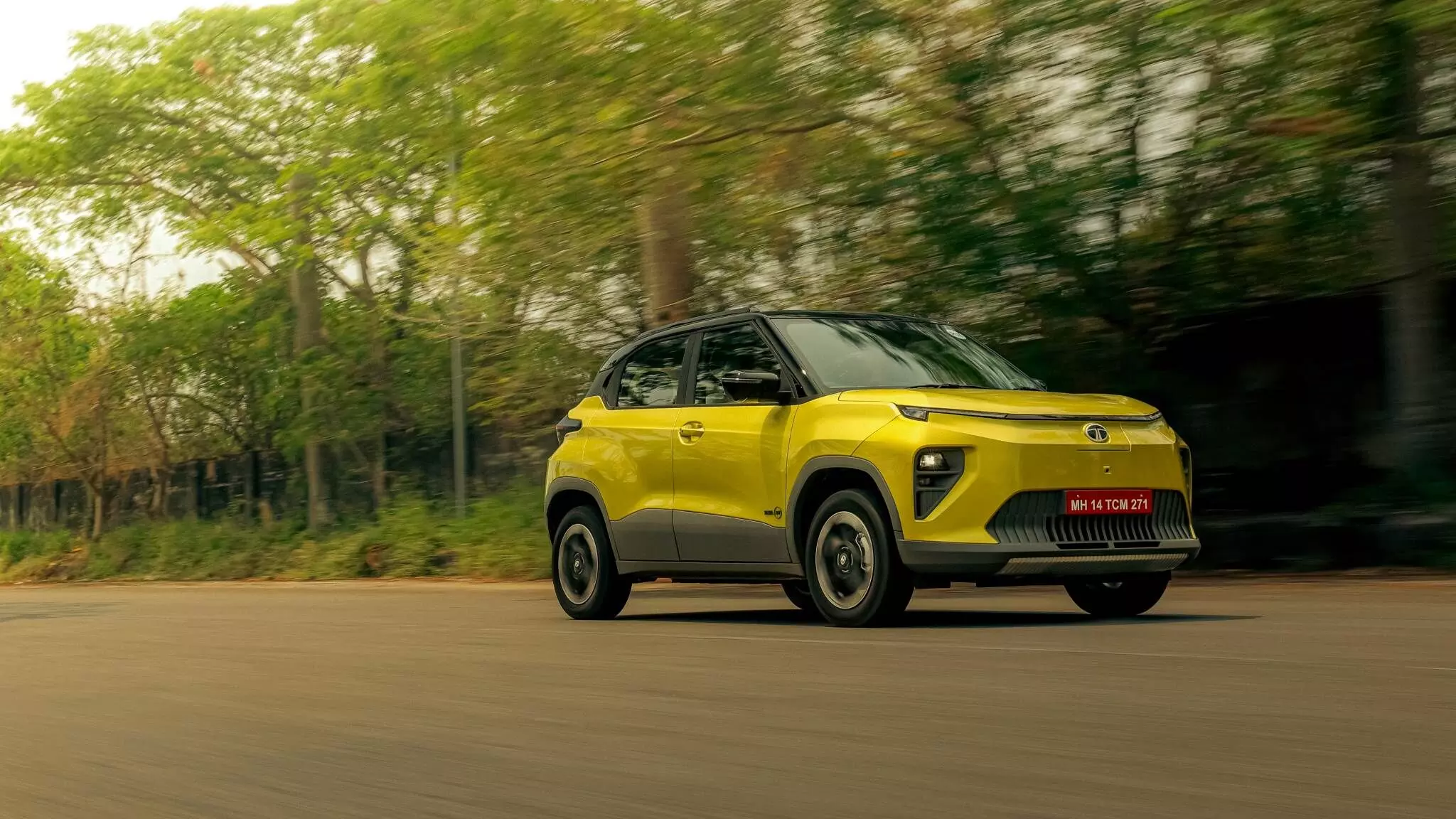
The Punch rides well over undulations in the roads - Shot by Avdhoot A Kolhe for evo India
At 195mm, the ground clearance has been increased by 5mm by retuning the suspension. Water wading is also up by 100mm to 450mm. The more important thing is that the Punch EV continues to drive well. Potholes and breakers are taken well, and in the city, there wasn’t much that unsettled the car. It rides with the maturity of a much larger car, and the weight, too, isn’t apparent. Even in deeper ruts, there was no heaving as you would expect in a heavier car. One thing I like here is how quietly the Punch EV goes over undulations. There’s no loud thud or clank, which would normally stress me out. It also rounds off the sharp edge of potholes and sudden bumps, making for a much more comfortable ride. All in all, Tata Motors’ engineers have certainly mastered the art of making a car ride well.
2026 Tata Punch EV design
There are changes in the design too. Cost savings come from removing the light bar up front, and overall, the Punch EV now has a new face, aiming for a cleaner design with a redesigned grille and headlight housing. A lot of people would be happy with the removal of the LED strip, but I think it should have stayed just for the sake of family resemblance. Interestingly, all around, the black cladding is now grey. Tata Motors folks claim it was done as grey hides scratches better. That may or may not be true, but I do have a feeling it might not fade as drastically. As was the case before, the front is different for both EV and ICE variants, but the side and rear remain the same. The EV continues with the same 16-inch rims from before, but gets a new rear bumper and light bar.
2026 Tata Punch EV interior
Inside, the changes are less significant and obvious. The dashboard remains the same, and like the exterior, adopts a grey theme. The standout features continue – 10.25-inch screens for cluster and infotainment, 360-degree camera, wireless charging, ventilated seats, sunroof, and a satisfactory sound system. The power window buttons are new and require less effort to use, though I’m not sure if an upgrade was really required. One peculiar removal is the missing ambient lighting. It might be one of the good-to-have features, but I honestly don’t find a reason strong enough to remove that. The inside of the Punch EV is quite a decent place for the segment it sits in, and the ambient lighting only added to it. The overall cabin experience remains good, with comfortable seats, both front and rear, and a good air conditioning system. I did expect the Punch EV to receive rear AC vents, but maybe next time. What continues in both exterior and interior, unfortunately, are build quality issues. Our test car had a panel on the centre console and a trim piece on the door that came loose.
2026 Tata Punch EV price and verdict
Now let’s talk about cost. With all the reductions in mind, the prices are down between ₹30,000 and ₹1.8 lakhs, depending on the variant, with the new starting price being ₹9.7 lakh, and maximum being ₹12.6 lakh. With that kind of savings, buyers would be lining up at showrooms irrespective of whether there was more driving range on offer. That’s the real value of the Punch EV. A compact car with chunky styling, high ground clearance, and comfortable dynamics – plenty for what a small family in the city requires.
The facelift becomes a much sweeter package once you factor in the increased range and usability with faster charging speeds and more ground clearance. A lot of owners might not feel the difference between the old and new powertrains, but a multi-billion-dollar automotive giant would surely have its reasons for the changes. For me, the reduced cost adds a lot of value to the Punch EV.
For those who are still on the fence, there’s now a BaaS option as well. The starting price comes down to ₹6.49 lakh, and over that, you pay a rental price of ₹2.6 per kilometre as you continue to use the car. There is going to be a long list of T&Cs, and Tata is being cagey about them for now, and we will report on them when we have more information. On first glance, though, it does seem like a good way to buy the car if money is a limiting factor. MG claims 15 per cent of owners opt for the BaaS service, and surely Tata Motors should also find takers. Especially considering the entire package offers more value in addition to being more accessible as standard.