

Car Reviews
Mercedes-Benz GLC 400 Electric first drive: BMW iX3 long wheelbase rival
Bookings open in October, deliveries begin before the year is out. We drive the Mercedes-Benz GLC 400 electric in Germany, ahead of its India debut.
The upcoming Mercedes-Benz GLC 400 Electric, and also its main rival the BMW iX3 long wheelbase have one good thing going for them, and that is all the hullaballoo over E20 petrol. Not that it was ever the intent, but all E20 noise has had one direct consequence: the accelerated adoption of electric cars. The negativity around EVs - unwarranted, and fuelled largely by social media - has all but disappeared as buyers weary of what E20 will do to their engines, how much more ethanol will be blended into petrol down the line, and the uncertainty over the rest of the country following Delhi-NCR’s lead on diesels, decide to save themselves the hassle and go electric instead. Manufacturers cannot make enough electric cars as a result, and that is true across every segment. Some numbers, pertinent to this story: compared to the same months last year, luxury EV sales jumped 70 per cent in April, 68 per cent in May and 105 per cent in June — an 83 per cent surge in luxury electric vehicles through the first quarter of FY26-27. Leading that pack is BMW, up 92 per cent in EV volume. Mercedes-Benz’s answer is the GLC 400 Electric and here is everything you need to know before it lands in India.
Mercedes GLC 400 Electric India: Launch Timeline at a Glance
• Bookings open: October 2026
• India launch: November 2026
• Deliveries begin: before the end of 2026
• Manufacturing: locally assembled, European-spec (not the Chinese long-wheelbase version)
• Expected price: ₹8–10 lakh over the current ICE GLC’s ₹76 lakh ex-showroom starting price (estimate)
• Powertrain (India): GLC 400 4Matic, dual-motor AWD, 94kWh battery
• Power and torque: 482bhp / 800Nm
• 0–100kmph: 4.3 seconds | Top speed: 210kmph
• WLTP range: up to 715km
The current GLC, with its petrol and diesel engines, isn’t going anywhere - it continues well into next year, when it gets a facelift to fall in line with Mercedes’ rather unsubtle new “iconic grille” design language.
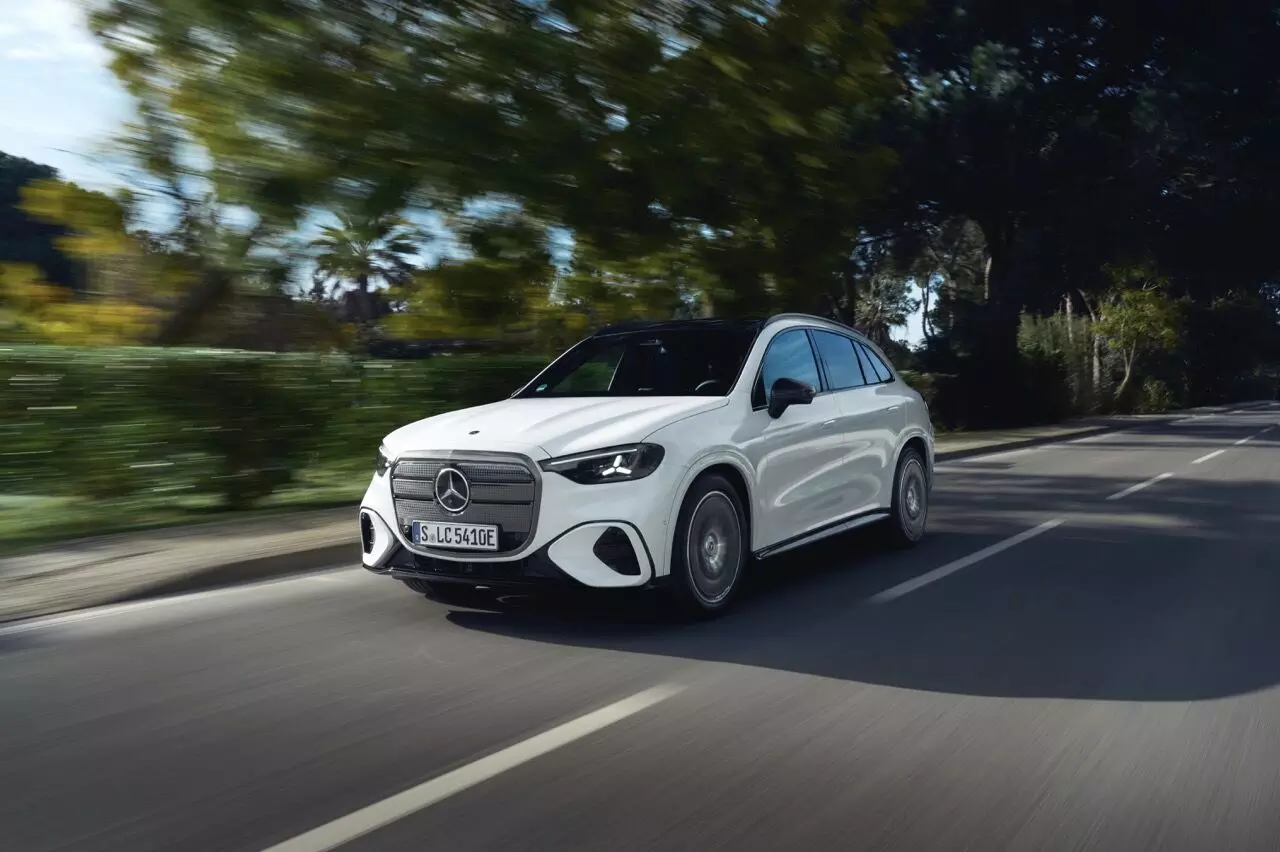
There are 942 illuminated dots, animatable, set within an illuminated grille surround with the Mercedes roundel
That Grille: Mercedes’ Loudest Design Statement Yet
Ah, the grille. Mercedes points to its heritage - specifically the W100 S600 Pullman (1963-1981), the W114 (1968-1973), the W108 (1965-1972) and the W111 (1959-1968), all of which wore massive upright chrome grilles designed to signal the great unwashed to part ways for the ultimate plutocrat automobile, the S-Class. For this reinterpretation, Mercedes has put its lighting engineers to work, and they have lit it up like a Christmas tree. There are 942 illuminated dots, animatable, set within an illuminated grille surround with the Mercedes roundel - also illuminated - at its centre. It is all finished in chrome; black chrome on the AMG Line, which is the spec India will get.
Flanking it are digital LED headlamps with a star motif and a throw of 650 metres on ultra-range high-beam. The pixel-based adaptive system actively bends the beam through corners and can selectively mask out oncoming traffic while keeping the rest of the road lit at high-beam intensity. Even the tail lamps carry the star motif internally to echo the front-end theme, though the housing size and shape are carried over from the outgoing GLC.
The platform has nothing to do with the outgoing GLC. This is MB.EA, a dedicated EV architecture shared with the new C-Class Electric, and it brings a raft of technology with it
An All-New EV Platform, Not a Converted GLC
The platform has nothing to do with the outgoing GLC. This is MB.EA, a dedicated EV architecture shared with the new C-Class Electric, and it brings a raft of technology with it: the MB.OS computer system, said to integrate all of the car’s functions into one “superbrain”; the “One-Box” brake-by-wire system; a two-speed gearbox on the rear axle; intelligent air suspension; and rear-wheel steering. All of it is confirmed for the India-spec GLC. Even the massive Hyperscreen infotainment system is India-bound - Mercedes is leaving no stone unturned, because waiting in the wings is the BMW iX3, which will come to India in LWB form.
How Big Is It? GLC Electric vs the Outgoing GLC vs the BMW iX3 LWB
The new GLC Electric is bigger than the car it replaces in every direction. The wheelbase is 84mm longer at 2,972mm, it’s 23mm wider, 9mm taller, and overall length stretches to 4,845mm. That translates to 47mm more rear legroom and 17mm more rear headroom. Boot space actually drops by 50 litres to 570 litres, but that is compensated by a 128-litre frunk up front - together, Mercedes says, good for 18 suitcases, though don’t ask me about the size of any of them.
Against the India-bound, long-wheelbase BMW iX3, the BMW is 40mm longer with a 33mm longer wheelbase, though the GLC is 18mm wider, 9mm taller, and has a 50-litre bigger boot. That is precisely why Mercedes is confident it doesn’t need the long-wheelbase version from China - and why it has been able to accelerate local assembly for India, arriving just six months after the car went on sale in Germany. A new record, if keeping records is your thing.
Power, Performance and That Two-Speed Gearbox
To keep complexity in check, India gets only one specification of the GLC 400 4Matic Electric: dual-motor, all-wheel drive, and a 94kWh battery. It makes 482bhp and 800Nm, and weighs in at nearly 2.7 tonnes. These aren’t record power figures, but honestly, nobody needs more power from an SUV in this category —-particularly since the GLC 400 takes just 4.3 seconds to hit 100kmph and goes on to a top speed of 210kmph.
That accelerative performance comes down to all-wheel drive and the two-speed gearbox on the rear axle - the same trick used on the Porsche Taycan and the CLA Electric. There’s a short first ratio for a violent lunge off the line, and second gear engages at a moment of the software’s choosing, depending on driving mode, driving style and other parameters. The system is tuned for efficiency at higher speeds without compromising initial performance, and unlike the Taycan - where you always feel the shift - here you have to be paying close attention to notice it happen. There’s even 2.6-tonne towing capacity, not that it will matter much to prospective owners of a luxury electric SUV in India.
What It’s Like to Drive
On the road, the GLC doesn’t have the over-eager throttle response we saw on the EQS, and it all feels very natural - once you realise there’s no start-stop button, and the car wakes up simply by pressing the brake pedal. Throttle response is instant, as you’d expect of an EV, and the turn of speed always defaults to the enthusiastic side of things. All-wheel drive means you can deploy all of that power without worrying about road surface or conditions. There are reserves of power in plenty, and it’s only on derestricted Autobahn sections that the GLC runs out of breath and you have to pull out of the fast lane to let other traffic bomb past.
Ride and Handling: Stiffer Than You’d Expect
Stuck in the middle lane gives you the chance to focus on other things. First up: the vertical body movement that was so pronounced - and uncomfortable - on the EQS has been reduced by a massive degree here. It’s still there, and you notice it over undulating roads, but it’s no longer a source of discomfort. Switch the air suspension to Sport and body control sharpens noticeably, making the GLC more eager and responsive, though I suspect that will come at the cost of ride comfort from an Indian perspective.
It’s impossible to really test ride comfort in Germany, but we found a dirt track leading to our shoot location, and the GLC felt stiff - very stiff - over a track that wasn’t even particularly rutted to begin with. There is a Terrain mode that engages the front axle automatically while adjusting steering and brakes for gravel and dirt. With air suspension, the GLC also gets 4.5 degrees of rear-wheel steering, giving it a super-tight 11.2-metre turning circle. India will of course get specific suspension tuning, so we’ll reserve final judgement until we test the India-spec car - due before the year is out.
Even so, comfort has clearly been the prime focus of the GLC Electric, and there’s noticeable body roll even in the tautest Sport setting. The electric power steering is well weighted but could do with a few degrees of sharper response in Sport mode.
Braking, Regen and the “One-Box” System
The brakes are genuinely impressive. The so-called “One-Box” system integrates the friction brakes (370mm front, 360mm rear) with regenerative braking to deliver a more consistent pedal feel. This is brake-by-wire, with one module combining all braking functions and sensors to deliver powerful, predictable braking without the jerky transitions you often get between friction brakes and regen. You can adjust regen levels via the steering wheel paddles, and D Auto mode proved the best balance in our drive - the car decides the ideal regen level for itself based on driving conditions and even Google Maps data.
Ground Clearance and Ride Height
The Euro-spec GLC has 148mm of ground clearance, which rises by roughly 25mm when the air suspension is raised. This height adjustment is also tied to driving modes and Google Maps-based road prediction - specifically to lower the car on motorways for the best possible aerodynamics, and therefore range.
Range and Charging
WLTP range is quoted at up to 715 kilometres from the 94kWh battery. The architecture is 800 volts, supporting 330kW DC charging that takes the battery from 10 to 80 per cent in 22 minutes - or, on paper, a ten-minute top-up claims back 305km. Good luck finding a charger like that in India, though - which is exactly why Mercedes has gone overboard with the cabin instead.
The party trick is the 39.1-inch MBUX Hyperscreen
Interior: The 39-inch Hyperscreen Steals the Show
The party trick is the 39.1-inch MBUX Hyperscreen - one seamless sheet of glass spanning driver, centre and passenger displays. It runs at 7680 x 1260 pixels with over a thousand LEDs behind it for zone-dimming, so if the sun is wrecking your passenger’s movie, they can fix their side without touching your view of the map. But there’s no peeping at the passenger’s videos: an onboard eye tracker watches the driver, and glance at the passenger screen for too long and the content shuts off in 1.4 seconds.
Running all of it is MB.OS - Mercedes calls it the superbrain, and it can process 254 trillion operations a second, learning your habits as it goes. The system runs on Android OS, with Google Maps built in, along with ChatGPT if you’d rather converse with your AI agent than a fellow human being.
Glass Roof, Sound System and Everyday Usability
Look up and the glass roof lights up with 162 tiny embossed stars across 64 selectable colours. There’s no hard cover for the glass roof, but unlike the CLA Electric, it’s electrochromic - you can turn it opaque at the touch of a button.
The underlying user experience is genuinely good: simple menus, fixed positions for key controls like air-con temperature, and a smattering of physical buttons, including for volume. Turn it up, and the Burmester system comes alive with 15 speakers, 670 watts, Dolby Atmos, and a light bar that pulses along with whatever’s playing.
The front seats are comfortable, ventilation will in all likelihood be offered on India-spec cars, but there’s no massage function. Rear seat space is good - better than the ICE GLC, for sure - and despite a higher floor, there are no knees-up seating complaints.
It’s genuinely hard to find fault with the GLC Electric
Verdict: Should You Wait for the GLC 400 Electric?
It’s genuinely hard to find fault with the GLC Electric. You might have opinions about that gaudy grille, but there’s no question buyers will love it, and it will get them noticed. Real-world range in the region of 500km is enough, and more, to make the GLC Electric a primary car - not the secondary vehicle most luxury EVs have historically been bought as. You might not be a fan of monstrous infotainment screens, but you’ll come to love the Hyperscreen and its exhaustive functionality. And if you miss the sound of a rumbling engine, you can switch the “Sound Experience” from “discreet” to “characterful,” which pipes an assortment of sci-fi noises into the cabin as you assault 100kmph in 4.3 seconds. Repeatedly. Without ever having to worry about the quality of the fuel in your tank.
