

Nissan Tekton: The baby Patrol
With the Tekton, Nissan has entered the most hotly contested car segment in India. To show us its prowess, they took us on a 700km long drive, which also included an over 15,500 feet of elevation change

Famous for two things – strict traffic cops and cheap alcohol, Chandigarh was the starting point of our 700km long journey. Generally first drives are actually just first impressions. We get to drive a car for a day (sometimes even half a day) and then we are expected to deliver a verdict. Rarely do we get to drive a car in varying conditions on the first go to be able to decipher its strengths and weaknesses in more detail. Nissan, though, broke that rule and thought that we should experience their new Creta, Seltos and Sierra rival in so many conditions that we have had to increase this piece by a couple of pages, than originally planned.
Nissan Tekton design and interiors
The name "Tekton" is derived from a Greek word that means "craftsman" or "architect". Nissan selected this name to align with the brand's ethos of precision engineering, performance, and distinctive design identity. It is no secret that Renault and Nissan co-developed this car, so the Tekton and the Duster are essentially the same underneath. In many aspects they are also the same on the surface as well, like the silhouette, much of the rear and much of the interiors. Thankfully, Nissan has also done enough to ensure they look different enough so the consumers don’t see another Grand Vitara and Hyryder design bummer. The face draws heavily from the Patrol's design language – Nissan's flagship – lending the Tekton a distinctly SUV-like presence on the road. The alloys, while of the same radius (18-inches), are less sporty and more mature. Clearly, Nissan has fully leaned into making this a standout looker on the road.


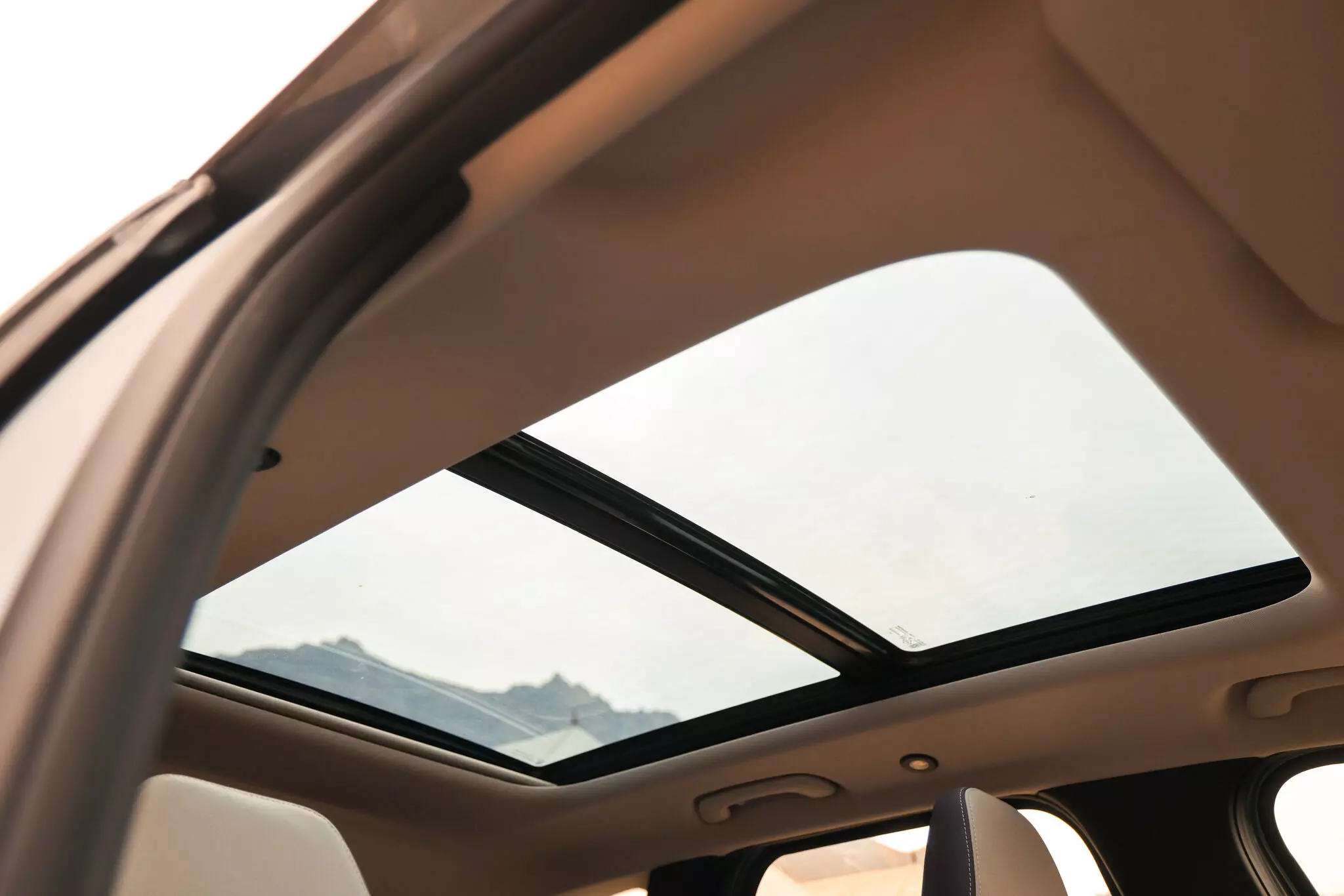
Inside, they are identical in their layout and choice of materials. The difference lies in the choice of trim colours. The car we got had a combination of beige, blue and rose gold interiors. Before you gawk at the word gold, it has been used tastefully. The overall colour scheme looked premium, and something average Indian consumers would like. The biggest difference is in the UI of the digital cluster. Personally, I never liked the Duster’s cluster UI. It was slow to respond to commands, the information was not very easy to read and the layouts would take a long time to get used to. I felt they tried too hard to be different and cool, and ended up spoiling the broth. Nissan has kept it simpler. The white on black makes it easier to read and while the transition to different modes is still slow, it has round digital gauges for speed and RPM (Duster doesn’t have those) – and this makes it more driver focussed.
Our first stop was Manali, and thanks to the newly made tunnels, the route to Manali no longer feels like a climb. The dual carriageway starts in Himachal and climbs gently all the way till the entrance of Manali. This was a good time to see how the car’s various functions feel while travelling. The first commendable aspect is the AC. It is a 160cc variable compressor which kept us sane when the outside temperature even as we traversed Himachal was mid to late 30s. Special mention for the physical buttons to control all AC functions – it has become a rarity these days. The intense dry heat meant we just wanted to reach Manali in a hurry. We did, after about 7 hours of driving – it took this long because we were in a 60 car long convoy. Thankfully, ventilated seats were at hand to make the journey easier too.
Nissan Tekton handling and power
Manali actually starts at about 6500 feet and keeps increasing as you reach towards upper Manali. After offloading our stuff at the hotel, we sneaked out with the car and went to the road that leads to Rohtang – me and our camera crew were desperate to catch some real mountain roads and cool breeze. This was actually the first time the Tekton showed its real strength – its handling prowess. It is equipped with front independent suspension and semi-independent rear suspension with stabilising bar. On road it translates to a very stable car when it goes over bad surfaces, regardless of your speed. The car feels well in control with just enough feedback and damping from the steering to know what the wheels are doing, so you can manoeuvre accordingly. There was only so much driving we could do on the first day, so we looked forward to the next day, when we also pass through our highest altitude for the entire route.
At 16,580 feet, Shinkula pass is the connection between Lahaul valley and Zanskar. Until recently, to travel from Manali to Leh by road, one had to cross Jispa and take three passes before reaching Leh. This route had its challenges, especially with the road conditions and the toll it took on one’s body. Now that the road from Shinkula to Leh via Zanskar has opened, it offers a much easier travel path, especially considering there is only one pass you have to endure.


Before we started climbing the altitudes where oxygen thins out, we still had a fair amount of distance to travel – Solang valley, Atal Tunnel and Lahaul valley. This gave us time to make notes on the engine and gearbox performance. This 1.3-litre turbo-petrol has strong creds, especially since Mercedes uses this for their entry level cars. It makes a healthy 160bhp and 240Nm, and is paired with a 6-speed wet clutch DCT. DCTs are known for their gremlins in Indian conditions, but a wet clutch DCT helps in keeping the gearbox cooler which in turn helps it be more reliable. On paper everything feels A+.
On the road, it was great in the city and highway, but on the climbs of the Himalayas, it scores B+ at best. The turbo lag is evident on the inclines and tests your patience as the real power band only begins after 2500rpm. Keeping it in the power band means working the gears manually as the car wants to go to a lower gear as early as it could to help with efficiency. So the best course is to put the car into manual mode – which comes after long pressing the right paddle down.
As we got past 15,000 feet, the car and I both start feeling oxygen starvation. While I have oxygen cans to help me in case I need assistance, the car’s lack of turbo spool at low revs becomes even more a subject of contention. I have driven a VW Taigun 1.5 through this same route a couple of years ago and I clearly remember having an easier time with that. I suppose at the end of the day, there is no replacement for displacement even with all the modern tech – especially at the sharp curves where the roads were eroded due to snow and rain. Thankfully, the suspension and platform still aced all what the terrain had to throw at them and compensated well to a good extent.
Nissan Tekton space and practicality
As we loaded up the 518-litre boot, I observed that our 5 foot 11 inch tall cameraman had a fair amount of headroom in the rear seat, but leg space was just about enough. He wasn’t the most comfortable because of the sheer length of this journey and how he felt cramped for room whenever he wanted to move about during the long run. He would have surely had a better time sitting in the back seat of a Kia Seltos. Another point to note is that this car gets a spare wheel as standard, whereas the Duster gets only a puncture kit and a spare wheel as an accessory.
Nissan Tekton price and verdict
We reached Leh without any drama. The car performed well for the most part. Like every car, it has its pros and cons. Overall it felt like a strong restart from Nissan into the mid-SUV segment after seeing relative success from the Terrano, which stopped sales six years ago. Most people would come to Nissan showroom drawn to its looks, and if they stay they will because of its ride quality and premium interiors. It is priced between ₹10.5 and ₹18.6 lakh, which is in the competitive range among its key rivals. The only major concern would be Nissan’s network spread, or rather the lack of it.
Back home, reminiscing on this drive, one has to appreciate the effort undertaken and the scale of this media drive. It is clear that Nissan is putting all their ammo into making this car a success. It is after all their most important launch and places them in the midst of the most hotly contested car category in India right now. They have spent 700 million euros on the Tekton project and are planning over 1lakh exports to 50 countries from India – all this apart from their hopeful ambitions for India going forward. Nissan has raised the media drive game by giving us the chance to properly drive their car and analyse it in various conditions – bold of them considering it also lets us explore some of its weaknesses. Even then, would we do another Chandigarh to Leh trip in a Tekton? Hell yes! This is after all a driver’s car and the Thrill of Driving is not just about power, but also about control.