

Car Reviews
Renault Triber 100 first drive review: Does the new turbo engine finally give this 7-seater the performance it deserves?
The Triber now sits on a new platform and gets a turbocharged engine, anti-roll bars, revised suspension, and brakes. But how does that influence the Triber? Let’s find out
- Increased performance
- Value proposition
- Built to hit a price point
While Renault India may have slowed down a while back, its plan to jump back into contention is fully in place. The company previously said it plans to introduce roughly 12 new products over the 18 months spanning the second half of 2026 and then 2027. This covers everything from new models to powertrains and updates to existing models, and the Triber 100 is a big part of that.
The Triber itself remains a very important product for Renault, having garnered over 2.5 lakh customers since its launch in 2019. The reasons are also fairly obvious. It gives you three rows of seats, a surprisingly versatile interior and compact dimensions, while still being priced like a small hatchback. Our, and several others’, biggest complaint, however, was performance. The regular 1-litre naturally aspirated three-cylinder engine makes 71bhp and 96Nm, which is adequate around town but starts feeling stretched when you load the car with people and luggage.
That is where the Triber 100 comes in. Renault has given it a fresh punch with a 1-litre turbocharged three-cylinder engine making 98.6bhp (100PS, and thus the name) and 180Nm. But that’s only the beginning. The platform has changed, the suspension has been revised, the steering has been retuned, the gearbox has been recalibrated, and there are even changes to the braking system. In other words, this is a heavily re-engineered version of the regular Triber. It’s just very hard to see the changes from the outside. The correct course, then, is to take you through the changes while talking about how it felt on the roads of Delhi-NCR.
Renault Triber 100 design
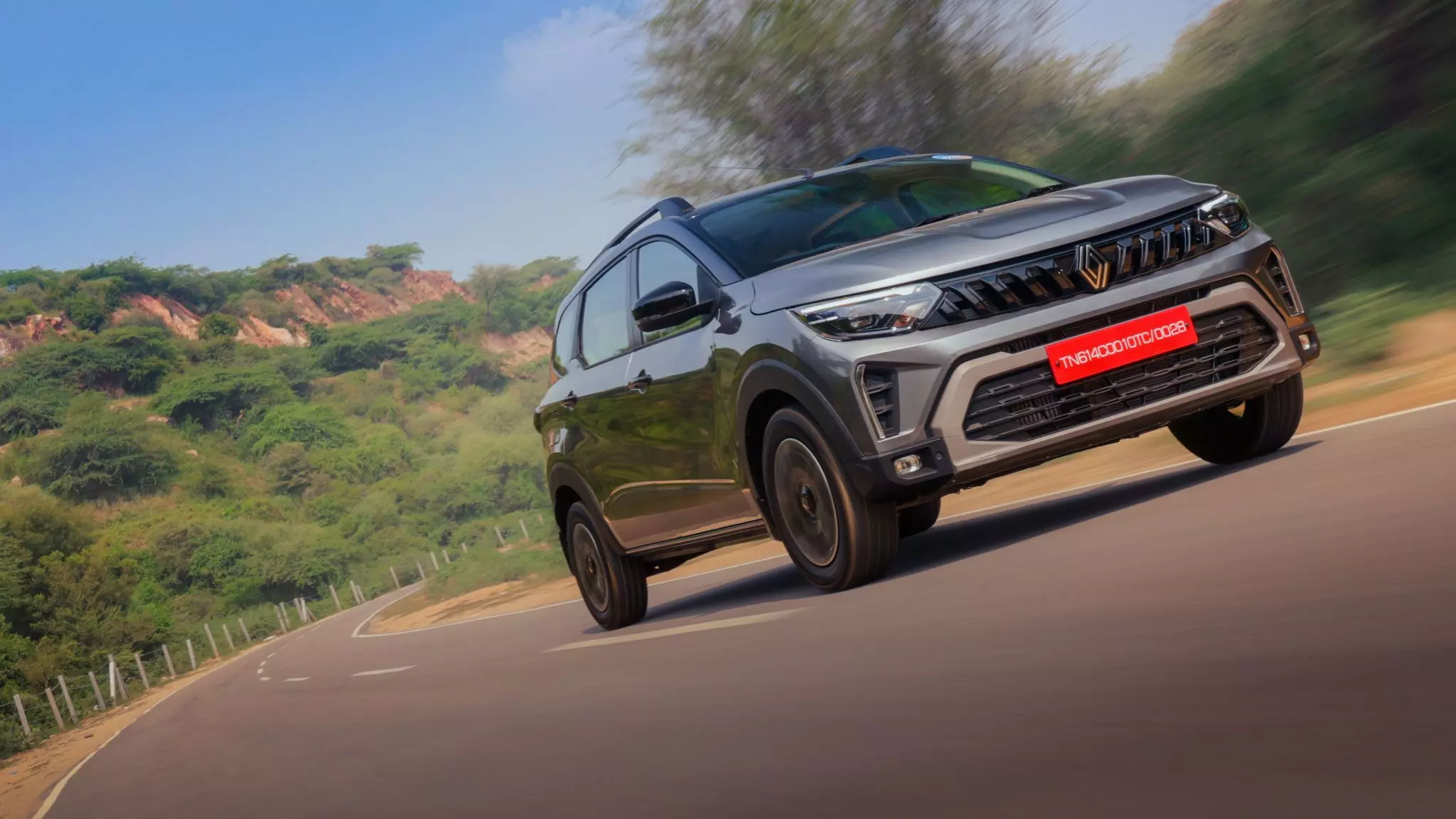
From the outside, you’ll have to look quite carefully to tell the Triber 100 apart from the regular car. The only differences are on the sides and at the rear. The grille, bumper, Renault logo, headlights and the fake air vents are all carried over. Even the wheels remain unchanged. What changes on the side is the graphic, while there’s a little turbo badge at the rear. That’s about it.
Personally, I would have wanted a bit more differentiation from a regular Triber, especially since so much has changed underneath the car. But if it’s about keeping costs low, I totally understand it, and it makes sense as well, because the Triber has always been about being practical and not just adding in bits to look flashy.
It still has the same upright proportions that allowed Renault to squeeze in three rows of seats in a sub-4 metre car, and that stays. You can drive it through the city without feeling like you’re piloting a very large MPV or SUV, but you still have the three rows to fit in the family or quite a lot of luggage.
Renault Triber 100 interior and features
The interior follows the very same philosophy as the exterior: don’t change something unless it’s broken. You get the same 8-inch infotainment system, the digital cluster, wireless charging, keyless entry and start, driver armrest, and a cooled centre console box. The seating arrangement also remains exactly the same, and all of that is a very good thing.
The Triber’s party trick is its flexibility, while offering a good amount of genuinely usable features for a fairly low price. The features on offer are all useful, with no gimmicky additions just for the sake of having them. The wireless connectivity, automatic air-conditioning, AC vents for all three rows, and the sliding and reclining second-row seats are things that you'd use almost daily, and these make it a good car to live with and drive long distances.
Take the third row out, fold the second-row seats, and you free up 1065 litres of luggage space, and that’s a lot. This versatility is what makes the Triber different from almost everything else in the Indian market. You can use it as a five-seater with massive amounts of luggage space, or carry seven people around. All of that makes absolute sense in the Triber, and nothing feels out of the ordinary.
Renault Triber 100 platform and chassis
This is where things get properly interesting. The most significant change has been the departure from the previous CMF-A architecture to Renault’s new RGEP platform for the Triber 100. The reason is simple: Renault’s engineers did not have enough space in the old architecture to fit a turbocharged engine while retaining the Triber’s three-row packaging. So, the platform had to change.
But Renault did not stop there. The brakes have been revised, the gearbox has been retuned, the steering has been recalibrated, and anti-roll bars have been added at both the front and rear. Even the suspension components have been revised. The added hardware and performance also mean the Triber 100 is around 80kg heavier than before, so Renault has increased the use of high-strength steel, extending from the front of the car all the way to the B-pillar.
This MPV weighs 80kg more than the NA variant due to the various revisions made to its chassis – Shot by Rohan Sonwane for evo India
The changes to the brakes are relatively comprehensive. The brake pads have been designed to move away from the disc after braking, reducing residual friction and improving efficiency. However, the braking performance itself hasn’t changed dramatically, and this remains one area where I would have liked a little more confidence from the Triber 100.
The suspension has also been beefed up, with thicker shocks and a move from axial to offset-type mounting. The anti-roll bars at both ends are another important addition. Moreover, the steering has been recalibrated too, with more weight added at higher speeds, while the gearbox gets revised ratios to make better use of the turbo engine’s additional torque – more on these in the ride and handling section.
Renault Triber 100 powertrain and performance
This is the bit that has changed the Triber most dramatically. The old 1-litre naturally aspirated three-cylinder engine continues to make 72bhp and 96Nm of torque, and it will be available throughout the range. But now you also have the option of a turbocharged 1-litre three-cylinder engine making 98.6bhp and 180Nm of torque. That’s a substantial increase in torque, and it is immediately noticeable when you start driving.
The turbo starts doing its thing around 3000-4000rpm, and that’s where the Triber 100 really wakes up. There is a strong pull towards the top end, and unlike the naturally aspirated engine, it doesn’t feel like it’s running out of breath as the revs climb. The mid-range is particularly useful in the city, where you’re mostly operating in the low and mid-range. The engine does have some amount of turbo lag, but once the boost comes in, there is enough grunt to make the car feel considerably more effortless.
Get onto the highway and, once you start getting into the mid and higher rev range, there is power throughout, and you’re not left wanting for more. Overtaking is no longer the exercise in planning that it used to be, and that’s a really good thing for this car. Last year, one of my main issues with the Triber, and by extension the Nissan Gravite, was that they just never felt like they had any enthusiasm. Now, that has changed. Stay in the sweet spot and, most of the time, you don't even need a downshift for overtakes.
The Triber 100 gets a 1-litre three-cylinder turbo-petrol engine making 98.6bhp and 180Nm of torque, delivers a potent mid-range – Shot by Rohan Sonwane for evo India
That is particularly important in the Triber because this is a car designed to carry a lot of people and weight. With the naturally aspirated engine, it simply didn’t have enough performance and could feel rather strained when you wanted to push it. With 180Nm of torque on tap, the Triber 100 feels much more suited to family drives. And even if you were to just use it for your daily commute, there is so much more performance here that the entire experience is considerably more enjoyable than before.
Refinement is decent, although you can’t completely hide the fact that this is still a three-cylinder engine. Truth be told, there are some vibrations at idle, and you can hear the characteristic three-cylinder note when you rev it out. More importantly, Renault is still claiming 21kmpl from the turbocharged Triber. That’s particularly impressive considering the additional performance, and part of the credit goes to the revised gear ratios. The gearing is taller, which means the engine can run at lower revs when you’re cruising at a steady speed.
The addition of a turbocharger has turned the Triber into a rather enjoyable driving machine, even when all three rows are occupied – Shot by Rohan Sonwane for evo India
Renault Triber 100 ride and handling
Before getting into the ride and handling, it’s worth reorienting ourselves. The Triber is in no way a performance car, and expecting performance car-like characteristics from it would be wrong. What it is, is a family car that now has the punch to make it more livable in the city and on the highways.
What has changed in terms of the ride quality is the way it behaves at higher speeds. The older car’s steering felt very light and slightly nervous once you started travelling faster. Renault has done some recalibration to the steering, so it remains light and easy to use in the city, but gains a more reassuring feel once you’re into triple-digit speeds.
Stability has increased too. I suspect the changes to the platform, including the increased use of high-strength steel and the additional weight, have also contributed to the Triber feeling more settled at speed. There is a greater sense of stability when you’re travelling quickly with a full load, although it's difficult to isolate how much of that comes from the added weight and how much comes from the changes to the chassis and suspension. The suspension continues to deal with broken roads well. Potholes and rounded speed breakers are handled with good compliance, which is exactly what you want from a family car. Hit a particularly nasty pothole hard, though, and there is still that thud from underneath.
The anti-roll bars have helped. There is definitely more composure through corners. But don’t expect this to suddenly become a driver’s car. There is still plenty of body roll when you push it into a corner, and the tyres don’t inspire enough confidence to make you want to attack bends. But that’d be missing the point. The Triber is a family car, and in that role, these changes make considerably more sense. The car feels more stable, more composed and more comfortable at highway speeds without losing its easy-going nature. In terms of ride and handling, it has definitely improved over the older car, even if it hasn’t been transformed into something enthusiasts would want to drive hard.
Renault Triber 100 price and verdict
The Renault Triber currently starts at ₹5.8 lakh and goes up to ₹8.05 lakh ex-showroom, depending on the variant. Of the four variants, the Triber 100 is available in three, with prices around ₹1 lakh more than the standard 1-litre naturally aspirated engine. And that brings us to the real question: is the extra money worth it?
After driving both, I find it difficult to argue against the turbocharged engine. The naturally aspirated Triber still does everything the original car was designed to do. It is compact, practical, comfortable and remarkably clever with its three-row packaging, all while offering a very attractive price. It is one of the most value-for-money cars we’ve seen in the market. The limitations are very clear, though. The performance simply isn’t at a level where I would be comfortable taking it out on long trips, particularly with a full load.
The Triber 100 changes that. You get considerably more performance and much better stability through corners and on the highway. And you still have the clever seating arrangement, the removable third row, the enormous 1065 litres of luggage space and the compact dimensions that make it easy to live with.
It isn’t perfect. The brakes could use more confidence; there is still some body roll, and the turbo does have some lag below the boost threshold. Most of all, my issue with the thinner tyres remains, and until that is addressed, I wouldn’t be completely confident pushing this car to its limits. But that is also part of what makes the Triber 100’s efficiency claim so impressive. Renault is still claiming 21kmpl from a turbocharged engine, and that is plenty for a car like this.
In essence, the Renault Triber 100 is not a performance car. It is a family car that finally has enough performance. The question you should be asking yourself is whether that extra bit of performance matters to you.