

Car Reviews
Tata Aeris iCNG first drive review: Is this the new benchmark for CNG sedans?
The Tigor replacement gets a new architecture, an AMT with CNG and a long list of safety and tech features. But how does it all come together on the road?
The Tata Tigor has been around for a while now, and while it has always made a strong case for itself as an affordable compact sedan, the segment has moved on. Buyers today want more than just a boot attached to a hatchback. They want better safety, more features, better road manners and, increasingly, lower running costs. That is where the new Tata Aeris comes in.
The Aeris replaces the Tigor and is built on Tata’s X-ALFA architecture, which Tata says brings a stronger structure and higher ground clearance. It also gets a completely reworked CNG package, with twin tanks under the luggage area, while the petrol and CNG versions get different wheel and tyre configurations. Interestingly, this won’t be sold to fleet owners who would still need to manage with the Xpres T.
On paper, the numbers aren’t particularly exciting. The petrol makes 84.8bhp and 113Nm, while the iCNG makes 74.4bhp and 96.5Nm. But there is more going on here than just an engine change. You get an AMT with the CNG powertrain, direct CNG starting, a rotary gear selector, paddle shifters, six airbags as standard and a fairly comprehensive suite of convenience features.
The question, then, is whether all of this actually makes the Aeris a better car to drive and live with. Because with a car like this, outright performance isn’t really the point. The interesting bit is how well the entire package works. Let’s find out if it does.
Tata Aeris iCNG design
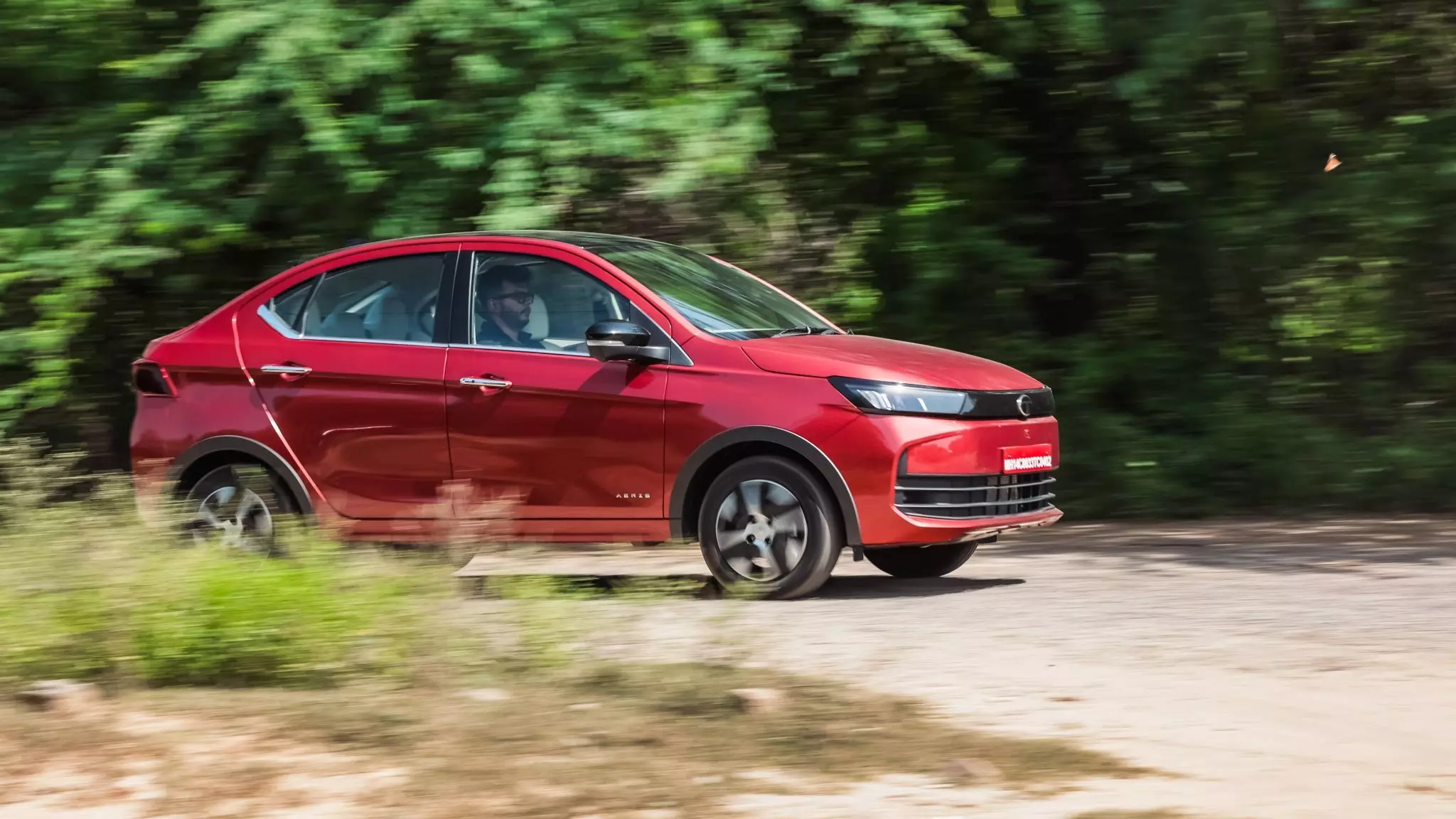
The Aeris follows a familiar compact-sedan silhouette, but Tata has given it a more upright and squared-off stance. The bonnet line is higher than before; the front gets new LED headlamps with DRL functionality – similar to the new Tiago, and the bumper and grille have both been redesigned.
The front also gets a camera as part of the 360-degree camera system, while the black panel between the headlights gives it a wider visual stance. The side profile is still recognisably Tata, but the 14-inch wheels, dual-tone black roof and chrome-lined door handles add a little more visual interest. At the rear, the tail lamps have been revised, and there’s a full-width lamp treatment across the boot, which, unlike the Tiago, has LEDs in it. The high-mounted lamp is the brake light, while the overall rear design is cleaner than the outgoing Tigor. The only differentiation between the petrol and iCNG versions is the iCNG badge at the rear.
There are some neat details here, too. The boot gets hydraulic support mounted externally, rather than the conventional arrangement tucked inside the luggage area. It is a small thing, but it adds to how much luggage you can fit inside.
Tata Aeris iCNG interior and features
Inside, the Aeris follows the familiar Tata template as we saw in the new Tiago, but there has been a clear effort to make the cabin feel more premium. You get a 10.25-inch infotainment screen, a 5-inch digital instrument cluster, wireless Apple CarPlay and Android Auto, and a dual smartphone deck – one of which supports wireless charging. The steering is taken from the Tiago EV with its matte finish, and even the new window switches are from the Tiago EV, both of which are good additions. The matte finish doesn’t attract fingerprints, and window switches are far more intuitive. With the new X-Alfa architecture, even the electronics have got a boost, and the entire infotainment experience is much more lag-free.
The cabin resembles that of the latest Tiago EV with its new steering wheel and switchgear – Shot by Rohan Sonwane for evo India
There is automatic climate control, rear AC vents and 65W Type-C charging, including a 65W port for rear passengers. The front also gets a wireless charger and Type-C connectivity. The seats are leatherette, and the front seats are ventilated. The rear seats get the same leatherette treatment, but aren’t ventilated. The ventilation itself works really well, and you immediately feel much more comfortable. But the fan could be unbearably loud in the highest setting.
An interesting piece of tech is the new factory-fitted DVR that effectively works as a dashcam. Its internal 4GB storage can hold around 30 minutes of footage, with the oldest clips overwritten when the memory fills up. In the event of a collision or heavy braking event, it saves a five-minute clip, comprising two minutes before the event and three minutes after it. Continuous recording can also be saved to external storage, with support for storage devices up to 256GB. There is also a blind-spot monitor, 360-degree camera, automatic headlamps, rain-sensing wipers and rear defogger. And then there is the safety equipment. Six airbags are standard, along with ESP, ABS with EBD and cornering stability control, hill hold and ISOFIX mounts. Tata has also added rollover mitigation and torque vectoring by braking. For the CNG version, there are additional systems for leak detection, thermal incident protection and rear crash protection.
Tata Aeris iCNG platform and chassis
This is another area where the Aeris impresses. The CNG version also gets a twin-cylinder tank arrangement under the luggage area. Tata hasn’t disclosed a separate CNG boot capacity figure, so the quoted 419-litre boot capacity applies to the petrol version. On the iCNG, the luggage space is whatever remains above the twin tanks. If I were to compare it to a single big CNG tank, the smaller twin tanks definitely add a bit more space.
This iCNG variant gets 14-inch wheels whereas the petrol variant is equipped with 15-inch items – Shot by Rohan Sonwane for evo India
There is also a difference in wheel sizes. The petrol gets 15-inch wheels, while the iCNG gets 14-inch wheels. Tata says the difference comes down to the load capacity requirements and the ride and handling characteristics it was targeting during testing. This has been the explanation for quite some years now, and I’d have liked Tata to try and bring alloys to the CNG variants as well.
Tata Aeris iCNG powertrain and performance
The Aeris iCNG uses Tata’s 1.2-litre three-cylinder engine, producing 74.4bhp and 96.5Nm. The engine can be paired with either an AMT or MT. Truth be told, if you are expecting hot-hatch performance from those numbers, you’re going to be disappointed.
From a standstill, the engine feels noticeably less eager at low revs. Below 3000rpm, there isn’t a huge amount happening, and if you ask for acceleration at low revs, the Aeris takes its time to build speed. Once you’ve built some speed, though, the mid-range is more useful. The engine doesn’t suddenly become exciting, but it does feel like it has enough to keep up with city traffic. If you want to make progress, you learn quite quickly to keep it in that part of the rev range.
Powered by a 1.2-litre three-cylinder engine which makes 74.4bhp and 96.5Nm; offered with an AMT and manual gearboxes – Shot by Rohan Sonwane for evo India
The AMT helps here. At around 40kmph in third, for example, asking for more acceleration prompts it to drop a gear. There is a brief pause while it makes the decision, but it isn’t something a lot of people will find displeasing. The gearbox is also quite smooth in normal driving. There is a very slight head nod during upshifts, but it’s very well contained, and even the vibrations aren’t noticeable. Even at idle, the steering doesn’t transmit much of the three-cylinder engine’s vibration into your hands. Refinement is otherwise quite good for a three-cylinder engine. You can hear the engine when you rev it out, but it doesn’t sound particularly coarse. At highway speeds, the engine also feels reasonably relaxed rather than strained.
Tata Aeris iCNG ride and handling
The Aeris is much more impressive here. At normal speeds, it handles speed breakers with a firm but controlled movement. There is no thump as the suspension takes the hit, and it doesn’t feel like the car is being unsettled afterwards. It gets even better when the road gets properly bad. On broken patches and rough surfaces, the suspension does a very good job of keeping the body controlled. There are sections where the car almost seems to skim over a series of undulations without transmitting too much of them into the cabin.
Importantly, it isn’t floaty. There is a firmness to the way the suspension works, but it remains controlled. Hit a bump, and the car settles quickly rather than continuing to bounce. Even over high-speed undulations, there isn’t any obvious loss of composure. That gives the Aeris a surprisingly mature ride quality for a compact sedan. The steering is similarly easy to live with. Around town, it is light without becoming excessively light or vague. As speed increases, it doesn’t feel very direct, but that doesn’t stop the Aeris from feeling confident at highway speeds. It holds a straight line well and doesn’t require constant steering corrections.
Push it into a corner, and you’ll notice some body roll, and you can feel the weight transfer through the car. But the important thing is that it remains planted. It doesn’t suddenly feel like it is running out of grip or control. This isn’t a car that encourages you to attack corners. It doesn’t need to be. What matters is that the chassis remains predictable when you ask more of it, and the Aeris does that quite well.
Tata Aeris iCNG price and verdict
The Tata Aeris petrol starts at ₹5.29 lakh and goes up to ₹8.74 lakh, while the iCNG is priced from ₹6.29 lakh to ₹9.74 lakh, ex-showroom. And that brings us to the real question: what exactly are you getting for the extra money? The Aeris makes a fairly convincing case because it isn’t relying on one big trick. The CNG powertrain gives you the lower running costs you’d expect, but around it Tata has built a car with a strong safety package, plenty of useful technology, a well-packaged cabin and, most importantly, very good ride and handling.
The engine is the weak link – but only for someone like me who’s excessively focused on performance. For a lot of other people, it will come off as plenty sufficient. The twin-cylinder CNG setup is another important part of the package. Tata has managed to incorporate the tanks under the luggage area, while retaining a useful amount of usable space.
After spending time with it, what stands out most isn’t the 74.4bhp engine or the list of features. It’s how sorted the car feels underneath you. In essence, the Tata Aeris iCNG isn’t trying to make you excited about CNG. It’s trying to make you stop caring that you’re driving a CNG car. And on that front, it has done a pretty good job.