

The MG Hector Tomahawk’s claimed 517km range might just be lesser than what it actually can give – first drive review
MG’s first EV on the Adapt platform impresses with punchy performance, genuine long-distance ability and a feature-packed cabin, though the suspension and cabin ergonomics aren't quite as polished
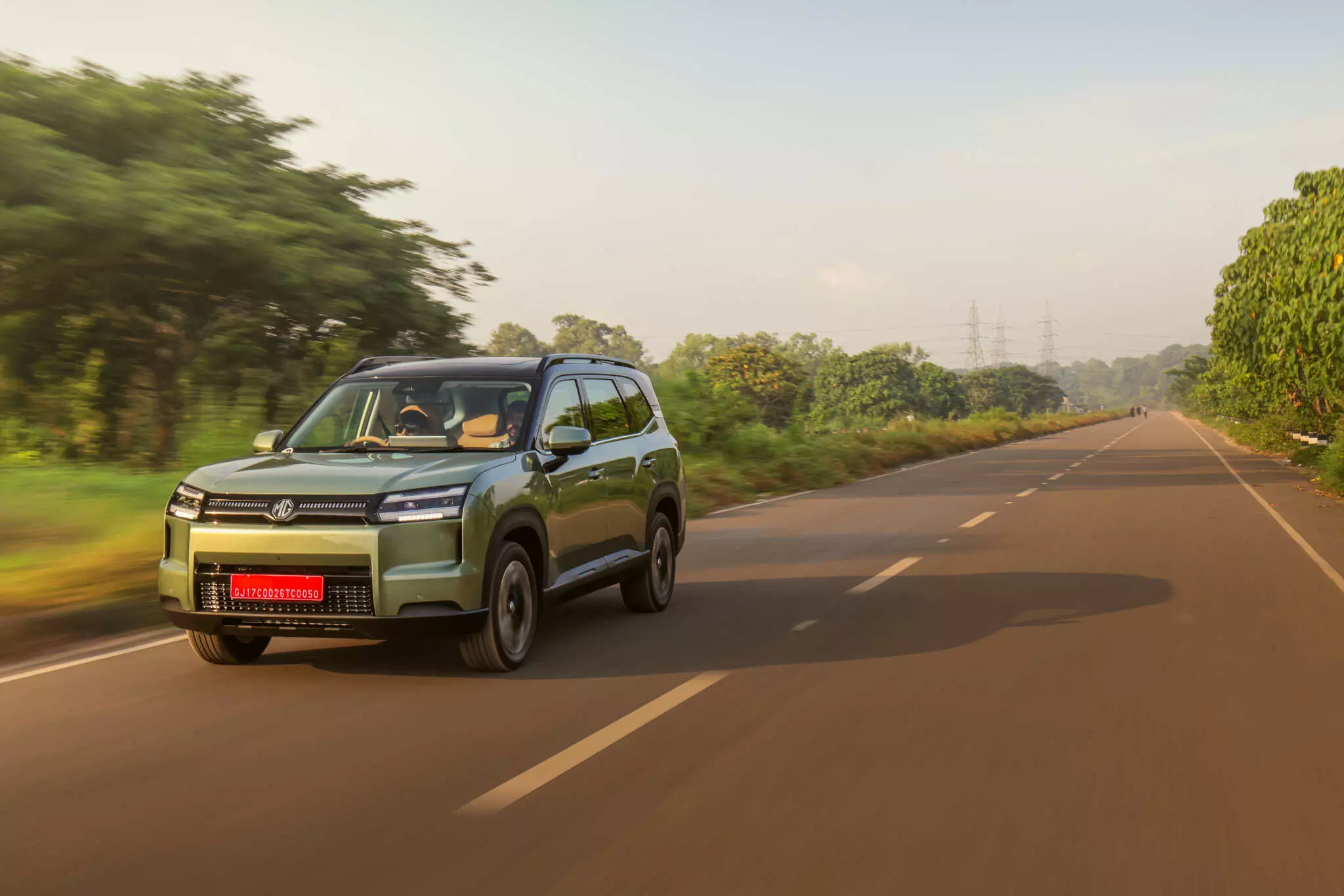
The MG Hector Tomahawk, the first car on MG’s all-new Adapt platform was showcased a few weeks back in the EV and PHEV form. Now, we’ve driven the Hector Tomahawk EV in Cochin, Kerala, the perfect place to drive an electric vehicle. Quick general knowledge check before we get into how the Hector Tomahawk drives – did you know that Cochin airport is the world’s first airport to be fully powered by solar energy? Now, back to how the Hector Tomahawk drives. Keep reading…
MG Hector Tomahawk EV styling
Before we get into how it drives, let’s talk about styling. The MG Hector Tomahawk’s design is a radical departure from how the standard Hector or Hector Plus looks. The Tomahawk features LED beacon headlamps, illuminated logo at the front, and dynamic turn indicators. The car has good road-presence, and great stance when you see it from the side because of the 230mm ground clearance, 2810mm wheelbase (60mm longer than the Mahindra XUV 7XO). and 18-inch dual-tone wheels. JK Tyre Ranger HP tyres come as OE fitment with the car and it not only looks good but is durable, provides good levels of grip, and helps with smooth ride quality. We drove the Renault Duster at the Duster Track Attack with these tyres across 5 cities in India.
Look at it from the rear and it might remind you of another MPV, the Toyota Innova Hycross. The clear-lens tail lamps, tailgate design, and badges, make the Hector Tomahawk look very similar to the Hycross, and that’s not a bad thing because it looks good. Overall, I would give the Hector Tomahawk 8 points out of 10 in terms of styling.
MG Hector Tomahawk EV battery and performance
The MG Hector Tomahawk EV gets a 69.2kWh battery pack with a claimed 517km range. How often is it that the claimed range figure is accurate? Probably never, until now. Our test car showed a range of 490km on 100 per cent SOC, which can be improved even further with better driving, since that car was driven and shot for two days by other media teams, before I drove it. This means you could actually get more range than the claimed range also.
The Hector Tomahawk EV gets a single electric motor that pushes out 201bhp and 310Nm, with 0 to 100kmph coming up in a claimed 8.2 seconds. Those numbers sound good, and out on the road, it does feel fun to drive. You have plenty of power on tap always, the electric motor doesn’t make too much noise, and put it into Sport mode to get better throttle and steering response. While I’m impressed with how it drives and puts power down, I have complaints regarding the regenerative braking. Normally in EVs, the moment you lift-off the throttle pedal, the car starts to brake instantly, and the force depends on what setting you have chosen. Most cars get three levels of regen-braking and a final one-pedal mode. In the Hector Tomahawk EV, the regen braking kicks in slightly late, and that can be a major fuss. There is a small one second lag before the regen brakes kick in, because of which, your driving judgement has to be altered. In bumper-to-bumper traffic, you will have to use the brake pedal because the speeds aren’t enough for the regen brakes to work. Whenever you drive any car on the ghat sections, you need to brake before entering a corner, and that works well in sync with most EVs because of regen braking. Gain enough speed before a corner, let go of the throttle pedal, let regen braking do the work for you, and get back on the gas pedal as you’re exiting the corner. But that’s not the case with the Hector Tomahawk. Because of the lag in the regen braking as I mentioned earlier, I found myself entering corners at a higher speed than I should have. The lag occurs even in the ‘Strong’ regen mode, which by the name suggests, is the strongest regen setting. This means that you will have to drive this car like a traditional ICE car on the ghat sections rather than rely on regen braking to do the braking for you.
MG Hector Tomahawk EV ride and handling
The MG Hector Tomahawk EV’s handling is something I was genuinely impressed by. At higher speeds, highway stability is decent, and feedback from the steering wheel is also good, although lane assist kicks in very often if you have it turned on, and can be a problem at times. On corners, taking tight lines at slightly higher speeds is possible since grip levels are high and the steering is accurate. Push it harder and the car will understeer with some audible tyre squeal, but it will still take the corner with as much accuracy as possible, without forcing you to adjust your line again.
While I have good things to say about the handling, I wouldn’t say the same for the ride quality. The suspension setup is such that driving on well-paved roads like highways will not reveal any faults or issues. The ride is supple, body roll is well contained, and it drives over undulations easily. But issues start to arise when you put it through a set of bad roads. We went to Athirappilly Waterfalls, also known as Kerala’s Nurburgring. But we went from the opposite side rather than the side that’s called the Nurburgring. The other side has well-paved roads and corners but only for a small stretch towards the end of the climb. Before that, there’s more potholes than there were roads, which also turned out to be a good proving ground for the Hector Tomahawk EV’s suspension and ride quality. This has something I would like to term as ‘runaway suspension’. What I mean by that is, the minute you hit a pothole, the suspension doesn’t land softly or absorb the harsh bump, like it does in cars like the XUV 7XO or XEV 9S. In this, it crashes, and the impact rushes immediately through the cabin. In simpler terms, it runs away instantly to the base of the pothole whenever you enter one without landing softly. The seats are also slightly stiff which contribute to the poor ride quality and discomfort on broken roads.
MG Hector Tomahawk EV interior and features
The MG Hector Tomahawk EV’s cabin might be one of the most premium out there. I always root for tan upholstery, and it is done very well in the Tomahawk EV. There’s soft touch materials on the centre console, a 50W wireless charging pad with cooling, and tons of storage space everywhere. In fact, the cup holders in the centre console, and bottle holders in the doors are so large that things start to move around when you’re driving the car. The dash has a large floating 15.6-inch info screen that is intuitive and easy to use. Drive modes, regen settings, ADAS settings, and most features are controlled from the screen, but there are physical buttons for aircon settings, which is a good detail. The system supports wireless Apple CarPlay and Android Auto, but the real talking point in the cabin is the 10-speaker Infinity sound system. The bass and audio levels are very-well optimised for the cabin and sound quality is brilliant. There’s also more features like a panoramic sunroof, ventilated seats, 256-colour ambient lighting, 8.8-inch digital cluster, 5 or 7-seater layout options, 360-degree camera with transparent bonnet and chassis view, and ADAS level 2.
What I didn’t like in the cabin was the stiff seats as I mentioned earlier, the seat height, the steering wheel and gear selector design. Because of the battery in the floor, the seats are placed higher. The driver’s seat will not go as low as you would typically want it to, and will make you feel like you’re sitting on top of the car rather than inside it. That feeling gets much worse when you get in the back, because the seats are placed even higher. The other thing I did not like was the 2-spoke steering wheel design. We have seen this before in the Comet and Windsor, but in a premium car like this, MG could’ve done a better job. The 3-spoke one in the Cyberster is a very-well designed steering wheel, which means that MG does have the ability to design a good-looking steering wheel. Another major problem I have is the gear selector stalk placed on the left-hand side of the steering column, and the indicators, wipers, and headlamp settings placed on the right-hand side. This is inverse of what we are used to generally because Mercedes-Benz cars, the Kia Carens Clavis EV, Hyundai Ioniq 5, Volkswagen Tayron and Tiguan R-Line, and many more cars have the selector on the right. Because of this, I ended up putting the car in reverse many times rather than giving the left indicator, which can be a major safety hazard. We have seen this before in the MG Windsor as well, and it is a major flaw that should be addressed immediately. Apart from these complaints, the MG Hector Tomahawk’s cabin is a good place to be in.
MG Hector Tomahawk EV price and rivals
The MG Hector Tomahawk EV’s pricing starts at ₹14 lakh when you buy it with the BaaS programme, and battery rental starts at ₹4.9/km. You will have to shell out ₹19.5 lakh if you want to buy the Hector Tomahawk EV outright without the BaaS programme.
At this price range, the Hector Tomahawk EV rivals cars like the Mahindra XEV 9S priced at ₹20.65 lakh, Kia Carens Clavis EV priced at ₹18 lakh, the BYD eMax 7 priced at ₹26.9 lakh, and the Tata Harrier EV priced at ₹21.79 lakh.