

Car Reviews
2026 Volkswagen Taigun facelift first drive review: Still the enthusiast’s choice?
Does VW offer an old wine in a new bottle or has the new Taigun stepped up to the plate against a dazzling set of new competitors?
How long is too long? A mosquito biting you for 15 seconds is too long. That traffic signal staying red for three minutes is too long. Zomato taking an hour to deliver food is too long. A human’s gestation period lasting 11 months is too long. A car taking 5 years to bring a facelift (not a gen change) is simply too long. Alas, it’s here. The Volkswagen Taigun has been updated with a fresher familial design and some features aimed to bring it up to speed with the times and competition. Breaking away from the typical loop of a media drive, we aren't just circling a city and heading back to the airport. Instead, we're taking the long way home – driving the 500km stretch from Jaipur to Chandigarh to see how these changes translate from a spec sheet to the open road.
2026 VW Taigun design and features
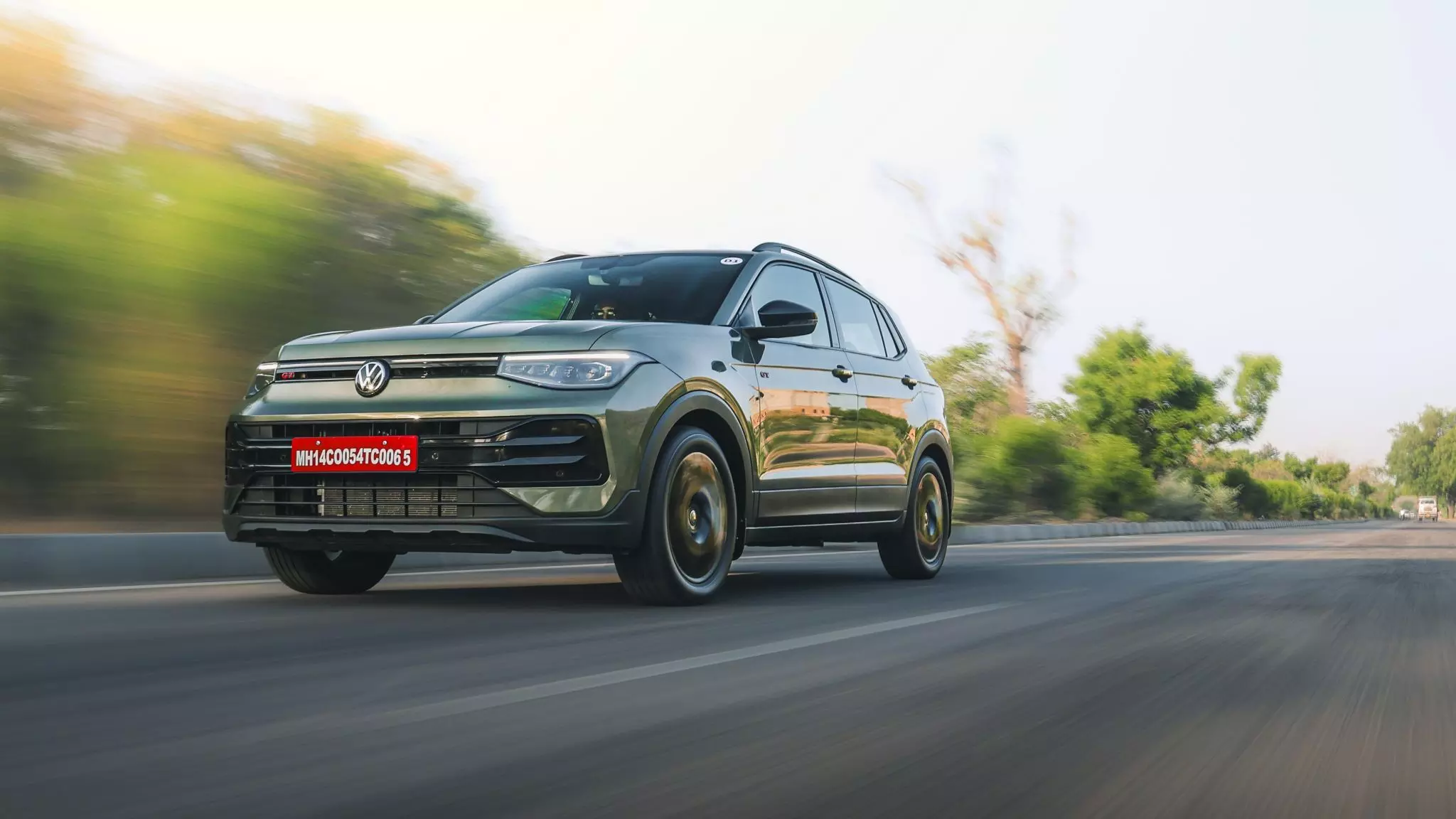
The doctor has ordered light bars to turn heads. And that’s what Taigun gets – front and rear. In addition, the VW badge now illuminates. The face resembles their range topping Tiguan and Tayron, proof that VW still takes the family design philosophy very seriously. And that’s not a bad thing. These design choices make VW cars look timeless and classy. There aren’t any significant changes on the profile barring the alloy wheels, which get a new design – black for the 1.5 GT and silver for the 1-litre, albeit with 17-inchers. Other than that there is a new colour – Avocado Pearl, VW parlance for a dark greenish-grey shade.
At first, it’s hard to notice changes inside the car. The overall layout is pretty much the same, but once you spend some time here, some important changes become apparent. People’s favourite panoramic sunroof is here. The roof shade is thick and sturdy and keeps the heat out. Extremely important considering the unbearable heatwave our country is facing currently. Which makes the next change the most important to have – it finally has an AC that cools the cabin well and quickly. The screens are 10.1-inch for infotainment and a larger 10.25-inch for the digital cluster.
The Taigun finally gets a full-width, 10.25-inch digital cluster instead of the pillar-boxed contraption from before – Shot by Avdhoot A Kolhe for evo India
The digital cluster is quite impressive with the way the information is presented – the fonts and colours make grasping the info you need very easy and the warnings no longer come on top of your current speed. Parking sensors are now on the front as well, but it still does not have a 360-degree camera or movable guidelines for reverse. There is also the voice assistant powered by Google’s AI agent and a self levelling all-weather LED headlight. We will have to wait for the rainy season to test that last one. This new headlamp is unique to the Taigun as the rear seat massager is to the Kushaq.
2026 VW Taigun engine, gearbox and ride
There aren’t any changes to the engines. The 1.5-litre and the 1-litre TSI engine remain and that’s not a bad thing. They make 148bhp, 250Nm and 113bhp, 178Nm respectively and are still probably the segment benchmark. Though the Renault Duster may have something to say about that, something we will have to answer by comparing them together. There is a new gearbox though for the 1-litre. The Aisin sourced 6-AT is replaced by their 8-AT. The gear shifts are still imperceptible, smooth and fairly fast. The advantage is an improved fuel efficiency of 5.8 per cent as claimed by VW. On our drive the 1-litre returned 15kmpl, but to be fair we did gun it for a while as well. Normal humans should be able to extract more out of it on highways. The overall performance of the 1-litre is stronger than one may expect out of an engine the size of an average bucket. It becomes loud in a groany manner at high revs, but that is to be expected out of a 3-cylinder.
The 3-cylinder, 1-litre variant packs a stronger punch than before with its new 8-speed automatic gearbox – Shot by Avdhoot A Kolhe for evo India
The 7-speed DCT continues for the 1.5 and why would you even think of changing that? The 1.5’s performance is expectedly stronger with its four cylinders, larger capacity and a lightning quick gearbox. I want to kiss the hands of the person who put the sheets of paper together to create this masterpiece. If you like driving, this is the engine to opt for.
The suspension set-up remains the same and so does the ride and handling capability of the car. It is not a magic carpet. It is a car. And it acts like one. Just the right amount of feedback from the road filters through to the steering and the car holds its poise well when cornered hard. All the attributes that made us like the Taigun when it first came out, still exist today. The more noticeable difference is in the NVH levels. The road noise was significantly lower. This may have to do with the new Ceat Securadrive tyres these cars now come with.
The 1.5-litre engine with its 7-speed DCT 'box remains delightful to drive enthusiastically; NVH levels also see an improvement – Shot by Avdhoot A Kolhe for evo India
2026 VW Taigun verdict
Even with these changes, I suspect VW will have to contend with challenges convincing more customers to buy into the new Taigun. This is more to do with the evolving customer taste and the response of other manufacturers to meet them. Products like the Sierra, Seltos and Victoris intend to dazzle the customers with tech and woo them with the softness of their ride. The Duster has become the first product to invade into Kushaq and Taigun’s space of driving prowess and is slightly larger as well to attract itself a set of customers from both – enthusiastic as well as practical camps. Interestingly though a set of customers exist who do not want a larger car because they find comfort in the 4.2-metre segment – especially the nuclear families and individuals. VW has specced the lower two variants with a mix of important and desirable tech like the all-weather headlamps, sequential indicators (interestingly only in the rear), rear wiper and defogger, voice assisted AI agent, front and rear parking sensors and the larger screen. This may bring them more buyers into the entry and mid variants. This is a similar strategy as played out by Skoda for Kushaq too. The winner between the two may be the one which carries more brand strength. Something to look out for.
Considering how long it took for the facelift to arrive, it’s hard to say when the new gen will be slated. But hopefully it will be sooner than the 5 year timeline, as by then the market would have moved on and newer products like the next-gen Creta and Mahindra’s mid-SUV would also join the fray. But as a driver’s car, this remains the one to beat.