

Car Reviews
Volvo EX90 review: The best 6-seater luxury electric SUV?
Volvo’s new flagship electric SUV brings three rows, a 106kWh battery, 450bhp and a completely new interpretation of the XC90 formula to India
- Plush ride
- Spacious, well equipped cabin
- Strong performance and range
- Too many basic functions buried in the touchscreen
- Not as engaging to drive
Volvo’s one-stop solution for all the world’s needs is the XC90. Want 3 rows? XC90. Want a luxury SUV? XC90. Want something comfortable, understated and loaded with safety? Again, XC90.
Now comes the EX90. Not a replacement. But a flagship, electric equivalent of that familiar formula. And now, four years since the global launch, we finally have it in India. But this isn’t just an XC90 with the engine removed and a battery shoved underneath. Built on Volvo’s dedicated SPA2 electric architecture, the EX90 is more than five metres long, weighs close to 2.7 tonnes and uses a 106kWh battery with a twin-motor all-wheel-drive setup.
The range? 625km on the WLTP cycle. Plenty to go against the rivals. But not only that, this Volvo is pretty well equipped elsewhere as well. The India-spec test car is available exclusively in a single fully-loaded variant with several options ticked as standard. Options like air suspension, leather upholstery and massage seats. Overseas, you also have an option for a single motor variant, but that is not being offered in India. Similarly, this is exclusively being offered as a three-row six-seater car with captain seats in the middle row. What also stands out is that this Volvo is pretty smart. The package includes a much more powerful computing platform and one that makes Volvo call the EX90 a software-driven vehicle.
But the crucial part remains how all of this works when you actually drive it in India. We spent time with the EX90 on highways, through villages and in traffic, while testing its range, ride, performance, interior, seating, technology and everyday usability. And this is what we found.
2026 Volvo EX90 design
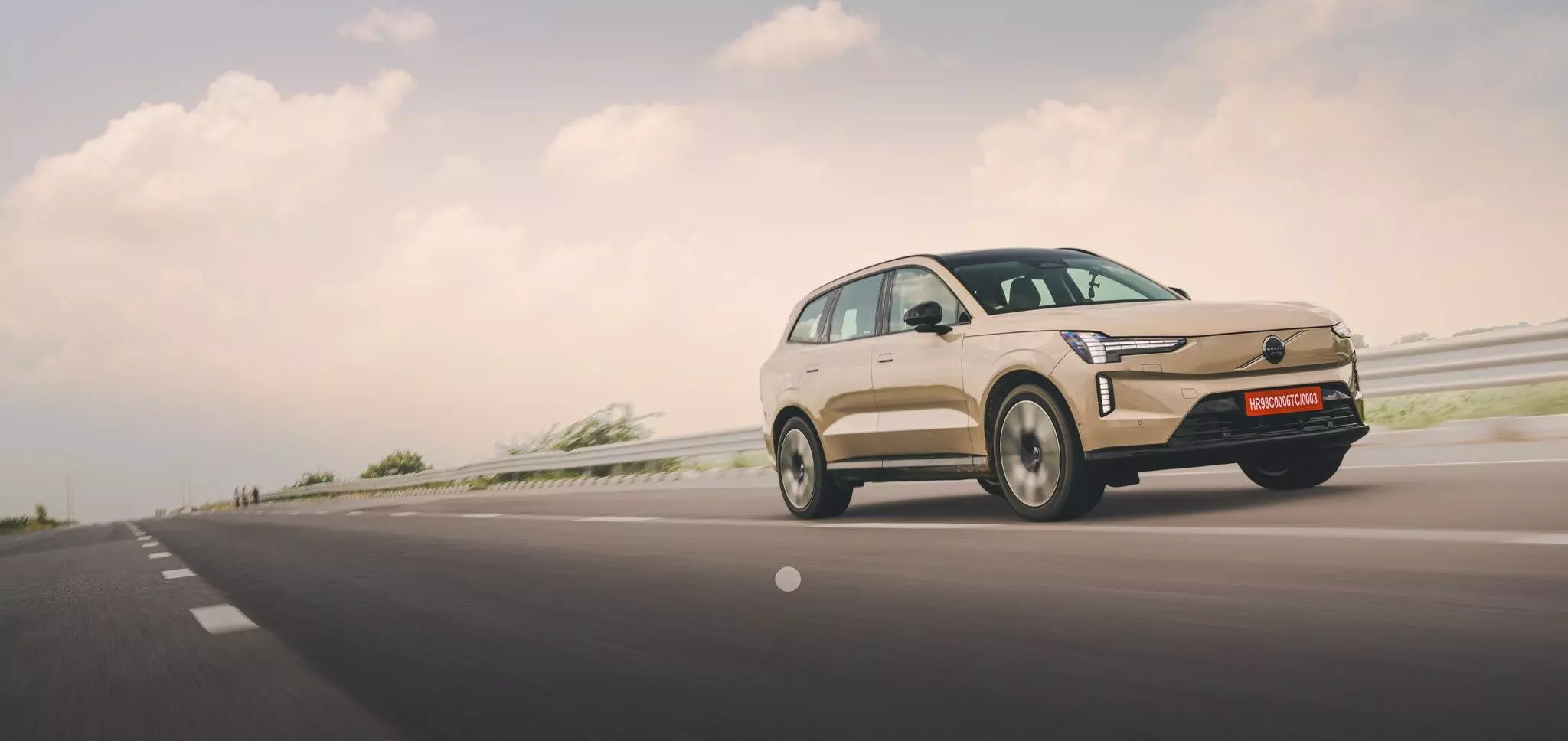
The EX90 is unmistakably a Volvo. It looks like a solid piece of metal, but it isn't boring. Far from it, the overall design is very elegant, but the body lines, LED lights, and big rims add some character. It also does not look like an electric XC90 – in fact, no body panels are shared between the two cars. It gets its own bodywork, and even though there are similar Volvo cues running through the design, the overall approach is to get a clean and understated design. At five metres long, the EX90 is also a rather large SUV.
The front gets a small body-coloured panel in place of a traditional radiator grille, below which are the air vents to cool down the internals. As in several other EVs, they open and close automatically as per demand. The proportions are really good, and unlike a lot of other EVs, the grille isn’t taking up the entire front, which makes it conventionally good to look at. The headlight carries the familiar Volvo shape with large pixel-like treatment. The party trick within the headlight is the fact that the DRLs actually hide the projector lamps behind them. Whenever the need arises, the DRLs actually move out of the way to showcase the projector lamps. A bit of overengineering, but it also looks cool. The result is a face that looks good without being polarising.
The side profile is restrained. There are flush-fitting door handles, a relatively cleaner shoulder line and large 21-inch rims. The 22-inch option won’t be available in India, but our roads hardly warrant having really big wheels. The door handles actually deserve a special mention. In the quest to perfect flush door handles, a lot of manufacturers force elaborate hand movements just to open the door. In the EX90, it’s somewhat traditional with a pull-up style movement that’s much easier and feels natural. At the rear, Volvo continues a minimalist and clean theme with vertical lights around the rear glass paired with C-shaped lights just below those.
Compared with German luxury EVs, the EX90 looks somewhat conservative. It doesn’t have the visual drama of those, but it also looks somewhat better because of it. And that understated approach becomes even more obvious once you get inside.
2026 Volvo EX90 interior and features
The cabin follows the minimalist approach with a combination of wood, soft-touch surfaces, premium leather upholstery and ambient lighting. It feels expensive and, right off the bat, gives a comforting feel. Acoustic glass all around also keeps the cabin noise relatively low. There’s also enough storage in the centre console and even the door pockets are big enough. As mentioned before, leather seats are standard as opposed to being an option in some overseas markets. Sitting up top is an electrochromic glass roof. That means, at the touch of a button, it would go from clear to opaque. Good if you don’t need a sunroof but do care about the openness feeling. What works in its favour is the fact that you actually don’t need a cover for the roof, though one can be had as an option. In the opaque state, it blocks all sunrays, and you don’t feel hot at all inside the cabin.
The biggest talking point, however, would be technology. In the centre sits a 14.5-inch vertically-oriented touchscreen. In front of the driver is a small cluster and above it sits the head-up display. The cluster is nicely executed because it’s not bombarding you with information and fancy graphics. The head-up display remains useful, and you don’t need to take your eyes off the road to see information like navigation and speed. I hope the same could be said about the infotainment, though.
Several simple functions are integrated into the screen. These include climate control, mirror adjustment, steering adjustment, opening the glovebox and more. The screen itself is rather nice; it uses Google’s ecosystem and supports functions such as Google Maps alongside wireless phone connectivity. The updated software stack means that operating the screen is very easy. There are no glitches, responsiveness is top-notch, and the icons too are aptly sized.
Then there are the window controls. Instead of having four individual switches, Volvo has eliminated two switches and has instead added a toggle to switch between front and rear windows – as we saw in the new Mercedes-Benz CLA. While it saves space, it’s a bit cumbersome to use, as you always need to be aware of which row is selected currently.
What I absolutely love is the music system. As standard, it offers a Bowers & Wilkins system with 25 speakers, including speakers integrated into the headrests, and a system output of 1610W. The audio system by itself is excellent, but the quiet cabin further amps up the listening experience.
Space is plenty throughout. The India-spec EX90 gets captain seats in the second row, so this is strictly a six-seater. The second row is genuinely spacious with enough room on all sides. The seats are set higher, so thigh room is also similar to any ICE SUV. The seats can be reclined and moved forward and back to add room to stretch your legs. The third row is spacious but much better suited for children than adults, especially if you are on a long drive. There is no scarcity of convenience, though. Second row passengers get their own climate controls (the EX90 features four-zone climate control), USB-C charging ports, cupholders and other storage spaces including large door bins and seatback pockets.
Safety remains a major focus, with seven cameras, five radars and 12 sensors. With that, you get ADAS with collision avoidance, Pilot and Park Assist, driver monitoring, and surround view monitor.
2026 Volvo EX90 battery and performance
The EX90 is powered by a 106kWh battery sending power through two motors placed on either axle. Quoted range is 625km on a single charge on the WLTP cycle, while on the ICAT cycle, estimates go up to 724km. In India, these will differ quite a bit. During our drive, we saw a consumption figure of 14.6kWh/100km at one point. If you simply extrapolate that figure against the 106kWh battery, the theoretical range works out to approximately 726km. But that’s just maths and not the actual distance that the car would be able to cover. Driving style, speed, traffic, temperature, and terrain will all affect the final number. Based on what we saw, 500km should be a realistic target in mixed driving. The EX90 gets an 800V electrical architecture. It supports fast DC charging, and Volvo claims up to 250km worth of charge can be added in 10 minutes.
The power figures stand at 450bhp and 670Nm torque. Volvo quotes a 0-100kmph time of 5.5 seconds and an electronically limited top speed of 180kmph. Given that this is a heavy car, it doesn’t seem slow at all. There is instant response from the moment you mash the throttle pedal, and it achieves triple-digit speeds easily. What stands out is that all that grunt doesn’t appear all of a sudden, and there’s a nice progression to power delivery. Even when you select the more aggressive settings, the throttle response remains predictable and easy to modulate.
There are multiple driving modes along with adjustable steering and suspension settings – both of which can be adjusted to your liking. For me, the standard seemed perfect. There are also regen braking modes with four-level adjustability. The one-pedal driving mode removes the need to control the brakes largely, and in low-traffic situations, it’s exceptionally useful.
2026 Volvo EX90 ride and handling
Where the EX90 will surprise most buyers is the ride quality. The standard air suspension is a big positive for this car. It deals with the EX90’s large, heavy body quite well, and keeps you isolated from the worst of the surfaces underneath.
The ride is plush, and the EX90 prefers to glide rather than attack the road. Unlike some of its rivals, where the ride can get a bit floaty with the added weight from the batteries, the EX90 remains balanced and in control throughout, even on really rough patches. I couldn’t really test the cornering on Rajasthan’s very straight roads, but the car left me pretty impressed by its road manners. What Rajasthan offered plenty of were uneven patches, and even with three people on board with their luggage, the ride remained superb.
For a Volvo, though, I would say straight-line manners matter more. You see, the entire design language and interior suggest that this would be a great family car. The quiet cabin, air suspension, comfortable seats and smooth powertrain work in its favour.
2026 Volvo EX90 verdict
What I find interesting about the EX90 is that it gets a lot of things right. It offers a much quieter and smoother driving experience, a fresh premium cabin experience with plenty of room and lots of important safety tech. The electric powertrain provides far more performance than most owners will require, while the 106kWh battery gives the EX90 actually usable range. What Volvo has got absolutely right is the ride quality. It’s going to be sufficient whether you choose to drive or be chauffeured.
The obsession with button-less philosophy needs to be discussed strongly. It creates some irritating usability decisions, but in an otherwise exceptional package, I’m sure we can learn to live with it. For buyers looking for a large, luxurious, six-seat electric SUV, the EX90, then, deserves serious consideration.
Prices will come out in October at launch, and I expect it to demand around ₹1.2 crore. At that price, it would go against the Mercedes-Benz EQS SUV and the BMW iX, which are its only established rivals. But for someone specifically looking for a large, comfortable, six-seat electric SUV, it makes a very strong case.