

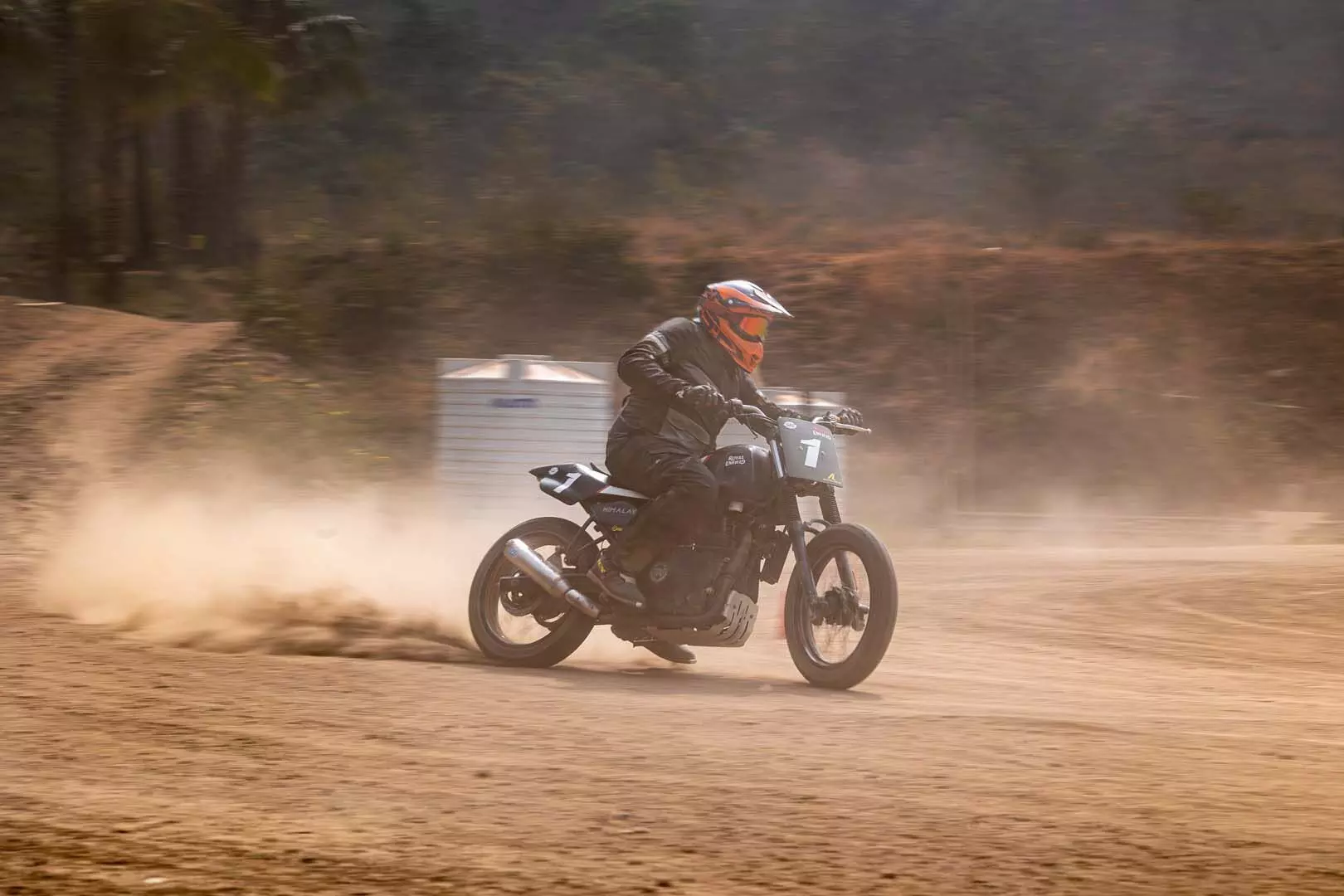
Royal Enfield Slide School at the Autologue Ranch in Pune
Royal Enfield Slide School at the Autologue Ranch in Pune
Bike Features
Attending the Royal Enfield Slide school
There’s a lot more to flat tracking than meets the eye. That’s where the experts at the Royal Enfield Slide School come in
Left foot down, akin to the slider on the knee when riding on track, right ball of the foot on the foot peg, the bike leaned over and your arse straddling the edge of the seat, elbows up and consistently open the gas while looking far ahead. That’s the recipe for a slide. Sounds pretty easy, right? I was under a similar assumption but when I tried it, the same left foot that was supposed to just graze the ground, ended up getting caught, stretching my leg, possibly affecting any chances I had of becoming a father one day. There’s a lot more to flat tracking than meets the eye and a lot needs to be removed from the bike and unlearned by you to actually accomplish anything on the oval.
Enter the Royal Enfield Slide School. The one close to our base is held at the Autologue Ranch in Pune. The school is run by the members of Autologue who appoint instructors that have been trained and certified by Royal Enfield. There are two bikes that you can ride: the Royal Enfield FT411 and then the FT450. The former is based on the older long-stroke Himalayan 411, whereas the latter is based on the new, liquid-cooled Guerrilla 450. In typical flat tracking manner, the motorcycles have been stripped off of all things that serve no purpose on the dirt oval. No front brake, no headlights, taillights, indicators, instrument cluster, pillion foot rests or any of that. There’s barely a seat too, with the stock unit replaced for not a very thick sheet of foam. The wheels are 18-inchers at both ends, ideally shod in bespoke flat track tyres, but in this instance the dual-purpose tyres did just fine. The stock exhaust makes way for a free-flowing end can, designed not to increase the power but to ensure the engine breathes as freely as possible. The byproduct of which is sound you would either love or hate.
Not having a front brake is an interesting experience, to say the least, and when you’re heading for the wall, reaching for the brake lever is similar to finding a good mobile network in the middle of the desert. It’s just not there. If you’re a beginner, like I am, you’re put on the FT411. The oval at the Ranch is not particularly large, which means that my learning impaired self didn’t have to focus on shifting gears as we were restricted to first. As is the case with all forms of motorcycling, vision is crucial while flat tracking. Looking where you want to go is one of the only ways you’re going to make the corner and not wrap yourself around a pole or a tree. Especially because the margin for error is really small considering that the track is neither too wide nor long. Then there’s the matter of speed. Too much and you find yourself in a frenzy clutching at thin air in a pathetic attempt to slow down, too slow and you lose all the momentum you need to successfully slide through the corner. When you come in slow, you also tend to open the throttle when you should ideally be off it, affecting the weight transfer of the motorcycle and again, not achieving a slide. Like all other forms of motorsport, the agenda in flat tracking is to be as fast as possible. The way to do that is to enter fast enough to be able to lean the bike in as soon as the straight turns into a corner, then open the throttle gently but surely, initiate a slide through the middle of the corner, run wide and straighten the bike up as soon as the corner straightens up again so you can be on the gas, bouncing off the limiter before entering the next corner and repeating the same process again.
At the school, you’re not expected to slide the bike like a flat tracking hall of famer, neither will you be able to until you put the work in. What you see in these shots is me posing for the camera, not actually successfully sliding through the corner. Remember the failed progeny at the start of the story? Yeah. But, the instructors do a damn good job of giving you the tools required to practice the art of going sideways. Unlike trail riding or off-roading, flat tracking, sadly, isn’t something you can just go and do wherever the road ends. You need a proper flat track that gets regular maintenance and a motorcycle that is fit for purpose. Thankfully, these schools don’t cost an arm and a leg. The RE Slide School at Autologue costs roughly `3000 for the day and all you have to do is show up in appropriate riding gear and the rest is taken care of. At the end of the day, I did start getting comfortable with the FT411 and did start to find rhythm around the track. For laughs and gags, the instructor asked me to swing a leg over the FT450 and see what that’s like. Right off the bat, it’s more aggressive, demands finesse, skill and cojones that aren’t bruised. One day, hopefully not too far in the distance, I will ride the FT450 and comfortably slide my way around the track on it too. But for now, the 411 is plenty. Doing a session of the Slide School also allows you to throw your hat in the ring for selection rounds for the Royal Enfield Slide Cup. Yet another great initiative from the brand to democratise racing.
After spending a day in the dirt and then coughing out said dirt, the one thing I can tell you is that riding a flat track motorcycle is very unlike other forms of off-roading and is one that definitely, albeit subconsciously, will have positive ramifications on your everyday riding. Plus, when done right, you get to go sideways. What’s not to love?