

Bike Features
Going racing with TVS Apache Racing Experience International edition
The 2026 iteration of the TVS Apache Racing Experience opened its doors to riders from around the world, making it a truly international grassroots level racing event
To go racing is something that every automotive enthusiast has dreamed of doing in some capacity or the other. Keeping the immense skill required to have even a slightly successful career aside, the logistics of it require you to have pockets far too deep. Even then to have a career in racing in India is a very difficult affair for a multitude of reasons. TVS Racing is one of the few companies in India that goes the extra mile to ensure that racing is as accessible as can be for the masses. It started with One Make Championships in the INMRC calendar, which also includes the Young Media Racer programme in which most of us journalists have cut our racing teeth. It’s also had regional rounds for Apache customers to come and get a grassroots level taste of what racing is all about. In the last few years TVS has ramped up what it is calling the Apache Racing Experience with the final rounds of these regional selections happening at the Madras International Circuit, giving the participants a true feel of national championship level racing.
For 2026, TVS Racing has taken the ARE (Apache Racing Experience) GP to the next level by opening it up to Apache owners from around the world. In this first international round, riders participated and got selected from Nepal, Mexico and Columbia and TVS only plans to grow this entity further. To get a first-hand taste of what the 2026 ARE GP was all about, TVS had us over to participate in the media class and here’s how that went.
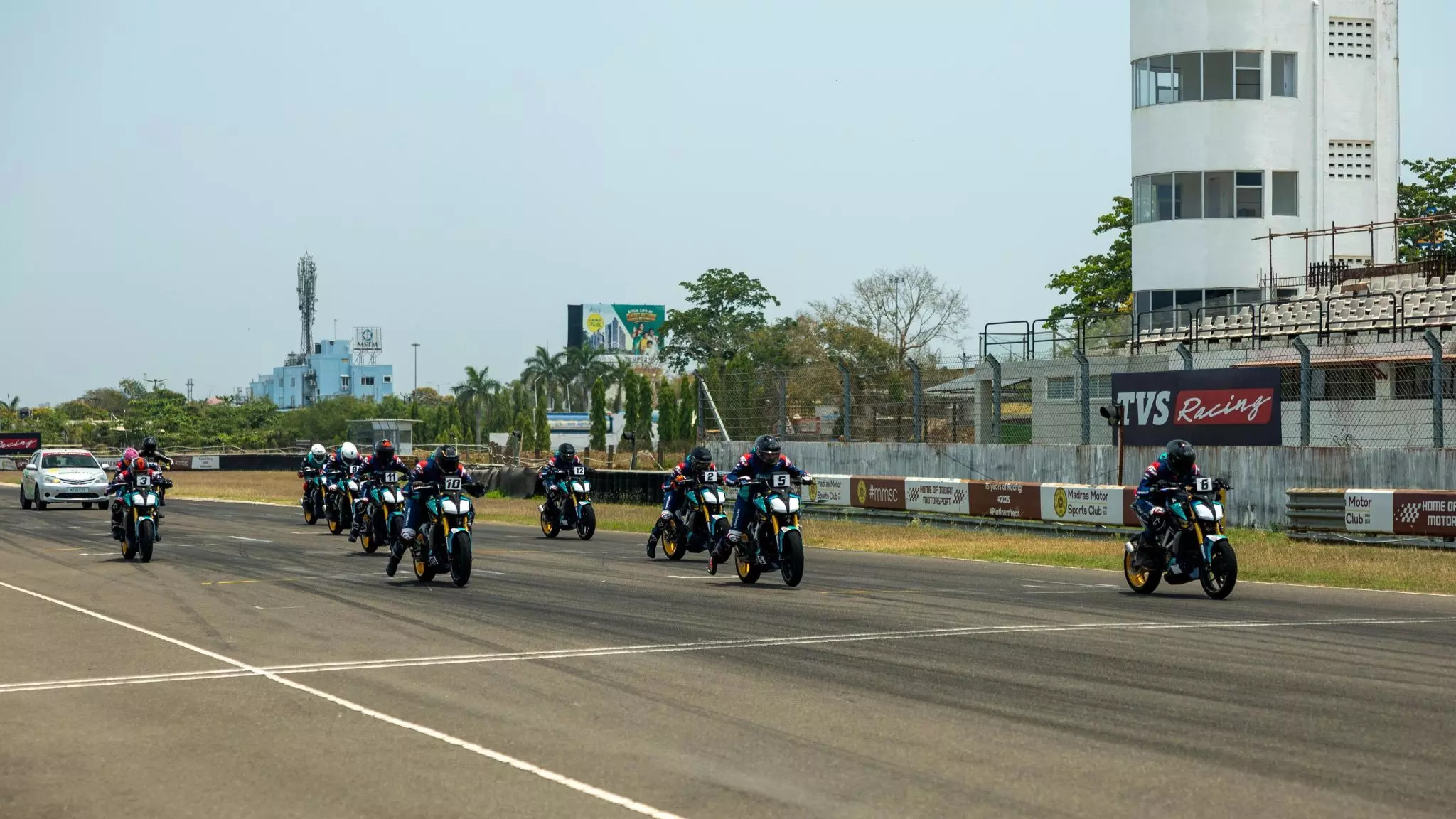
In typical racing fashion, the ARE GP follows the race weekend calendar. That means that you arrive on a Saturday, get registered, and get familiar with the bike and the track in your free practice sessions. After that you get your grid positions for the races on Sunday with your qualifying session. The classes for the races include the novice class – 160/180cc class and the 200 class on the RTR 200s, then there was the 310 class with the riders riding the OMC spec RR 310 and then the Media class with the Women, Men and Expert class riding the race-spec RTR 310.
I participated in the Expert Class, which meant hopping on a RTR 310, which was relieved from all its road-worthiness – Images by TVS Racing
The race-spec RTR 310 was essentially the stock naked bike void of all paraphernalia that makes it road-legal. Then the stock exhaust makes way for a free-flow exhaust which seems to have the sole agenda of making you deaf. The electronics too have been disconnected, meaning no ride modes, no ABS or traction control. Nice. Apart from that the motorcycle is more-or-less stock and therein lies one problem. While it was a hoot to ride and something that we worked around, the fact that the footpegs were in stock position, meant that they would scrape the minute the lean angles started to increase. Again, not a problem per se, but something that needed to be worked around.
The race-focused alterations left the footpegs in the stock position which added slight friction to the intense leaning manoeuvres – Images by TVS Racing
I got to race in the expert class and that was a hoot and a half. Peers from the industry, battling it out on the track is always fun. Courtesy of my weight, the bike wasn’t the fastest down the straights and that resulted in a P11 qualifying. One from the last for those who are curious. That being said, come race day, energies were high and excitement levels were through the roof. I botched my start with a big wheelie off the line and lost the only position I could courtesy of it. But trying to hold on to the pack and faster corner speeds meant that I could gain back not one, but two positions in the first lap of the four lap race. After this, I was in a constant dog-fight with another peer from the industry but his consistent lines and the short length of the race meant that I had to settle for P10. But this meant that the second race would see me start from P10.
My larger frame on the rather stripped down and slender race-spec RTR 310 proved to be detrimental on the MIC straights – Images by TVS Racing
Race 2 got off to a similar start with a poor launch and my rotund self, fighting the physics of a big dude on a small bike against significantly smaller and lighter riders. That being said, I managed to put in faster lap times in the race owing to the weather being a smidge kinder and like in Race 1 gained the 2 positions I lost in the launch, in the first lap itself. But right from the first lap, the race was a bit of a demolition derby, with one rider going down in each lap. By the end of the race four of the 12 people that started the race, did not finish owing to crashes. This meant that I finished the race in P7. While this is no result to write home about, in those two days, I felt like a professional racer with a proper crew working on the bike, riding on one of the best race tracks in the country. This is exactly what the participants felt like too and that is commendable.
Everything at the 2026 ARE GP was handled with utmost professionalism and made you feel like you were truly part of a proper racing experience. Safety too was something that was taken very seriously with Alpinestars suits, airbags and boots being provided to all the participants. Helmets too were all FIM certified and nothing else would be accepted. The riders had to wear these high-quality gear and it was an absolute non-negotiable. Which might be uncomfortable for some who are used to wearing their own gear, but this rule just enhances the level of safety and ensures that the riders can focus on giving their all while being cocooned in quality riding gear.
The TVS Apache Racing Experience is the perfect place to whet your racing appetite for a plethora of reasons. First, if you get selected, all you have to do is turn up, and the rest is taken care of. Meaning that you can gauge whether racing professionally is something you want to consider without the financial burden that comes with it. Secondly, everyone is here to learn and the competition is not as cut-throat as it would be in a national championship and this helps with morale. Thirdly, it is organised in a very professional manner with all the right safety protocols in place to lend you the sense that this is a serious professional event. And most importantly, you get to have a lot of fun and get to experience, first-hand, what you wait to see on television every weekend. And that is something you cannot put a price on. So if two-wheeler racing is something that excites you, I implore you to participate in the next round of the TVS ARE GP. Because this is something you do not want to miss.