

Car Features
Tata Sierra 1.5 Diesel versus the rest of the mid-size SUV segment
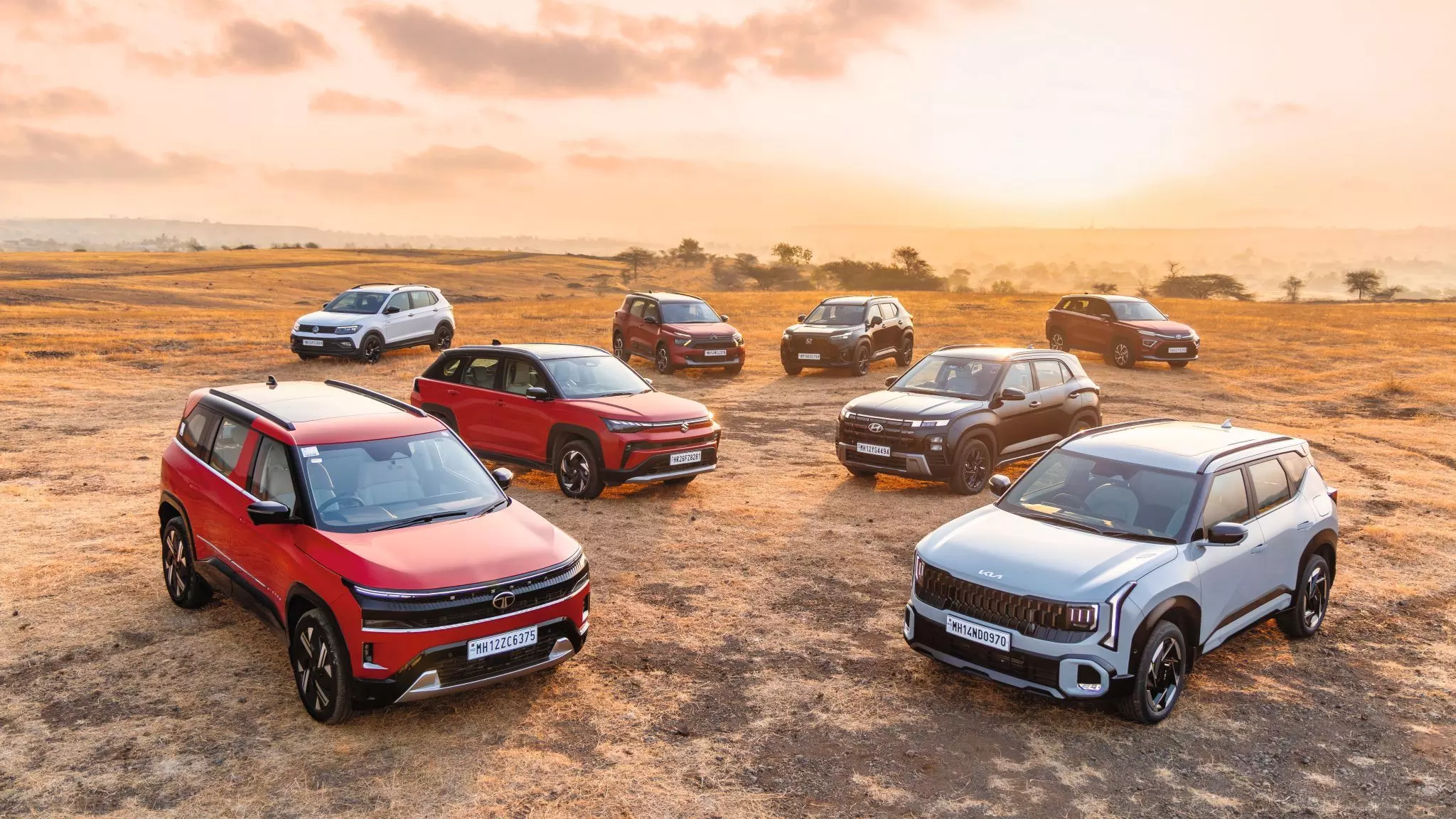
We bring eight of the segment’s hottest mid-size SUVs in India! Is the Tata Sierra the best of the bunch?
I get it, it is confusing. Citroen, Honda, Hyundai, Kia, Maruti Suzuki, MG, Renault, Skoda, Tata Motors, Toyota, Volkswagen. Petrol, turbo-petrol, diesel, hybrid, CNG. Dual-clutch auto, torque convertor, manual transmission. Phew. And we haven’t even gotten into individual model variants lists yet. The mid-size SUV segment has it all. There’s more options than there is direction and that’s exactly what this story is going to do. Point you in the right direction. Explain the strengths and weaknesses of each SUV, and try to make sense of which one suits your needs. And in the process, a winner should emerge – a benchmark for the segment. The Hyundai Creta has been the undisputed benchmark ever since its launch in 2015. Today, however, it has real competition. The numbers don’t lie. The Maruti Suzuki Victoris has been doing 12,000-15,000 units a month. The Tata Sierra? Close to 10,000. The Kia Seltos? Little over 10,000 again. Three new cars that have launched in the last six months, all pulling in big numbers. Our contenders are varied. The Creta is here to defend its title. The Victoris takes the strong fundamentals of the Grand Vitara and improves the value proposition.
The Seltos is the first recipient of the Hyundai Group’s all-new platform which, for the first time, gets 5-star crash safety ratings. All heavyweights in their own right. There are some incumbents as well – none of them pushovers – the Honda Elevate, Citroen C3 Aircross X, Toyota Urban Cruiser Hyryder and Volkswagen Taigun. And then there’s the Sierra with neo-retro styling and a tech fest. A couple of disclaimers before we dive into the driving: the Taigun here is the pre-facelift car. There was no way we could have gotten the facelifted Skoda Kushaq or VW Taigun in time for the shoot, and so we consciously decided to include the older car as it was the ride and handling benchmark. Other notable absentees are the Renault Duster (also a miss owing to its launch timing) and the Grand Vitara (which we didn’t include since the Victoris was already here).
The benchmark
Let’s start where the last comparison test left off. The Creta. The best way to blow off the cobwebs and hit reset on our perspective. Almost like a palate cleanser before getting to the rest of the segment. I’ll save you the lecture on how the Creta reset what we could expect in this segment – you know that narrative. What’s impressive is how the Creta continues to sell so strongly while so far into its life cycle. This generation of the Creta arrived in 2020 and got a facelift in 2024 – it is long in the tooth compared to its rivals here. And yet, it outsells every single one of them. Hyundai’s trump card is an all-rounder in every way. It has three engine options which makes it versatile, has wide appeal and has more than enough equipment. It checks the important boxes: panoramic sunroof, big screens, Bose audio, wireless phone charger, 360-degree camera, ventilated seats, dual-zone climate control, ADAS. There’s very little you can point at in rivals and say it’s missing from the Creta. On test is the NA petrol and this is the variant that really sells well. It is smooth, refined and while it isn’t a benchmark when it comes to other NA options, the overall package works really well. The Creta’s turbo-petrol is the enthusiast’s choice and the one we would recommend if you’re seeking thrills. If you want to win drag races against the Taigun and Kushaq you’ll need to get yourself the manual transmission Creta since the DCT launches far less aggressively than the VW DSG allows for. As for diesels, the Hyundai diesel is certainly the segment benchmark.
Despite its age and not having received a refresh like the Seltos, it still continues to drive volumes in the segment – Shot by Avdhoot A Kolhe for evo India
The Creta’s dynamics have taken a big step-up over the years. Every update has brought in incremental improvements, and even the last facelift brought a strengthened chassis and retuned suspension that made it feel more robust. Ride quality is sorted. It is set up for comfort and it soaks up the worst of our roads well. That softness means it doesn’t deal too well with a full load, sitting too low in its suspension travel, and moving the dampers out of their ideal working window. And that focus on comfort also means it isn’t setting any handling benchmarks. It remains safe and composed in the bends, but the steering is vague and it can’t compete with rivals in terms of outright dynamics. The big challenge with the Creta is it doesn’t have a B-NCAP or G-NCAP safety rating yet. The facelift had big talk about strengthening the chassis, they even had a bare monocoque on display to drive the point home. But the real point-driving happens when B-NCAP drops a report and that hasn’t happened yet. It should change soon. There’s a gen update due for the Creta which will inherit the new Seltos’ K3 platform, larger dimensions and 5-star B-NCAP safety rating. How unstoppable would the Creta be when that happens…
Sharp shooter
There’s no doubt about the safety credentials when it comes to Tata Motors. It was Tata and Mahindra that really invested in safety early, raised the bar and forced the rest of the industry to follow suit. There was no doubt from the start that the Sierra would score a full 5 stars at B-NCAP and it has. With that out of the way, let’s talk styling. Honestly, I hate talking styling in a comparison test. Everyone’s tastes are different and styling itself is subjective. Except, in the case of the Sierra, it isn’t. Dripping in ’90s nostalgia, there’s no getting away from the fact that the Sierra is the most heartachingly beautiful car in the segment. Upright lines, strong shoulders, Defender-inspired shut lines for the windows and some clever use of colour to mimic the sky light of the OG Sierra. The rear does look a little under-styled, but I’ll let it slide what with how good the rest of it looks. The interior is a mixed bag. Space and tech is excellent. Class leading, even. The dash layout with its three screens shows Tata’s intent to position this at the top of the segment – the Mahindra 7XO is the only other ICE SUV to have this feature, and that sits half a segment up. Other highlights are the massive sunroof (that sits a lot further back than I would have liked) and the Dolby Atmos sound. And yes, it does have the hygiene features that are now expected in the segment. The backseat of the Sierra gets boss mode, sunshade, the best knee room courtesy the longest wheelbase and excellent headroom too. Oh and the biggest boot in class as well. However, where it falls short is material quality and finishing. The gear lever remains frustratingly tricky to use.
The Sierra feels robust and sturdily built but lacks the AWD system option offered on the Urban Cruiser Hyryder and the Victoris – Shot by Avdhoot A Kolhe for evo India
The soft-touch material on the dash somehow manages to feel cheap. The armrests aren’t properly supported and shake if you try to move them, and the generous use of gloss black isn’t doing it any favours. In photos, it looks great but the tactility and materials let it down. Engine wise, the Sierra has an Atkinson cycle NA petrol (that we haven’t driven yet), a new 1.5 turbo-petrol and diesel. The turbo-petrol impressed us when we drove it first. Punchy performance combined with a good DCT meant it was pulling sub-10 second 0-100kmph times. It was refined for the most part and had good drivability. The diesel is what we have on test, loaned to us by a friend of evo India and it is not nearly as quick but delivers that typical slug of torque once it comes on boost in a narrow powerband. Ride comfort is excellent for the most part – at high speeds, it is very composed and handles our undulating highways very well. Tata Motors always manages to engineer their cars to behave larger than they actually are, which works brilliantly. Low speed ride was also something that impressed me at the first drives and we proclaimed it to be a benchmark. However, driving it back to back with the likes of the Victoris, proved otherwise. You can feel a little bit of heaving over bumps and potholes, something you don’t feel on the lighter cars in this test. As for handling, again, the weight plays spoilsport. The steering is direct and you do have a great connection to the road, but with that massive sunroof and tall stance you get a centre of gravity that is a little too high and you feel it. You can sense that the limits of the Sierra come in a little bit earlier than some of the other SUVs that have been set up for dynamic driving and the result is ESP cutting in earlier, quite aggressively and very intrusively as compared to the others.
Moving up If you thought the Sierra was moving the segment higher up, wait until you see the Seltos. Based on the new K3 platform, the Seltos is now longest in class – at 4460mm, it breaches the unsaid 4.3m cap that this segment has always had and takes it up to the size of the Jeep Compass. And you can see that size in the flesh. The insides are really well done. They haven’t gone over-the-top with the end-to-end displays like the Sierra, but has a digital interface similar to the Syros. It has three screens, with the middle screen being a tiny, near-redundant one for the AC. Why redundant? Because the Seltos has a smattering of physical controls for both air-con and media. Features-wise, there’s little to complain about – it gets everything you expect. I could nitpick and say that it gets eight speakers to the Sierra’s 12, or that it misses out on the rear wireless phone charger which the Creta gets. But none of these are deal breakers. What I took away from the Seltos, though, is the overarching sense of quality and good ergonomics. Controls fall to hand easily, physical buttons are front and centre, and you don’t have to dive into the screens for small tasks. The materials and tactile sensations are top notch, and the visual impact is also very clean. This feels like a car that has been well thought out, keeping the driver in mind.
The Seltos’ powertrains are shared with the Creta’s so I’m not going to dive into the nitty gritties. It continues with all three – NA petrol, turbo-petrol and diesel, and impressions in terms of the way it drives are very similar. Of course, the bigger size and weight would necessitate gearing changes, but the overarching impressions are very similar. What I do want to focus on is the ride. The previous Seltos was a bit too firm. It got better over its life cycle but was still on the firmer side by the end of it. That has been fixed. The ride is far more balanced – it has a slight hint of firmness to it, but isn’t jarring in any way. It sits somewhere between the Creta and the old Seltos, giving you that high-speed composure without being stiff. This is important, because it makes the Seltos far more useable in our conditions. Handling is surefooted and composed. The steering is light but it feels balanced and willing in the bends. What is welcome is the 5-star B-NCAP rating, something the older Seltos could never manage. It opens this SUV up to a whole set of safety-conscious buyers who would avoid a product solely on perceived safety. Big win for Kia!
Body double
Which brings me to the Maruti Suzuki Victoris. I was initially stumped by Maruti’s decision to build it. Another mid-SUV to sit alongside the Grand Vitara? Didn’t make sense to me, but the numbers prove why I’m not in any decision-making capacity at Maruti. 50,000 units in five months are serious numbers and it is no accident. The Victoris looks good, the best of the three cars it shares a platform with. The conventional headlamps and sharper roofline no doubt help. Equipment is generous. Over the Hyryder and Grand Vitara, you’re getting ADAS, Harman sound system with Dolby Atmos, powered tailgate and better instrument cluster. Much like the Seltos, it isn’t over the-top but it checks every box it needs to. And crucially, it has a 5-star B-NCAP rating. On test is the 1.5 NA petrol with AWD and the six-speed AT, a combination the Grand Vitara never offered. In fact, it is the only AWD on test making this a more serious SUV than any of the other pretenders. The Japanese know how to extract the best from a naturally aspirated engine, and this K15C is nice and refined. Around town, it’s quiet and smooth and you barely know it’s there. The AT matches the engine’s character well, slurring through ratios without drama. The issue is out on the highway – the engine is a bit gutless. It doesn’t have the shove we’ve gotten used to with turbocharged engines. Thankfully, it also has the hybrid on offer to deal with that problem. As for the AWD, you barely need it in everyday driving but on that off chance you’re exploring a trail and you get stuck, it’s nice to know you have it in your corner. And we must point out that this is a very capable AWD system which will take the Victoris far, further than any of the other SUVs here. The ride quality is where the Victoris really shines. Low speed ride is best in segment – it deals with broken tarmac and potholes with a lightness that the other cars here can’t match. The suspension just soaks up everything in sight and you barely feel it in the cabin. At high speeds it holds up well too, though the Sierra does feel a little more unflustered while bombing down the highway. Through bends it’s nimble and willing, and the lightness holds it in good stead. And then there’s the thing no rival can replicate: Maruti Suzuki Arena’s sales and service network. They’ve taken a genuinely good car and put it in every corner of the country. That combination is why the Victoris is doing the numbers it is.
Clean machine
The Hyryder sits in an odd spot in this test. It is half a generation behind the Victoris – same platform, same powertrains, but just been around a lot longer and is seemingly not as fresh. But the reason it’s here is the powertrain under its hood. This is Maruti’s platform with Toyota’s strong hybrid technology at its heart – and it was only appropriate to bring Toyota’s SUV to check out the hybrid. It is a three-cylinder engine paired to a CVT, and the caveat is that if you drive it hard, it will protest – the motor gets vocal and the CVT doesn’t do it any favours. Drive it the way it was meant to be driven though and it is very impressive. In town and in traffic is where it shines brightest. It sits in EV mode for a fair bit of time, is genuinely silent and the transition between electric and petrol is near-seamless. Overtakes come easy because the electric motor fills in torque right from zero. It isn’t quick to the point of being enthusiastic, but it gets the job done much better than the NA alternative. It is self-charging, so there is no range anxiety. Plus, the strong hybrid is still the most fuel-efficient powertrain in this test by a mile. It is also future-proof: proven tech, clean enough that the government isn’t looking to mess with it anytime soon, and none of the infrastructure headaches that come with EVs. It doesn’t have the same plushness as the Victoris – likely a function of the retuned suspension for the added weight – but it remains a nice car to drive.
Dynamic benchmark
A caveat before we get into it: the Taigun on test is the pre-facelift car. We’ve already explained why, but it bears repeating – it is here because it remains the ride and handling benchmark of the segment, and that shouldn’t change with the facelift. It still looks good too. The Taigun has aged more gracefully than the Kushaq, and the design holds up well against newer, flashier rivals. It is slightly smaller than everything else here – both in length and width – a drawback for those looking for a ‘big’ SUV. Sadly, that isn’t changing with the facelift. The 1.0 and 1.5 TSI engines are familiar: both enthusiastic motors in their own right. The 1.0 is probably the best of all the entry-level drivetrains in this class, while the 1.5 TSI is even better and the one to have if you can stretch your budget. The DSG, too, remains a benchmark. The Taigun is still the most driver-focused car here. It turns in keenly, holds its line and communicates more than anything else in this test. Where the others will not mind you pushing them hard, the Taigun actively enjoys it. The Duster comes close on that front, but we’d need a proper back-to-back to call it definitively. As of going to press, the facelift is confirmed and incoming, and it should bring meaningful updates if the Kushaq’s are anything to go by: a light bar, a new instrument cluster, and an 8-speed automatic for the 1.0 that should improve efficiency (the biggest drawback of the 1.0 turbo-petrol over all the 1.5 NA petrols). The Taigun’s other big drawback is the lack of equipment and that should improve with the panoramic sunroof on the facelift, but again, going by the Kushaq’s updates, it still won’t be able to go toe-to-toe with the top of the segment.
There's no two ways about the fact that this pre-facelift Taigun is the most dynamically sorted machine in the lineup – Shot by Avdhoot A Kolhe for evo India
The dark horse
Nobody talks about the Elevate in the same breath as the Creta or Sierra, and that’s entirely the Elevate’s own fault – it isn’t shouty. The styling is simple, the interior is clean and there’s nothing remotely ostentatious about it. In a segment that’s headlined by triple screens and Dolby Atmos, the Elevate just can’t compete. The feature list is just about adequate – a simple touchscreen, wireless phone connectivity, wireless charger, ADAS and a sunroof. However, this is a regular sunroof and not the panoramic kind. No fancy audio system, 360-degree cam, ambient light or powered seats here. Today, the Elevate can’t compete with the rest of the equipment. It can’t compete on engine options either. There’s only one motor – a 1.5-litre NA petrol – no diesel, no hybrid, no turbo. What the Elevate does get right is it just gets on with the job of being a nice car. The i-VTEC is very smooth, very refined and very enjoyable to rev out. Push it hard and it has a sportiness to it. Typical Honda. The trick is you have to work it – and to work it hard you have to be in the right gear and willing to use the entirety of the tachometer. The manual gearbox is superb and rewards exactly that kind of driving style. The CVT takes some of that joy away but adds the convenience that most buyers in this segment will actually want. Dynamically, the chassis is sound. It turns in well, feels light on its feet – much like the Victoris – and the ride is excellent. The Taigun is still the handling benchmark but the Elevate is enjoyable too. Carry momentum, use the revs, foot to the floor on corner exits, and it is rewarding in its own way. The fundamentals are excellent. In fact, as the NA option, the Elevate is probably the benchmark if you’re willing to consider purely the mechanical package and look past the missing equipment. Sadly, most Indian buyers aren’t convinced. The entry point Speaking of missing equipment, Citroen has been most guilty of this. The Aircross X still doesn’t get a sunroof – of any kind! The Aircross occupies a fascinating position in this test. First, it is a 7-seater, which none of the others are. It is also the same size as everything here, but sits half a segment lower on price, the (lack of) features is part of the reason why. Early versions of the Aircross felt a little too sparse inside and that impression of cost-cutting is proving hard to shake. The X variant, added in late 2025, has addressed that to some degree with more equipment and better material finishes. But it hasn’t done enough. The engine is a 1.2-litre turbo-petrol – smaller than the 1.5-litre turbos that rivals use but it punches well above its displacement. It is strong and responsive, and pulls the Aircross along nicely. Where the Aircross makes its most convincing case, is the ride. It is set up soft and it deals with bad roads – broken tarmac, potholes and serrated surfaces that are all too common in our parts – exceptionally well. And crucially, that softness doesn’t make for soggy highway manners. At high speeds, it remains very comfortable, without feeling floaty or unsettled. The handling is nothing to write home about but that is the sacrifice you make for comfort. The mechanical package is strong, there’s no doubt about that. The challenge for Citroen is to shake off the ghosts of the past, build the network and build confidence amongst its customer base. A mid-SUV at the price of a sub-4m SUV is a tantalising proposition. However, a sunroof would certainly help with the convincing.
Let’s now make sense of all this
The Aircross X is a perfectly good option if you’re on a budget – a mid SUV at the price of a compact SUV definitely has our attention. The Taigun remains The Thrill of Driving benchmark, but it can’t rest on its laurels with the Duster lurking. The Elevate is easy to recommend to someone who wants something mechanically sound, stress-free and doesn’t care about features. The Victoris is even easier to recommend to someone with the same set of priorities but with an eye on features. And if you want a hybrid, the Urban Cruiser Hyryder makes a great case for itself, at the expense of boot space. Which leaves us with the Creta, Seltos and Sierra. The day has finally come where the Creta gets eclipsed. Both the Sierra and Seltos do plenty more than the now-ageing Creta. The Hyundai remains extremely competent, it’s just that the game has moved forward. The Sierra raises the bar with equipment and tech, along with backseat space and the way it drives while appealing to your emotional side with its fabulous styling. The Seltos takes the strengths of the Creta but polishes them, hones them and makes them more modern. There’s little to choose from between the Sierra and Seltos – both with their own advantages and drawbacks. I entered this test assuming the Sierra would be the new king of the segment. But after a day of driving… drum-roll… it is the Seltos that’s our winner. The styling is not to everybody’s tastes but all things considered, the Seltos feels more upmarket, polished and complete. Much like the Creta before it, it is an all-rounder that will be the benchmark for every new entrant into the segment. Of which there will be plenty.