

Features
We spent a day at the BMW M drift academy.
My day at a drift school learning the art of going sideways
MY HEART WAS THUMPING IN MY CHEST. I’d done well so far. What was going wrong now? I had just bungled up two attempts and had exactly one more attempt to execute a perfect drift circle. If I failed, that was that. I was going home with a participation certificate. A consolation. But if I pulled it off, I was going to go home with a red badge.
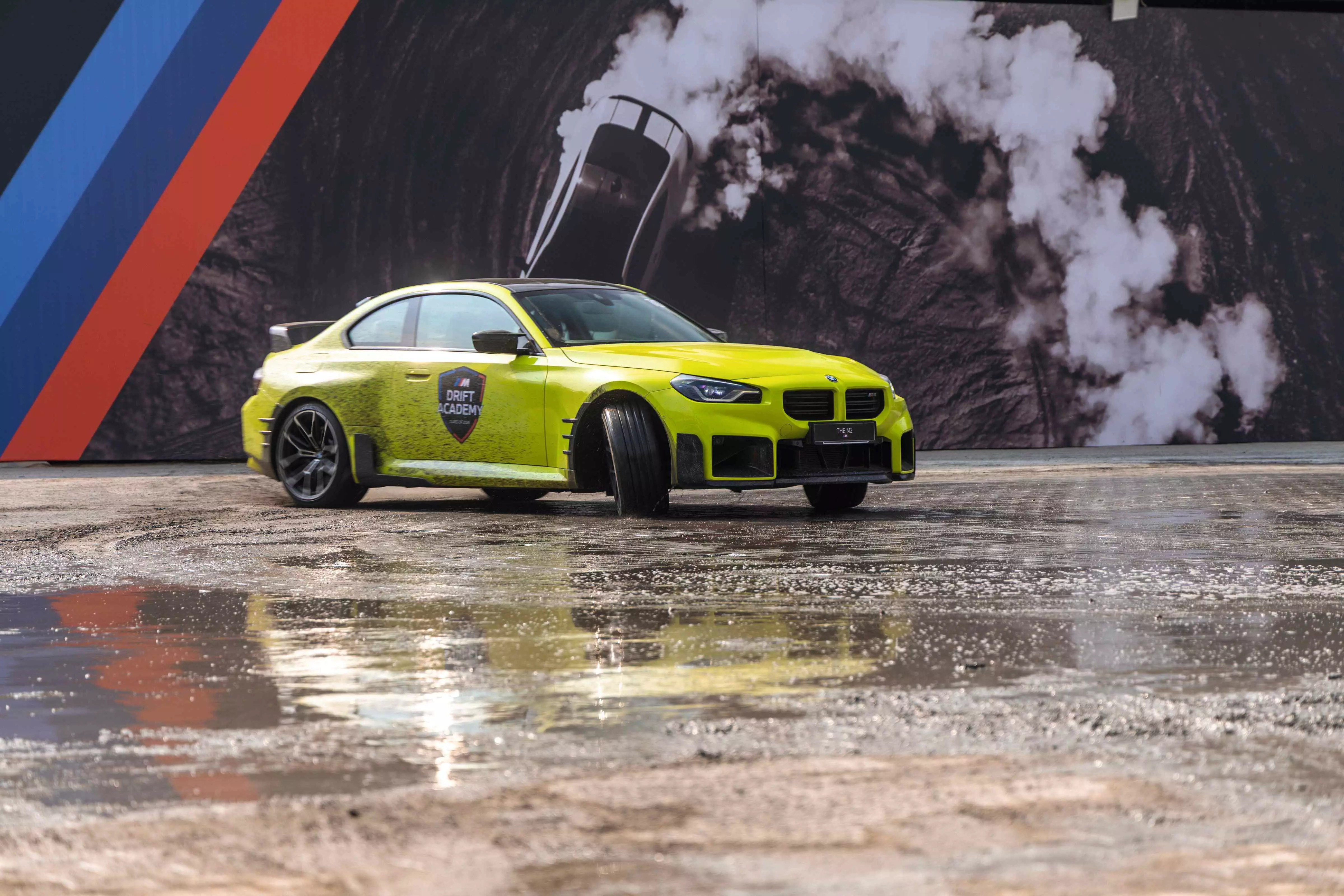
I was spending an afternoon at the BMW M Drift Academy. The name says it all, it is a drift school, with BMW Ms to play with. A fleet of M2s and M4s greet you in every colour, almost like… M&Ms. I’ve been waiting a while to make that joke. The rules of engagement are simple. You arrive, you get briefed on safety, you get taught some basic theory, and then you’re strapped into a car. I picked a bright yellow M2 with all sorts of aero addenda fitted onto it. I was worried that the M2 with its shorter wheelbase would be a bit too snappy compared to the M4, but the M2 gives me better vibes. And vibes are everything, right?
I know the theory. Boot the throttle, get the tail to hang out, figure out how to catch the slide, and then hold it there. I’ve fooled around occasionally trying to figure it out, and have never binned a car so I’d call that a success. But this time around, it was serious. We had a proper RWD car, a proper closed-off space, an instructor at hand and an exam at the end of it. I felt a proper weight on my shoulders.
Step one is to turn the electronics fully off, which were very kindly pre-programmed into the M1 button. The next step is to get comfortable with the loss of traction. Our instructor Nachiket encouraged us to just floor it and spin out, to feel the sensations of oversteer. It’s always unnerving, feeling the back of the car start to get away from you. It isn’t a natural feeling, you’re used to traction, you’re used to the car reacting certain ways to certain inputs, and once you’ve induced oversteer, all that turns on its head. Soon enough, though, you learn to feed in throttle so you don’t immediately spin around the rear, but let it break traction progressively.
“Let go of the steering once you reach the drift angle you want, it will begin to correct itself. These cars come set up with proper caster to let that happen.” This was a game changer. In all my time attempting to drift, I always thought you need to dial in the opposite lock manually. I was never fast enough with my hands and spun out more often than not. Turns out in these BMWs you don’t. Once the car is sideways, let go of the steering wheel, and it whips the other way on its own.
“Look where you want to go.” This was the second game changer. The track was set up such that it had cones that indicated where to look. Once I started paying attention to them, my hands and feet were doing the right things without me really thinking. points. Two attempts remain. The next one, I hit the throttle a little too firmly and spun out immediately. No points. By simply paying attention to the cone ahead, my hands were shuffling the steering and feeding in throttle as required. Hmm, it isn’t that hard after all. I was able to do a couple of full circle drifts, no stress.
Then came the figure-of-eight. Seems hard on paper. You had to initiate a slide, circle round a cone clockwise, then whip it the other way and do an anticlockwise circle around another cone. It tested your ability to hold a drift, your vision, your understanding of weight transfer and stringing all of that together into one seamless flow. Honestly, I found it a lot easier than a full circle drift. The fact that you could use the weight of the car to help initiate the slide, and then you didn’t have to hold it too long before you had to change direction, made it actually quite simple once you had the basics down. I honestly surprised myself with how easily I got into a flow. I pretended to be nonchalant about it on the outside, but I was doing cartwheels on the inside. I had learned how to drift!
It was finally time for the test. The rules were simple — we had to do four perfect figure-of-eights and four perfect circles. You had four attempts for each, and each task completed gave you 3 points. Thus, you could score a maximum of 24 points. You needed to get a minimum of 18 to get the badge, and consequently protect your honour as a driver. I started strong. 12/12 in the figure-of-eight task, a perfect score. It dropped the pressure for the second task — I only needed two clean attempts of the circle to get the badge. The first one, I just about managed. I kicked the tail out, held it for exactly one full circle and then spun out. Another 3 points in the bag, 15/15 so far. Then the next drift, I initiated the slide, but a few metres in, I regained traction. No points. Two attempts remain. The next one, I hit the throttle a little too firmly and spun out immediately. No points.
I had one attempt left, and was still sitting at 15 points. I absolutely had to do a perfect circle now, or I was done. No red badge. It was as good as scoring a zero. I remembered the lessons. Throttle control, let go of the steering wheel and then catch it, and most importantly, look where you want to go. I took another deep breath and focused on my vision. Look, I told myself, and the rest will fall into place.
I flexed my right foot and the tail rotated. I was looking ahead, just as I should. Muscle memory took over; my hands let the car correct before grabbing the wheel and holding it there. The engine was roaring, the rear wheels were over-rotating, but I couldn’t hear it. All I could hear was “look at the next cone, and now the next one, and the next one.” I had entered a flow state. And in that flow state, I pulled one long perfect slide that covered a full 360 degrees.
The weight on my shoulders lifted. The pressure relented. The magnetic red badge now lives on my fridge, but something more important lives in my head. The confidence that I can actually, successfully control a car over the limit.