

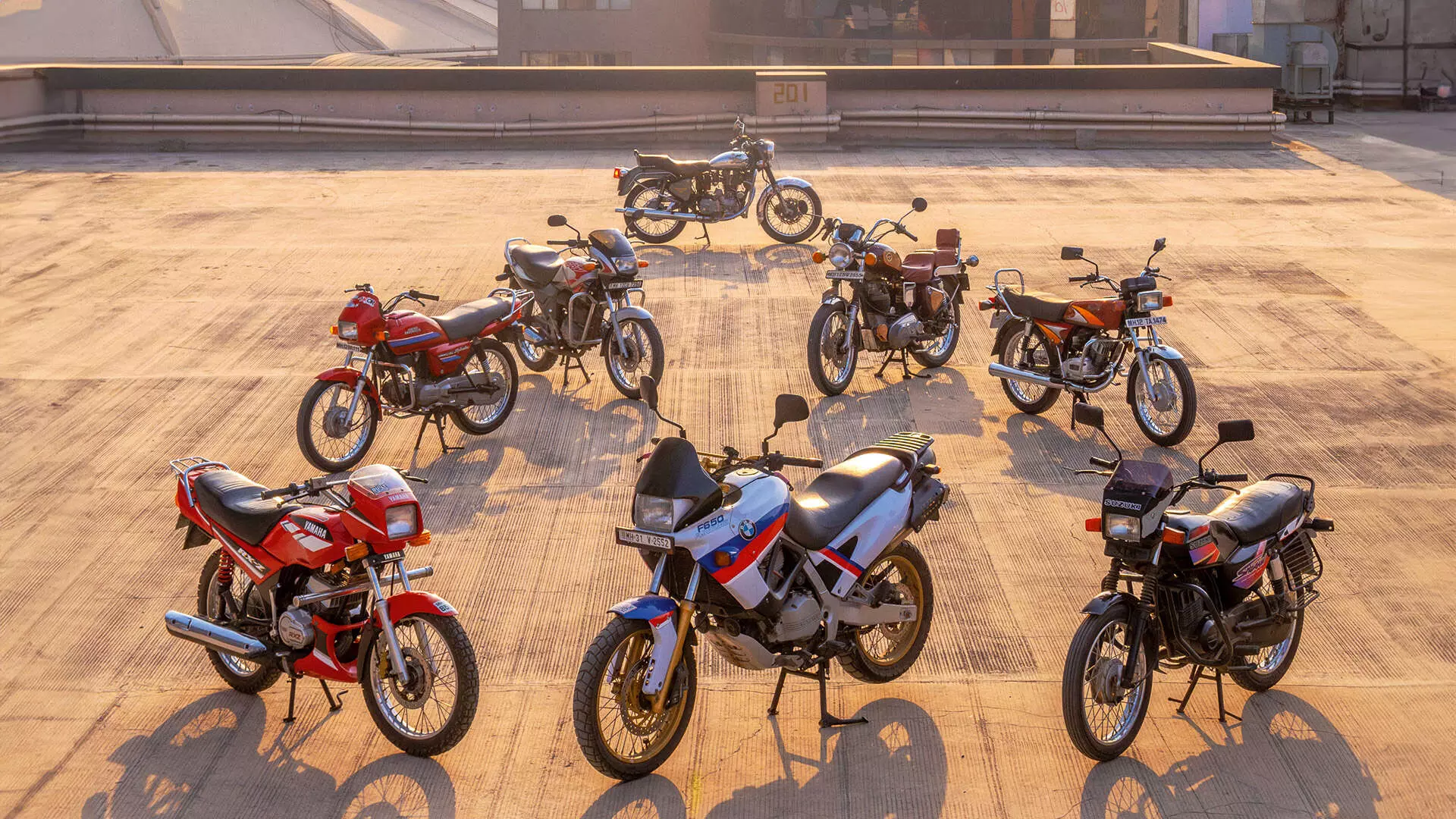
Motorcycles in India in the 1990s
Motorcycles in India in the 1990s
Gone but not forgotten
GBNF: The two-wheeler industry in India in the 1990s
After over a decade of scooters being at the forefront of two-wheeled mobility, the 1990s ushered in an era of motorcycles in the mainstream. Best of all, most of them were designed to cater to the enthusiast
The 1990s were a very interesting time to be alive. From almost everything being analogue, we were transitioning into a properly digital world. The World Wide Web had become a thing, Google was just about gaining steam, music was becoming heavier and the Hubble telescope was setting off to pap the galaxy. All this was mostly abroad. On Indian shores, specifically when it came to two-wheelers, the shift from scooters to motorcycles was happening and the consumer was also warming up to the idea that a motorcycle needn’t just be a tool to commute with but also one that could be as thrilling as it was practical. The ’90s gave us some serious icons and unlike the 1980s, a lot of the machines that we ride and cherish today are sipping petrol because of the legends that were birthed in that glorious decade. One I wish I wasn’t born at the end of and rather, had lived through. Because man, how incredible would it be, to have been alive in the era that bridged the gap between analogue and digital.
Yamaha RX-Z
Ring-ding-ding-ding. Yes, the 1990s started with this legendary soundtrack. The RX-Z was the result of its predecessor the RXG not being the success that Yamaha had hoped it would be. The reason? It’s pretty straightforward. The benchmark was set quite high with the RX 100. When you have a bike that displaces a little more but doesn’t come close in terms of performance, you’re setting yourself up for disappointment. The RX-Z rectified that with not just performance but clothes that made it a proper temptress. With the mill from the RXG revamped with a change in compression ratio, power went up by 0.5bhp to 12bhp while peak torque remained unchanged. While that seems inconsequential, the way it delivered its power mattered. Because boy-oh-boy, what a fun bike it was. On the go, it had the violent, narrow powerband of a two-stroke. When you got it there and rammed it up the gears, all you’d do would be giggle like a schoolgirl. Not just that, the way it handled was also something that made it an extremely loveable motorcycle. At 104kg it was light, flickable, but at the same time, very stable at highway speeds. And if you wanted to make the bike even more fun to ride, you could go to a Yamaha showroom and get yourself a set of race handlebars and make full use of the thoroughbred chassis. Yamaha also went out of its way to make the bike easier to ride by using a high mass auto advanced magneto, that smoothened power delivery, and an expansion chamber that was designed to not just allow you to exploit the explosive top-end performance but also give it a useable low-end that ensured the bike didn’t feel like a pedal bike going uphill when you weren’t in the powerband. It was also quite efficient, delivering close to 42kmpl. Despite all of this, it was far from perfect. The seat was uncomfortable and getting it changed or reupholstered wouldn’t really solve the problem because the suspension was inherently stiff. Then there was the price. ₹52,000 was a lot of money for the time and emission regulations forcing manufacturers to switch from two-strokes didn’t help matters either. There was also a large chunk of people, who, swayed by the precedent set by the CD100, prioritised outright efficiency and comfort over everything else. For them, the RX-Z was the last thing on their shopping wish list. But I feel really bad for those folks, because riding one of these machines feels sensational even today. A little twitchy, ready to get its front wheel up, eager to race at every traffic signal and relatively comfortable to live with (within the realm of reason) for a two-stroke. Given the amount of praise I’ve heaped on this bike, you can imagine what one of the most iconic two-strokes of that era must’ve been like. Because unlike in the 1980s, Yamaha didn’t have the craziest two-stroke motorcycle of the 1990s. That crown belonged to the love child of another Indo-Japanese collaboration. One that had some serious motorsport pedigree.
Kawasaki-Bajaj 125
After spending decades making scooters, Bajaj pivoted to making motorcycles. One of its first offerings was the KB 100 RTZ which was heralded as one of the best-handling bikes of the time, but its beating heart left something to be desired. Then came the KB 125 which is widely regarded as Bajaj’s first stab at making a performance motorcycle. Nothing about the styling suggested that but the KB 125 was a proper wolf in sheep’s clothing. In fact, there was very little telling the KB 100 RTZ and the KB 125 apart. Bajaj loved to play the familiarity card and to that end, the suspension, chassis, fuel tank, side panels and instrumentation were identical. The engine is where all the difference was. 125cc, an aluminium cylinder block, chromium-plated bore, and power and torque figures of 12.5bhp and 12.75Nm, respectively, made the bike a proper pocket rocket. Not only that, the chassis setup was exceptional, meaning that it handled all of the power really well too. Riding one today immediately makes it apparent as to why the motorcycle was so highly regarded. It has a bit of a kick to it even today, as it should, because back then it could do the sprint from 0-60kmph in around 6.1 seconds. Where the RX-Z faltered in being able to offer good ride comfort, the KB 125 excelled. Not only was it a bike that could accelerate and handle like stink when you wanted it to, it was also genuinely comfortable to live with on a daily basis. While the bike had a lot going for it, there were two things that held it back from realising its true potential. First being the gearbox; with only four cogs distributing all that power and torque, the KB felt like it would run out of steam plenty quick even though it had a lot left to give. The second were the tyres. Bajaj offered it with blocky, efficiency-first tyres, which worked well on our bad roads, but when it came to a set of twisties, they held you back from making full use of what was a brilliant chassis setup.
Hero Honda CBZ
How can one talk about the 1990s and not talk of the Hero Honda CBZ? On the one hand, it would be fair to say that Hero Honda set off the race to create the most fuel-efficient motorcycle, having sparked this trend among manufacturers with the CD 100. On the other hand, it also delivered the CBZ. Pronounced cee-bee-zee, it was a motorcycle that laid the foundation for the modern low-displacement performance motorcycle. On February 11, 1999, when Brijmohan Lall, the chairman and then managing director of Hero Honda Motors unveiled the motorcycle, he said “The CBZ is the first of its kind in this country and will go a long way in meeting the aspirations of our customers.” And he wasn’t wrong. India had seen performance bikes but not like this. The CBZ was a muscular machine, one that looked substantial and rode well too. Powered by a 156.6cc, four-stroke, single-cylinder motor, it made 13bhp and was capable of sprinting from 0-60kmph in around 5 seconds and onto a top speed of 100kmph. The engine was also fitted with a transient power fuel control system that aided with instant power delivery for quick overtakes and there were systems in place to ensure the bike passed emission norms way ahead of its time too. It was the most exciting low-displacement bike from this era. It wouldn’t be a stretch to say that the template for the Pulsars and Apaches was set here. It was comfortable but with slightly committed ergonomics and tyres that actually gripped when you tried to lean the bike beyond the side stand. All of this would suggest that the CBZ would have been the bees-knees of the time. But alas, that wasn’t the case, for a couple of reasons. Firstly, it wasn’t particularly fuel-efficient and secondly, being a thirsty Hero Honda didn’t bode well with the economy-conscious buyer of the time. Then the ₹57,000 and ₹61,375 price tags for the drum and disc brake versions, respectively, just seemed like too much of an ask. That said, if it weren’t for the CBZ, the performance motorcycle landscape in India would have been very different today.
Hero Honda Splendor
Unlike the CBZ, the Splendor did significantly better for the fortunes of Hero Honda. Unlike most other motorcycles here, it didn’t focus on performance, features or tugging at the buyer’s heartstrings. What it did, for better or worse, was carry forward the torch lit by the CD 100. Launched in 1994, the Splendor remains on sale to this date and still sells like hot cakes, moving over three lakh units in February 2026 alone. Even though the numbers suggested otherwise, the CD 100 was becoming long in the tooth. It had very little going for itself character-wise and that’s when Hero Honda launched the Sleek and then the CD 100 SS. Primarily to fix the design of the frame around the sloper engine that was prone to taking hits when ridden in rural parts of the country. The idea with the two was to breathe new life into the utilitarian design of the CD, but neither did really well. Then came the Splendor with all-new styling but a core ethos that remained the same. Still an advocate for the “Fill it, shut it, forget it” slogan, the Splendor refreshed the economobile space. It was still far from exciting to ride and the specs reflected the same. 97.2cc, 7.5bhp and 7Nm of torque. But the spec that mattered was its fuel-efficiency figure, which had gone up to 85kmpl, even more than that of the CD 100. The real-world number would be closer to 65-70kmpl, still plenty. The revolution started by Hero Honda, is one that still rages on. Us enthusiasts aren’t particularly chuffed about it but there’s no denying the fact that the company is responsible for putting Indians from all walks of life on two wheels, liberating them from the confines of our dismal public transport systems. In their own way, the CD 100 and then the Splendor are true torchbearers of the idea of motorcycling in India.
BMW F650 Funduro
The BMW F650 Funduro, in my humble opinion, is by far and away the most exciting motorcycle that was sold in India in the 1990s. It looked like it had just come off the podium at the Dakar rally. The Funduro was always on my list of bikes I really wanted to try and when I actually got a chance to swing a leg over it, it did not disappoint. Launched in India in 1996 by the then Hero Motors, it came with a 652cc, liquid-cooled single-cylinder, and oodles of power and torque. Close to 48bhp and 57Nm of it. At the time it was the most technologically advanced motorcycle available in the market. The Funduro was the love child of BMW and Aprilia. Designed by the Germans and manufactured by the Italians in Noale. The engine was developed by Rotax, a unit so iconic that it was selected to do duty in the modern BSA Gold Star 650. At its core was a single-loop frame made from pressed section pieces and square tubing. The upper half would house the oil reservoir for the dry sump, while the engine was a stressed member of the frame. Attached to that was a trellis sub-frame. Proper space-age stuff for the time. The suspension was from Showa with a telescopic fork at the front and a monoshock at the rear.
Given that it was an ADV, it came with wire-spoked wheels with a 19-inch front and 17-inch rear setup. Braking was from Brembo. A lot of the componentry was designed specifically for this motorcycle. Unlike other BMW bikes of the time, it was the only one that used traditional chain and sprockets instead of a belt or a shaft drive system. Ride the bike once and everything you hear about the bike stands true, it was an absolute hoot to hoon around on irrespective of the terrain. It enjoyed going off road as much as it did attacking the twisties and the plush suspension setup meant that it could cope with even the worst roads. I’m no historian, but I wouldn’t be wrong in saying that the BMW F 450 GS is the spiritual successor to the Funduro. The bike had a lot going for it. All of the tech, all of the performance and versatility and even the fact that the recommended service intervals were 10,000km apart made owning it easy. But what was immensely difficult at the time was buying one. Because Hero Motors launched the bike in 1996-97 at a little over ₹5 lakh and that was something the market flocking to buy Splendors and KB 125s just couldn’t digest. Even true-blue enthusiasts had a hard time wrapping their heads around the fact that the Funduro would cost nearly as much as a Daewoo Cielo or an Opel Astra. To give you an idea of how different India as a market was at the time, when globally launched, the F650 Funduro sold nearly 12,000 units the first year itself. In India, the lack of sales caused Hero Motors to panic and it started to discount the bikes by as much as 60 per cent and even that didn’t do the trick. It got to a point where the last few units were almost cleared in a garage sale fashion. This also meant that what could have potentially been a fruitful partnership for the Indian masses had permanently ended. The F650 Funduro was just much too early for India at the time, but the next time you’re out riding your KTM 390 Adventure or your Himalayan 450, remember that this is where it all began for the ADV segment in India.
Suzuki Shogun
The TVS-Suzuki Shogun was the brand’s answer to the RX 100 dominating the two-stroke space. Named after the hereditary military dictator of feudal Japan, total dominance is exactly what TVS-Suzuki hoped for with the Shogun in the Indian market. Powering it was a two-stroke, air-cooled, 108.2cc, single-cylinder engine that put out 14bhp and 11.4Nm of torque, instantly making it the most powerful Indo-Jap bike in its class. Riding one immediately confirmed all statements about it being a thoroughbred race bike. It responded only to violence and was most rewarding when ridden hard. It even looked the part. It was mated to a four-speed gearbox, was capable of sprinting from 0-60kmph in 5.6s and didn’t really care for fuel economy too much. Which is why it was a crowd favourite amongst all the racers who deployed it in almost every discipline of two-wheeled racing in India at the time and won. If outright power and performance were all that was key, the Shogun was all set to be a runaway success. But sadly, as was the case with the RX 100, emission norms crept up on the Shogun, needing the makers to fit it with a catalytic converter, making the bike even more expensive. The companies knew that buyers for an outright performance oriented two-stroke bike were numbered and sold more efficient, less powerful machines such as the Super Max 100, 100 R and the Samurai alongside the Shogun. Taking on the RX 100 was no mean feat, but that’s exactly what TVS-Suzuki very successfully did, and for that and a horde of other reasons, the Shogun will go down in the history books as a truly iconic motorcycle.
Royal Enfield Lightning
With the Lightning, Enfield India ushered in a new era of motorcycling in India. With it came the cruiser. A form factor that was so desirable that many manufacturers would go on to have a stab at making one of their own. The Lightning 535 was amongst the final motorcycles to get the Cast Iron series of engines. In fact, the Lightning was unique because it had the Cast Iron engine but with 35 more cee-cees, a displacement we would only see later on with the Continental GT 535. The Lightning with its tall, wide cruiser handlebar and laidback stance looked like nothing else on the road back then. It also had its scale going for it unlike some cruisers that came later on and looked properly malnourished. Because it was a Cast Iron, it still had the gears on the wrong side and I hilariously struggled to ride it but for the little time that I did, it really surprised me. It felt easy-going and relaxed but at the same time had enough grunt to take this near 190kg behemoth up to 125kmph when asked. I rode the Machismo a little later and despite that being a roadster, the Lightning felt quicker to steer and a lot more relaxing to ride. At the time, it was sold for ₹80,000 and that meant that it was positioned as a properly premium motorcycle. This particular Lightning pictured here is one of those real rare ones because it actually was the very one showcased at the fourth-ever Auto Expo at Pragati Maidan and came with the 500cc engine that very few Lightnings ever came with; everything else was the same. The dials looked modern and told you more than just the speed, and the design properly differentiated it from all other Enfield India bikes. And in case you weren’t sure, the supremely famous Thunderbird and now Meteor 350 owe their existence to the Lightning.
Royal Enfield Machismo
By the late 1990s, the Enfield India thump was a mainstay across most of India. Right from the towns, to the highways to the mountains, the Cast Iron engine had traversed the length and breadth of the country, spilling oil or grease along the way. It was around this time that the company was going through a transition as well. The Eicher takeover had just happened and a lot of things were changing. But the most important change came by way of the main thing that made an Enfield an Enfield – the engine. By 1999, the company phased out the Cast Iron engine and got in the AVL engine, also known as the AVL Lean Burn engine, this engine got the brand to contemporary times. It was a 346cc, air-cooled, four-stroke motor that made around 18bhp and 27-odd-Nm of torque. The most important part was that the gears were now on the left side and that there were five of them. The ratios were a little taller and that, coupled with a larger 14.5-litre tank on the Machismo and the claimed 50kmpl efficiency figure meant that you could go much longer without needing to stop. The Machismo looked every bit the Bullet that you wanted it to but gave you a lot more by way of chrome finishing and even the option of a disc brake a little later on in its life cycle. It still had the iconic dug-dug, but felt a bit more modern. With electronic start and gears on the correct side, it was what made this style of bike accessible to a much wider audience to cherish.
The 1990s were a very different time to the 1980s. It was a decade where manufacturers were clearly experimenting. Not only that, despite bikes such as the Splendor comprising a chunk of what sold at the time, the enthusiast had a lot more choice. A lot of the bikes that you and I ride today such as the Pulsars, the KTMs, the adventure bikes and the sporty commuters exist because of some radical movement or technology shift that happened in the ’90s. Two-stroke machines were at their peak with bikes such as the Shogun and RX-Z leading the charge. Bajaj, now known for being a multi-brand conglomerate with brands like KTM and Triumph, started its motorcycling journey in this decade. It was the decade when adventure motorcycling came to India, a segment that we now cannot imagine our market without. It was a time when most bikes were more than just tools of getting from point A to point B, it was a time when each machine had a story to tell. A story, if you lived through the ’90s, you would be lucky to call your own.
Credits: Shot at Amanora Mall, Pune.
With thanks to Akash Nagarkar, Byram Godrej, Nikhil Bhagat, Siddharth Bhowmik, Sumit Mahabaleshwarkar, and Baljeet Singh for their motorcycles.