

Car Reviews
Citroen Basalt X first drive review: Do the upgrades now make it a better package?
The Citroen Basalt X gets a host of upgrades inside, like new upholstery, Cara AI assistant, ventilated seats and more tech
- Ride quality
- VFM
- fixed major feature misses
- No keyless entry
- No sunroof
When Citroen launched the Basalt last year, it had the right idea but not quite the right execution. The design was striking, the ride was sublime, and the price was tempting – but step inside and you’d see where the cost cutting had gone too far. The interior felt bare, the features list thin and buyers simply looked elsewhere. They were barely able to sell any units after launch and the number kept declining as time went by. Citroen needed to address the elephant in the room, and that’s exactly what the Basalt X is about.
The ‘X’ update is the brand’s way of saying we heard you. The cabin has finally received the attention it deserved. The dashboard and seats now wear new brown-and-black dual-tone upholstery, complemented by gold accents and soft-touch materials on the dash and door pads. There’s more features such as ventilated front seats, cruise control with a speed limiter, and a 360-degree camera (the quality could’ve been better though). The centre console and aircon vents have been redesigned, and the 10.25-inch infotainment unit has been carried over, but now gets the new Cara AI assistant, which responds to natural voice commands to control navigation, air-con settings and more. It’s surprisingly intuitive and is one of the only genuinely useful voice assistants out there.
What really stands out, though, is the new diffused white ambient lighting that runs across the cabin. It looks properly premium at night and adds a sense of occasion to what was once a rather bland interior. At the back, the adjustable thigh support and winged Cara AI assistant responds to natural voice commands to control nav, air-con settings and more rear headrests – one of Citroen’s trademark comfort features continue from before. Despite the coupe roofline, space at the back is surprisingly good; there’s plenty of kneeroom, and headroom for most adults shouldn’t be an issue. You also get two type C charging ports at the back for added convenience. Still no sunroof or keyless entry though!
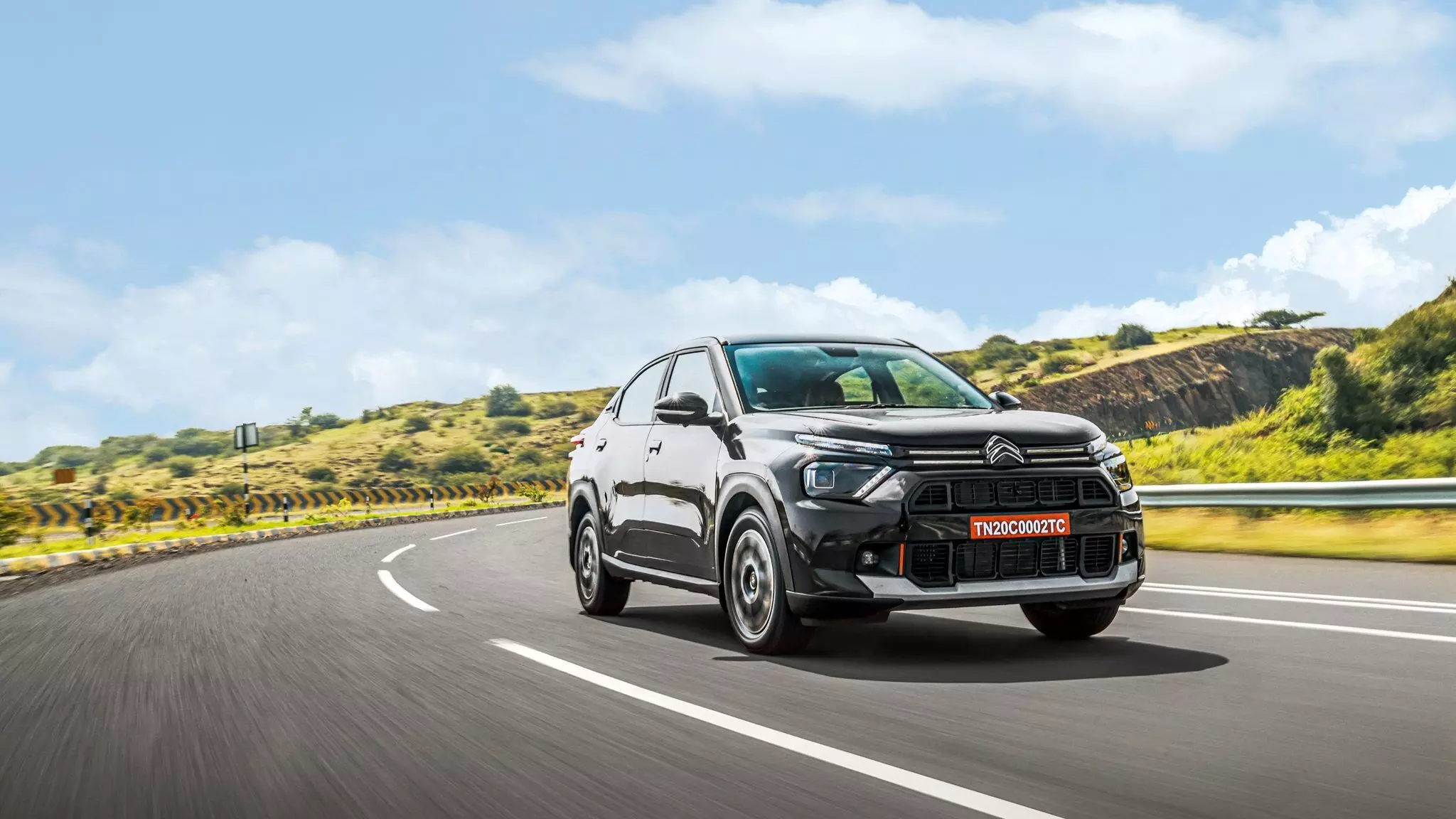
Before you ask, no – the exterior hasn’t changed much. The front wears Citroen’s signature split LED DRLs and projector headlamps, which do a fine job of catching your eye even in daylight. The car rides on 16-inch diamond-cut wheels, but that makes the car look undertyred. It deserves at least 17s and a wider footprint to look meaner and sportier. Citroen could’ve really hit a sixer with this one change on the exterior. The only change on the outside is the new Basalt X badge that quietly tells you this is the updated version. But that’s enough about the surface. Let’s move to what truly defines this car – its USP. The suspension.
The first thing that comes to mind when you think of France is wine. But for an automotive enthusiast, it’s not the Bordeaux or Champagne – it’s the suspension. Because nobody makes suspensions quite like the French. It’s practically a birthright. Post-World War II, the roads in France were shattered and the country needed cars that could take a beating yet deliver a smooth, composed ride. The case here is similar. The suspension and damping in the Basalt X seems tuned by someone who’s spent years studying how to make Indian roads feel European. Ride quality is, unsurprisingly, the Basalt X’s party trick. It glides over bumps, dismisses potholes with a muted thump, and feels incredibly composed on uneven highways. There’s a sense of airiness in the way it moves – like it’s floating above the road. Body roll is evident if you try hustling it through corners, but the trade-off for that creamy ride is worth it.
The Basalt X's ride quality is its biggest USP — Shot by Shubham Hadke for evo India
Under the bonnet sits the familiar 1.2-litre turbo-petrol engine, producing 108bhp and 205Nm, paired to a 6-speed torque converter. On paper, it’s not going to scare the Germans or the Koreans, but on the road, the Basalt X plays to its strengths. It’s smooth, reasonably refined and delivers a good slug of torque from low revs. The transmission keeps things calm and fluid, though it can get a bit vocal if you really put your foot down. Even though it drives like before, the whole process of it has become much simpler. The addition of cruise control has made long road trips easier and would also end up returning better fuel efficiency. I drove the car for about 800km in one week and fared an average of 12.8kmpl, which included maximum driving time in the city, and some on the highway. So, how does the car stack up?
The Basalt X sits in a very interesting space. The base You variant continues to sell as the standard Basalt at ₹7.95 lakh; the Plus variant onwards all variants have become the Basalt X. Its price starts from ₹9.42 lakh, and goes up to ₹13.1 lakh. The car sits in the price range of sub-4m SUVs such as the Hyundai Venue and Skoda Kylaq, but is even longer than the Creta and from a higher segment. So, essentially you pay much less for a car that’s from a segment above. The design, suspension, and powertrain that didn’t need a change remains the same, but all the tech, features and feel inside the cabin has been changed to make the experience much more premium now. And I think they’ve aced it. With this, there’s nothing to stop the Citroen Basalt X from selling like hot cakes!