

Bike Reviews
Ducati Monster V2 first ride review: A monster that doesn’t bite?
The fifth-gen Ducati Monster V2 promises to be every bit the hooligan you expect a Monster to be while being easier to live with
As children, you’re always scared into doing your chores or getting into bed at a reasonable hour with the threat that the monster under the bed or lurking in the shadows will come get you. But like everything in life, it’s not as simple as black or white. Sometimes there’s a healthy dash of red and the monster in question might just be one by name. Think James P. Sullivan or Toothless. These are the friendly, caring kind that are ferocious when you need them to be, but mostly just cuddly. That’s exactly what the Ducati Monster V2, now in its fifth-generation to be. Easier to ride, more familiar to the eyes and packs enough of a bite when needed. Is this actually the case? We got a day to tame the new Monster to find out.
Ducati Monster V2 design
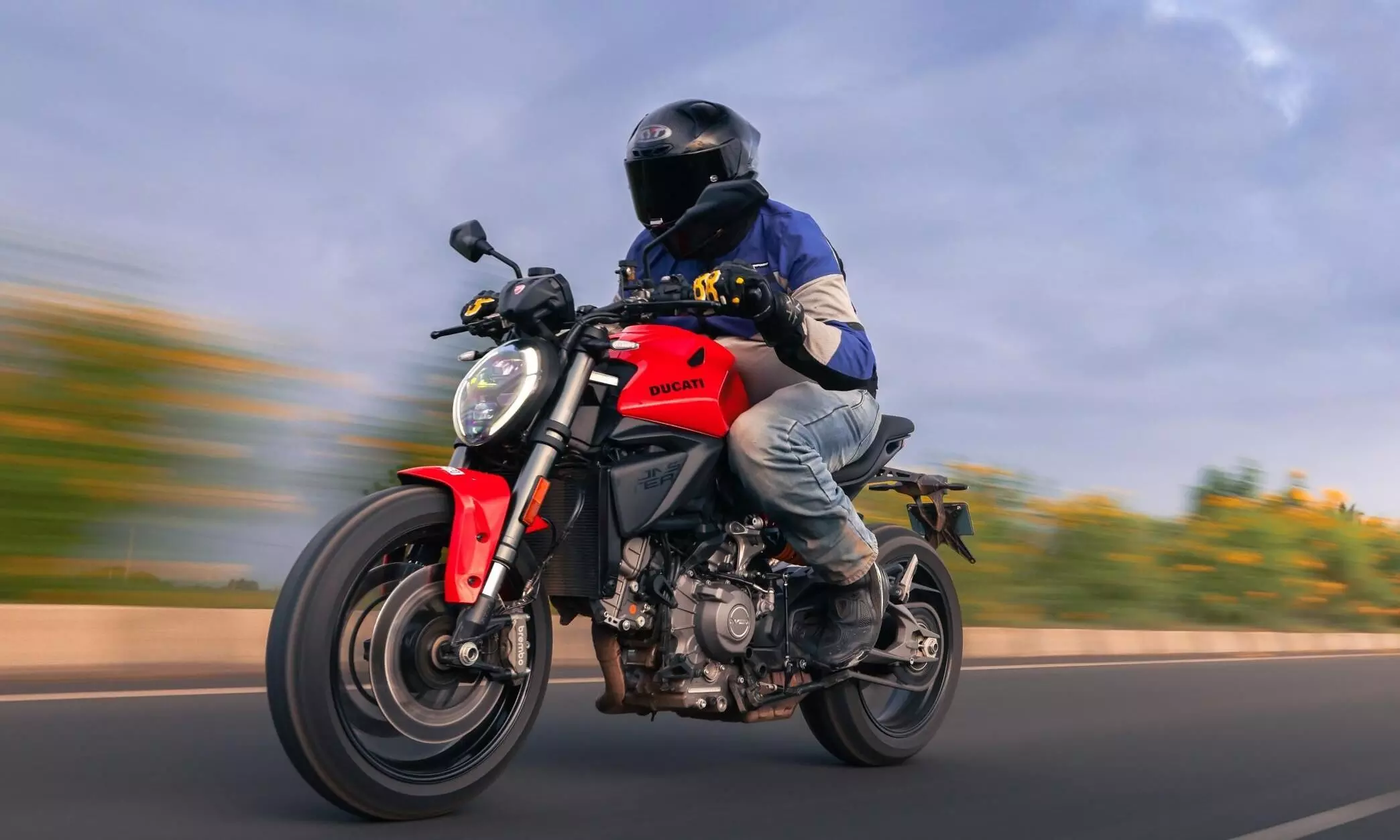
Look at the photos and not much seems to be different on the fifth-generation Ducati Monster over the model it replaces. But see it in the flesh and the changes are quite apparent. Ducati tells us that the new Monster harks back to the original in terms of its styling and is more bulbous and muscular rather than the chiseled fourth-gen Monster before it. To a large extent this holds true. The tank is broader and curvier giving it the hunkered, broad shouldered look. Then there’s the return to the single-piece seat, just like Monsters of yore. The headlight gets a redesign as well with C-shaped DRL elements just like the new crop of Ducatis, as does the rear section with C-shaped elements making up the taillight. The twin-barrel exhaust continues but unlike the previous Monster with the tips sawed-off diagonally the barrels look more traditional and much nicer in my opinion. I especially love the grille at the exhaust tips. If you want a fly-screen and a rear cowl you can opt for the Monster+ variant which gets them as standard fitment. You can also choose between two colours – Ducati Red and Iceberg White. Summing up the design, the new Monster V2 certainly captures the essence of the original Monster by becoming a little curvier. It retains the aggressive styling but is not as sharp as the previous bike and that in my opinion is exactly what the Monster is meant to be.
Ducati Monster V2 performance
Powering the new Ducati Monster V2 is the new 890cc, 90-degree V2 engine that does duties in the Multistrada V2, the Streetfighter V2, Panigale V2 and the upcoming Hypermotard V2. It of course is in a different state of tune, one that works rather well for the bike. In terms of numbers, the bike makes 109.4bhp at 9000rpm and 91.1Nm of torque at 7250rpm. While the torque is down marginally, it is of little to no consequence because the engine also gets IVT or Intake Variable Timing – essentially a variable valve timing system that means that you get nearly 80 per cent of peak torque from as early as 4000rpm. Crank the bike, and you’re greeted by a familiar, raspy, burbly Ducati exhaust note. The kind that isn’t too loud or jarring but actually quite the aural treat. Pull the clutch in, slot it into gear, and you will realise that the clutch is on the heavier side and the shifts aren’t the most satisfying from a tactility point of view. But that’s about where my complaints with the engine end because once you get past that, what a treat it is to ride the Monster.
With IVT, there’s usable power and torque almost everywhere in the rev-range. Which means roll the throttle on in any gear from anywhere above 3000rpm and the Monster is ready to go. This means that you can not only carry a gear higher into a corner and still get plenty of drive to exit, but you’re also not constantly rowing through the gears when riding in the city. Cruising on the highway is effortless, but this is not news. We’ve already ridden the Multistrada V2 and already know of the touring ability of this engine. 120kmph and you’re sitting comfortably below 6000rpm, the engine is stress-free, no vibrations to complain off and making a quick overtake is just a matter of rolling on the gas. No gear shifts needed. The heavy clutch can be a little cumbersome in chock-o-clock traffic but apart from that the DQS 2.0 (Ducati Quick Shift) works supremely well, and the dollops of torque smattered across the rev range mean that clutchless upshifting at lower rpms is plenty smooth as well. There were times that I did a roll-on from 2500rpm in sixth gear and the bike actually managed to pick up speed without screaming blue bloody murder and sputtering and stalling. This is very unlike Ducatis that we’re accustomed to which always require you to be on the boil.
Because of how tractable the bike is and because you have access to power almost everywhere, it doesn’t feel as ferocious as before. Because earlier you’d have to rev the engine out to get that surge of power that made things seem violent. What you have here instead is power that is genuinely usable without getting yourself in trouble. And as far as performance is concerned, this Monster feels faster in almost every perceivable way than before and this is despite not making any more power than the previous model. It manages heat fairly well too. Yes, it does get hot and that is something you can’t avoid when the engine packs so much oomph. But the engine manages the heat very well, and even though you do feel some of the heat on your legs, you needn’t worry about not being able to further your lineage. Then there’s the fact that the major service – valve clearance inspection of the engine has gone up by 15,000km to 45,000km means that the new Monster V2 is genuinely an easier motorcycle to live with. Not just in terms of riding, but also maintaining. The Monster is meant to be a playful, aggressive urban bike and not a thoroughbred track machine. – Shot by Avdhoot A Kolhe for evo India
Ducati Monster V2 ride and handling
The chassis setup of the new Monster V2 is quite similar to the model it replaces. The monocoque front frame continues to do duties in the 2026 bike, but it has been revised to offer better outright performance. In fact, along with the new engine, the boffins at Bologna have managed to shave off 4kg when compared to the previous bike. Which means that the new Monster V2 tips the scales with fluids topped but fuel tank empty at 175kg. Then when you factor in all the extra performance, that’s impressive. And light the Monster V2 does certainly feel. The rest of the chassis is made up of a 43mm, non-adjustable Showa Big Piston, Separate Function USD fork and a preload-adjustable monoshock, also sourced by Showa. Braking is taken care of by Brembo M4.32 callipers chomping onto twin 320mm discs at the front and a twin-piston calliper mounted on a 245mm disc at the rear. Swing a leg over the bike, and you immediately feel like you’re sat in the bike rather than on it. This could be down to the fact that the Monster V2 sold in India gets the 795mm short seat height as standard vis-a-vis the 815mm seat that does duties on the international model. While this makes the bike plenty accessible to riders of a shorter stature, I really wish that Ducati would let you option the standard seat height if gravity has been kinder to you. At five-foot-ten-inches, I feel like the taller seat would have been that much more comfortable for me. Because the footpegs aren’t particularly rear-set and taller riders will find the bend in the knee to be a little cramped. Apart from that you reach out to a wide single-piece handlebar. Barring the short seat, the riding position is spot on. You’re sat upright in a commanding stance, the kind that allows you to ride peacefully and seamlessly transition to attack position when the corners are quickly approaching. Shorter riders will not only appreciate the seat height and the low weight but also the fact that the bike is narrow which will allow them to get their feet down quite easily.
Coming to the ride quality, this is where the Monster left me plenty impressed. The suspension setup is on the sportier side of plush. Plush being the key word. It manages to deal with most of the bumps that our roads muster with quite a bit of ease, without really unsettling you or the bike. It’s only the sharp, squared ridges and bumps that manage to seem a little harsh, but for a bike with sporty intentions, that is more than acceptable. The best part is that the plushness doesn’t come at the cost of handling and the inherent Ducati traits certainly bleed red here. Show it a set of corners and the bike shows its Monstrous side. Transitioning from side to side is easy, and it tips into a corner with a lot of surefootedness, and that same trait continues through the corner as well. Yes, it is not going to be as sharp as a Streetfighter V2 or the Triumph Street Triple RS. But it is not meant to be. And it straddles the line of being an easy, fun bike to ride daily, while being plenty capable to take to the twisties or a track day rather nicely. Braking is equally impressive with the M4.32s continuing to impress even after all these years. The calibration is spot on too, with not a very aggressive initial bite. Which is great given that the suspension is on the softer side. Would I have liked an adjustable suspension setup? For sure. But is the bike worse for not having one? The Monster is meant to be a playful, aggressive urban bike and not a thoroughbred track machine. And this new Monster is exactly that.
Ducati Monster V2 electronics and features
Like we’ve come to expect of all Ducati’s, the Monster V2 gets a whole plethora of electronic rider aids. DTC (Ducati Traction Control), EBC (Engine Brake Control), DWC (Ducati Wheelie Control), ABS, and an optional DPL (Ducati Power Launch) take centre stage of the rider aids. All of these parameters have their own calibration basis of which of the four riding modes you’re in. Speaking of which, there are four riding modes to choose from – Rain, Road, Urban and Sport. All the electronics can be customised even further in each mode. Then there’s also the Power mode, which essentially allows you to choose between Low, Medium and High power modes that also subsequently soften or sharpen the throttle response. This essentially allows you to tailor the motorcycle to the level of naughty or nice you’re feeling that particular day. All of these are controlled by new switches on the left switch cube and a new larger, 5-inch colour TFT screen. In typical Ducati manner, navigating the UI is very intuitive, and the screen is bright, crisp and well laid out. In addition to all of that, you can also opt for heated grips and cruise control, adding another layer of practicality to the motorcycle.
Ducati Monster V2 verdict
The Ducati Monster V2, in my humble opinion, is a great step in the right direction. It has a clear sense of purpose, in that it is a sporty, approachable urban motorcycle and not one that is looking to set lap records. All the changes over the previous generation bike do reflect Ducati’s intention of making the Monster the sort of motorcycle that you would genuinely enjoy living with. Yes it has a few shortcomings like the heavy clutch, a vague-feeling gearbox and, if you’re taller, the cramped seat. But these are fairly minor inconveniences in the grand scheme of things. Prices for the fifth-generation Ducati Monster V2 range from ₹13.99 lakh to ₹14.34 lakh (ex-showroom), depending on which colour (Ducati Red or Iceberg White) and variant (Monster or Monster+) you get. At this price, you’re certainly paying a premium over its competition, but that holds true for all Ducatis. Will you smile every time you ride it, yes. Will you look back at it every time you’re done riding yet, also yes. I look forward to doing a comparison to figure out if the Monster justifies that premium or not. But until then, what I can leave you with is that the new Monster is a genuinely fun motorcycle, one that will keep you happy irrespective of where you ride it.