

Car Features
India's Estates: A Complete History of the Wagons Nobody Bought
Station wagons never took off in India, but carmakers and coachbuilders have kept trying for more than fifty years
Indians have never been big fans of station wagons. SUVs and sedans took the sales, and the estate became a footnote in showrooms. But that footnote is long, stretching from the Ambassador Estate and a Mumbai coachbuilder's Padmini Safari in the 1970s to a modern-day super wagon from BMW.
Almost none sold in large numbers, but together they tell a story about what Indian buyers wanted and what carmakers thought they would want. This is every estate India has been offered, and why so many of them quietly disappeared.
Hindustan Ambassador Estate
Wagons here began with the car that defined Indian motoring. The Ambassador started life as the Morris Oxford III, and Hindustan Motors built it from 1957 to 2014. At its peak, it held around 70 per cent market share of the new-car market, and for decades it was the only car many families could imagine buying. By 2013, only about 2,200 were sold in a market of 1.8 million cars, and production was suspended.
In the early 70s, Hindustan Motors launched the Ambassador Estate, similar to the Oxford Traveller, to show that the platform could underpin different body styles. The monocoque shell was unusual for its day and adapted without much re-engineering. Wagons and delivery vans could be ordered from the factory, and coachbuilders could finish bare commercial chassis. Only a limited number of estates were ever built, which explains why India never developed a wagon culture. When one car does everything, nobody builds a separate wagon.
Premier Padmini Starline Safari
The Safari is the most charming car on this list, and the one that needs the biggest asterisk. It was never an official factory product. A Mumbai workshop called Starline Motors built it in 1973 on the Premier Padmini, which Premier Automobiles made in India under licence from Fiat. It used a 39bhp petrol engine, and every Premier Safari body came from Starline, which is why enthusiasts more commonly call it the Fiat Safari.
Starline was more than a bodyshop. They even fielded a racing team in the 1972 All India Highway Motor Car Rally, so they knew driving as well as panels. Owners remember the cars fondly, and some families kept theirs for well over a decade. It's a coachbuilt conversion rather than a factory car, but it belongs here because it shows that Indians wanted a wagon enough to get one built, even when no manufacturer would make one.
Tata Estate
The Tata Estate is the most important car on this list. Tata Engineering, now Tata Motors, built it in Pune from 1992 to 2000, and it was the company's first real attempt at a passenger car. Tata was already a giant in trucks, with commercial-vehicle roots going back to a 1954 partnership with Daimler-Benz. Ratan Tata said that JRD Tata always dreamed of building a car that was truly a "Tata", and that the Estate fulfilled that dream.
Underneath, it was a truck-maker's idea of a family car. The platform came from the Telcoline pick-up, the styling was similar to Mercedes-Benz wagons of the era, and a 1.9-litre diesel making around 67bhp powered it. It followed the Sierra, Tata's 1991 passenger-vehicle debut, and it arrived ahead of its time, so the early release had its share of teething problems. Its legacy is bigger than its sales. The ladder runs from the Estate to the Sumo in 1994, India's first SUV, then to the Safari and Indica in 1998 and the Indigo in 2002. The Estate taught Tata how to sell utility vehicles to Indian families, and the company returned to the wagon a decade later with the Marina.
Sipani Rover Montego Estate
Sipani launched an estate version of the Rover Montego in the early 90s, with a 2.0-litre diesel making 80bhp and 163Nm. The Montego was a mid-80s Austin Rover family car, and Sipani was a Bangalore firm trying to offer a foreign-badged alternative to the Ambassador while the market was still tightly regulated. It was an ambitious idea for a small manufacturer.
It didn't sell much, and the Montego Estate remains one of the rarest cars here. The market simply wasn't ready for a niche car with British heritage and a price to match.
Tata Indigo Marina
The Marina arrived in September 2004, built on the Indigo sedan, and it was developed with Italy's I.DE.A Institute. Tata priced it at roughly ₹4.3 to 5.3 lakh, the same bracket as the sedan. This broke the rules, compared to how other car makers sold estates, because they positioned them as lifestyle variants and tagged them almost a lakh above the sedans. Roof rails were standard, a diesel was on offer, and Tata planned to sell around 6,000 a year.
It had real strengths. The cabin was spacious enough that Ratan Tata was known to drive his pet dogs around in one. The engines were 1.4-litre units, an 84bhp petrol and a diesel making around 69bhp. A facelift later added luxury trims with leather seats and headrest-mounted screens. By then, Tata said, more than 125,000 Indigos and Marinas were on Indian roads. It was the most successful mass-market wago India has seen, and a neat bookend to the Estate Tata launched in 1992.
Opel Corsa Swing
Opel came to India with General Motors in 1996, and the Corsa sedan followed in 2000. In 2003, Opel launched the Corsa Swing, priced near the ₹6 lakh mark. It was powered by a 1.6-litre petrol engine making 92bhp, and it was fairly fun to drive. The pitch was German engineering at roughly a third of the price of the cheapest Mercedes sold here.
Fiat Palio Adventure
The Palio Adventure was an enhanced version of the Palio Weekend, with body cladding, some sporty bits and cosmetic changes. The idea was to give the wagon a more rugged look, in the way Volvo and Audi had done with their raised estates. It kept the punchy 1.6-litre petrol from the Weekend.
With sales that never really taking off. It was a shrewd attempt to blend the wagon with the growing taste for crossover looks, one that arrived while the Indian market began to develop an appetite for SUVs.
Maruti Baleno Altura
Maruti's Baleno was Suzuki's sedan for India, and the Baleno Altura gave it a wagon body a few years after it launched. It was a rare case of the country's biggest carmaker trying an estate. Maruti is known for reading the Indian market better than anyone, so the Altura was an unusual experiment.
It also never found a real audience, and Maruti never followed it up with another wagon. Even for a brand with the widest reach in the country, a station wagon simply wasn't a car families wanted.
Skoda Octavia Combi and Combi vRS
The Octavia has been Skoda's calling card in India since the brand’s arrival, and the Combi sold alongside the sedan. It offered the same cabin and refinement with a much bigger load bay. For buyers who wanted a practical European family car, it was the obvious choice.
The vRS was the performance flagship, and it was the amongst the quickest wagon on sale in India, until the Audi RS6 Avant arrived. Its appeal was a practical body with a sporty engine, at a price an enthusiast could actually afford. It showed that India's wagon audience was small but real.
Audi RS6 Avant
The RS6 Avant came to India in 2015 at ₹1.35 crore as a CBU import, with a 560bhp 4-litre V8. The RS6 carried that idea into the 2010s with supercar-level performance wrapped in a family-sized body.
Volvo V90 Cross Country
Volvo built its identity on estates, and the raised Cross Country’s roots go back to the late-90s. The V90 version carried that tradition into the modern era, with a premium cabin and a calm, understated character. It was introduced to the Indian market in 2017 and is no longer on sale.
Its extra ground clearance suited Indian roads better than almost any other wagon, which is the logic behind the whole genre of lifted estates. It was a thoughtful car in a market that mostly bought SUVs.
Mercedes-Benz E-Class All-Terrain
Mercedes launched the E-Class All-Terrain in India in 2018 and it was on sale alongside the V90. It's a raised, cladded take on the E-Class with SUV attitude, built on a body style Mercedes has made for decades. It was Mercedes' bet that a rugged wagon could succeed where a plain one hadn't.
It brought a luxurious cabin, air suspension, and a powerful diesel engine. Few cars here are as hard to find today as the All-Terrain. It arrived in 2018, just as Indian buyers had warmed up to SUVs in a big way, so a raised wagon was always going to be a tough sell. It never reached the numbers of the sedans around it, and it slipped out of the lineup without much noise.
Porsche Panamera Sport Turismo and Taycan Cross Turismo
Porsche has twice tried to sell Indian buyers a wagon. The Panamera began in 2009 as a four-door grand tourer, and the Sport Turismo is its more practical sibling, with a longer roofline and a bigger boot. An India launch was announced for January 2018, with the Turbo priced at Rs 2.08 crore.
The Taycan was Porsche's first all-electric production car, and the Cross Turismo adds a raised wagon body. It arrived in India in 2021 in a couple of flavours. Together they show Porsche treating the wagon as a way to broaden a sports-car range, and a way to offer buyers something their neighbours won't have.
BMW M5 Touring
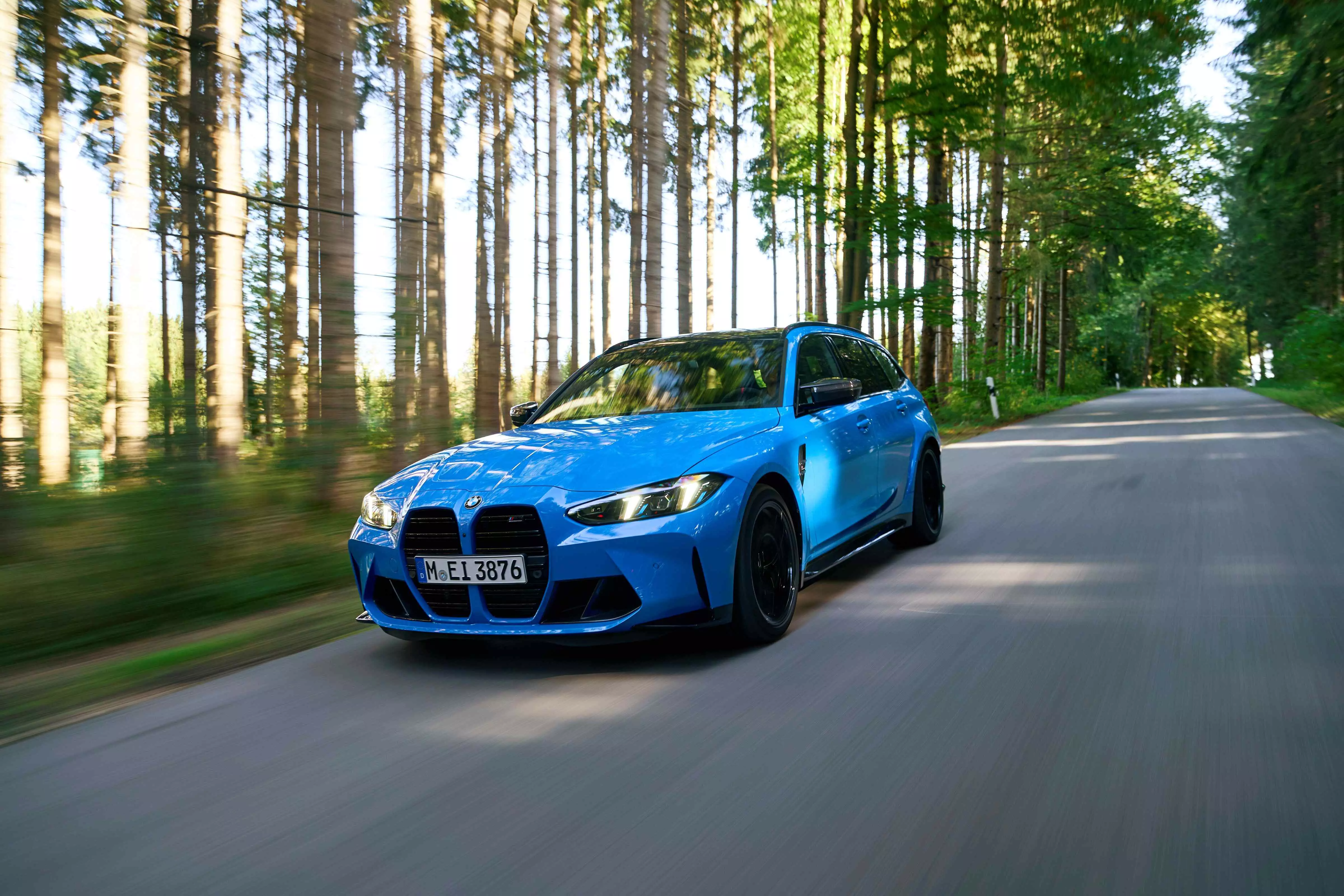
BMW has made the M5 Touring available in India through the limited-run 100 Jahre Nürburgring edition, with bookings now open. It is BMW India's first estate offering. It uses the same 4.4-litre twin-turbo V8 plug-in hybrid as the sedan, making 717bhp and 1,000Nm, with an 8-speed automatic and all-wheel drive. BMW claims 0-100kmph in 3.6 seconds, and a pure-electric range of up to 67km on the WLTP cycle.
M5 estates go all the way back to the hand-built E34 Touring of the early 90s and the V10-powered E60 Touring after it. Estate launches are exceedingly rare in India, which makes this one a notable moment for the segment. Only 3 units will be coming to India with an ex-showroom price of ₹2.59 crore.