

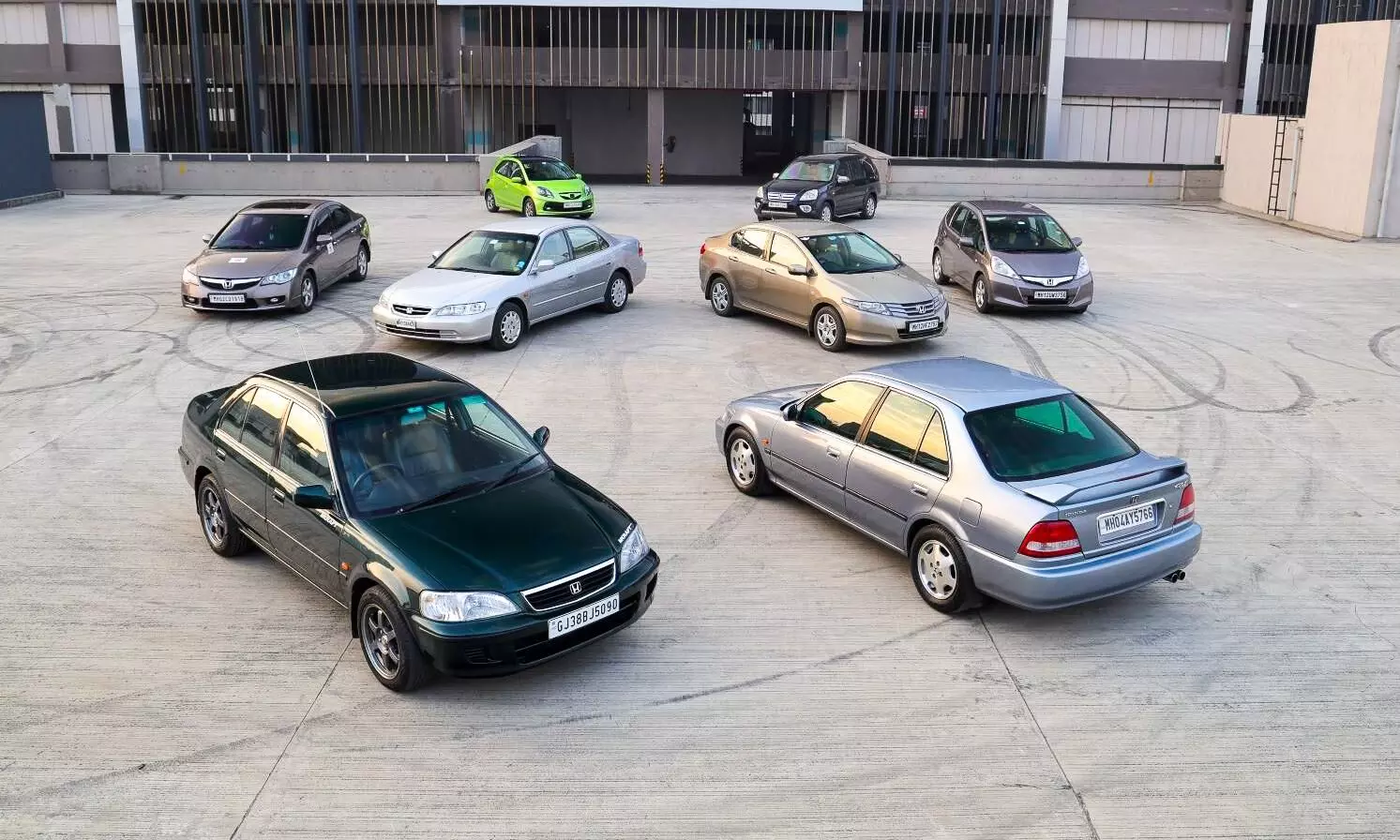
Gone but not forgotten
30 years of Honda Cars India: Honda’s greatest hits
With Honda celebrating 30 years in India, we bring together the carmaker’s greatest hits
Turn back the clock 30 years and in 1995, Honda, the globally renowned carmaker from Japan, would go on to form a joint venture with Delhi-based Shriram Industrial Enterprises Limited thus creating Honda-SIEL Cars India or HSCI, kicking off its Indian innings. Forming a JV was a route that most global players took when entering the Indian market. General Motors had teamed up with the Birlas of Hindustan Motors, as did Mitsubishi, while Ford struck up a JV with Mahindra. Fiat turned to Premier and the best example of them all was obviously Suzuki, which had partnered up with Maruti Udyog, and its cars were ubiquitous on our roads by then. But for all the virtues of the Maruti 800 and even the Maruti Suzuki Zen, these cars weren’t exactly desirable or enthusiastic – these qualities would be embraced and eventually, defined by the Honda City.
The City was the first offering from Honda in India and was introduced in 1998
Honda City Gen 1
This is genesis. Honda introduced the City Gen 1 Type 1 in India in 1998 and this was a low-cost Honda, developed exclusively for Asian markets. The ₹6.4 lakh sticker price meant it wasn’t exactly low-cost when it came to buying, and the equipment levels on some variants were shocking! No power steering, no central locking, no stereo, no tachometer, no wheel caps – no door pockets even! But to enthusiasts, it did not matter.
The car on the right is the Honda City Gen 1 Type 2, a facelift, which was later offered with the VTEC engine, creating the desirable City VTEC seen on the left
There were two engines on offer – 1.3-litre and 1.5-litre petrol, and the latter was the first engine in India to make 100bhp. In performance tests, the City 1.5 managed a 0-100kmph time of 13.32 seconds – putting it ahead of rivals such as the Mitsubishi Lancer, the Daewoo Cielo and the Maruti Suzuki Esteem. The dark green car pictured here is the Type 2, which was launched in 2000, which got styling updates and even managed to address the equipment shortcomings. But to be honest, all we cared about were the four letters slapped on its boot – VTEC.
The B15 1.5-litre naturally-aspirated engine in the Honda City VTEC produced 106bhp
VTEC kicked in yo!
Six months after the Type 2 came to India, the Honda City got a boot spoiler, 14-inch alloy wheels, twin exhaust tips, but the heart of the affair lies under the bonnet. Lifting it up on Ashish Zion’s pristine example reveals the cylinder head with ‘VTEC’ stamped on it, and it is a gorgeous sight even today. And the performance of the VTEC blooded an entire generation of motor noters. The B15 1.5-litre naturally-aspirated engine produced 106bhp (detuned from 120bhp in other Asian countries) and managed a 9.92 second 0-100kmph time, though that required a shift to third gear unlike the Baleno which managed it in second. “I still remember we ran a deep red VTEC on our long-term test fleet, and everybody absolutely adored – and nailed! – that car, Sirish joyfully recalls. “It was the first car with a silver-finish centre console and see-through headrests; it managed to successfully conceal the fact that the cabin was rather cheaply built without even a moulded roof lining,” he adds. The oh-so-low driving position had you sold, and long before the Skoda Octavia RS and its ilk, it was the City VTEC that enjoyed a cult following amongst enthu-cutlets in India. It even had a thoroughly successful motorsport career in India – without any factory backing.
The Gen 2 ‘dolphin’ was introduced in 2004 and got a 1.5-litre iDSI engine
Honda City Gen 2: The ‘dolphin’
Following the highs of the City VTEC came the lows of the iDSI. The Gen 2 ‘dolphin’ (as it is colloquially referred to) was introduced in 2004 got a 1.5-litre iDSI engine which made a measly 77bhp and killed off any sportiness that we associated with the City. Amends were made with the City ZX in 2006 which once again was powered by a VTEC mill, but it was the third generation City which marked a return to form for Honda.
The Gen 3 Honda City seen on the left was based on the Honda Jazz platform
Honda City Gen 3: The arrow shot
The ‘arrow shot’ was based on the Honda Jazz platform, and had a longer wheelbase over the Gen 2 City. The seats were higher-set, 15-inch wheels were standard, the chassis was uprated, and the City finally got ABS and twin-front airbags as standard. What you’ll likely remember it for was the controversial deletion of the CD player from the equipment list, with Honda claiming USB and aux inputs were sufficient for the stereo. But most uncles who actually bought Citys were probably aghast. The Gen 3 continued to be a terrific steer, but the lack of a diesel engine meant it seriously got bruised by the competition like the Hyundai Verna – and for the first time since Honda began their Indian innings, the City was knocked off the top of the sales charts.
The Honda Accord was the logical upgrade for City owners
Honda Accord Gen 1
In the early noughties, if you wanted to upgrade from a City, you had to consider something like a Mercedes-Benz C-Class, a jump too far. This is where the Honda Accord came in, and if things had gone to plan, it would’ve been the first Honda to be offered on sale in India. Back in the mid-eighties, Tata Motors or TELCO, as it was known in those days, had applied for a licence to manufacture the Accord in partnership with Honda, but the-then dispensation denied the licence, citing concerns such as foreign currency outflow for luxury car production. 16 years later, we would get the sixth-generation Accord in India in 2001. By now, Honda had established itself as the purveyor of premium and desirable cars, and the Accord’s entry into India reinforced the sentiment, making it a favourite of the moneyed class. In the verdict of his road test, bossman Adil Jal Darukhanawala wrote, “Make no mistake, the Accord is a mighty fine car and Honda knows it too well. So well that Honda SIEL has priced it high but forgotten to add the few bits and pieces which would have made it a great car.”
The interiors were festooned with leather, but relatively spartan on equipment. This entry-level example got a powered driver’s seat, climate control, a stereo and that’s about it – all of which feels inconsequential when you get into the sofa-like rear seat. The back seat is properly spacious and luxurious, and is the perfect place to slink back in and be chauffeured home after a long day. The spec sheet reveals that this generation of the Accord came with independent five-link double wishbone suspension at the rear, with the two diagonal links forming a Watt’s linkage. If that sounds familiar, it’s because this has only come into the foreground in recent years with the Mahindra employing a Watt’s linkage in the Mahindra Scorpio-N and the Mahindra Thar Roxx. But Honda? They had it back on the Accord in 2001.
This generation of the Honda Accord was arguably the best one we got
The best Honda Accord that India got
Three years later, came the seventh-gen Accord (Gen 2 in India), and this is the shape that we’re more familiar with – arguably the best Accord that we got. It was offered with a 2.4-litre engine as well as a 3-litre V6, the latter producing 221bhp of power and 267Nm of torque. Interestingly, while the Accord featured an SOHC (single overhead camshaft), a version of this V6 with a DOHC was employed in none other than the mid-engined Honda NSX sports car! Polished aggression is how one might describe the performance of the V6-engined Accord, and the Accord managed to sprint from 0 to 100kmph in 9.58 seconds. I’m not sure how many buyers of an Accord or its segment rivals would have actually preferred to drive their cars, but this certainly was the car to get if you wished to get behind the ’wheel and get rid of the chauffeur.
The following generation came in four years later and would be longer, wider and comfier than the car it replaced, while also being more expensive and solely focused on the plutocrat sitting in the rear seat – if they hadn’t migrated to a German luxury sedan or SUV already. The uncontrolled rise in Accord prices didn’t help. In 2012, the eighth-gen Accord cost ₹20 lakh. When the following generation made its way to India with a hybrid powertrain, prices jumped to ₹40 lakh. The justification given for the increase in prices was the worsening Yen-Rupee rate, but what was left unsaid was that Honda were no longer assembling the Accord in India. And with the popularity of SUVs on the rise, coupled with Honda’s push towards the mass-market with cars such as the Jazz and the Honda Brio, the writing was on the wall for what was once the finest car in its segment.
The Honda CR-V was a soft-roader that broke away from the traditional SUV template
Honda CR-V
It’s not like Honda were ill-equipped to cash in on the SUV craze. Even before the segment was in vogue, Honda sniffed an opportunity to create a niche. Back then, SUVs were big, burly beasts with a body-on-frame construction, their engines sipped diesel and the dynamics were never going to be something to write home about. All that changed with the Honda CR-V – a soft-roader which broke away from the template of traditional SUVs. Compact Recreational Vehicle or Compact Runabout Vehicle was what ‘CR-V’ stood for, depending on who you asked, and the SUV was introduced in India in 2003. Honda’s own launch communication and messaging did not push the CR-V as a hardcore off-roader, like a Mitsubishi Pajero for instance.
What the CR-V did instead was offer the comfort of an Accord while still taking on bad roads. It was powered by a 2.4-litre iVTEC petrol engine with AWD, with the automatic versions getting a dash-mounted shifter which was very MPV-ish, freeing up space inside the cabin. It had a folding tray between the front seats and hidden away in the boot floor was a picnic table. Despite it being a soft-roader, the first-gen CR-Vs looked the part of ‘proper’ SUV, complete with the spare wheel on the tail gate. That said, the following generation which was unveiled at the Paris Motor Show in 2006 was an even bigger hit among city slickers. Sadly, the same cannot be said about the next major update for the CR-V in India, which was a major departure from its predecessors, and made its way to our shores in 2018. This was the first CR-V to be offered with a diesel engine in India, but it never caught on in popularity like its predecessors.
The Jazz's mini-MPV kind body style embodied the ‘Man Maximum, Machine Minimum’ principle
Honda Jazz
By this point, Honda had tried its hand at becoming a major player in the mass-market, looking to annihilate the competition with the Jazz. Except that didn’t happen because with that pricing, Honda ended up shooting themselves in the foot. The mini-MPV kind body style embodied the ‘Man Maximum, Machine Minimum’ principle, and the Jazz was very practical – the ‘Magic Seats’ had three configurations helping you liberate a lot more space in the cabin. The 1.2-litre iVTEC engine was superb, and even in a mega comparison where we put it up against every hatchback in India from the Tata Nano to the Volkswagen Polo, it scored the highest. But that pricing – a hatch for ₹8 lakh! – was the only thing between the Jazz and victory. For roughly ₹20,000 more than a fully-kitted Jazz, you could get a Volkswagen Vento, and Indians have always equated sedans with higher status, resulting in the Honda not currying favour with buyers.
All of the key inputs for the Brio came in from Honda’s Indian engineers and product development team
Honda Brio
Having burnt its fingers with the Jazz, the Brio was Honda’s second stab at making a hatchback, and this time, right from the conceptualisation to the engineering, all of the key inputs came in from Honda’s Indian engineers and product development team. It had kei car-like dimensions, and that meant Honda had to innovate on packaging. The one-piece seats with integrated headrests were stiff because the foam itself was slender (slenderisation in Honda-speak), the dashboard and door pads were scooped out to liberate more interior space, but the rear seat could still seat two at best. The Boot space wasn’t generous, and the rear glass tailgate was something that might have put off a lot of buyers. The 930kg kerb weight and the 1.2-litre iVTEC engine making 87bhp meant it was quick on its feet, but the relatively lukewarm response to both the Jazz and the Brio means it is unlikely that we’ll get a hatch from Honda in India again.
Even today, that swooping, low-slung silhouette of the Civic manages to look effortlessly cool
Even today, that swooping, low-slung silhouette of the Civic manages to look effortlessly cool
Honda Civic Gen 1
While fanboys might not exactly be clamouring for a hatchback from Honda, they definitely yearn for a new Honda Civic. The nameplate has a storied lineage in global markets but the Civic made its Indian debut in 2006 – and the immediate verdict was that it was light years ahead of its time, especially if you compared it to something plain Jane like a Toyota Corolla. Even today, that swooping, low-slung silhouette of the Civic manages to look effortlessly cool, the front-end is aggressive and those taillights – fully round on the initial models and squared-off with the subsequent updates – were designed to resemble the afterburners of a fighter jet when lit up in the dark.
Keeping up the cool quotient was the interior and its two-tiered instrument display. Right in the driver’s line of sight was a digital speedo, and placed below it in a more conventional position was an analogue tachometer. The low driving position was a hit among the enthusiasts, though there were some oddities; the handbrake for instance was shaped like a chicken leg and gave you the impression of being delicate. And an armrest with volume controls for the music system made little sense, considering that rear seat space wasn’t all that great in the Civic.
The Civic became the second pillar for Honda in India alongside the City, and initial response was super positive. Like all Honda engines, the 1.8 iVTEC which made 140bhp of power was a joy to cane to the redline, and had solid tuning potential. It even went on to win the ICOTY in 2007, and it seemed like Honda could do no wrong with the Civic. Except that the low-slung stance of the Civic meant it would scrape its underbelly over every other speed breaker, which also meant sales hit the proverbial speed breaker. The other chink in its armour was the lack of a diesel engine, addressed years later when the tenth-generation of the Civic came to India, alongside the same 1.8-litre iVTEC petrol mated to CVT.
Ideally, what Honda should’ve done is get the Civic Type R to India, but what we got instead was the Civic Hybrid. Powered by a 1.3-litre iVTEC engine mated to the Integrated Motor Assist System, it made less than 100bhp and was the complete opposite of what fanboys wanted. Fuel efficiency was obviously great but even the kitna-deti-hai crowd were in shock when the price for the hybrid went up by 100 per cent, from ₹10.2 lakh to ₹21.5 lakh, meaning the Civic Hybrid bombed on the sales chart, making it a sad chapter in the story of what was once the sportiest Honda on sale in India.
Make Honda great again!
There were other missteps from Honda as well, such as the Honda WR-V, the Honda Mobilio and the Honda BR-V – cars that weren’t necessarily flawed, but ones that failed to read the market properly or were priced out of sync with segment expectations. There was the delay in getting diesels into the line-up and in a bid to battle Maruti Suzuki on volumes, Honda overstretched themselves. But while it’s easy to write off Honda because of these missteps, just look at the cars over the last few pages – every single one will put a smile on your face. The Honda community is tight-knit even today, so much so that within just days of us putting up an Instagram post scouting for cars for this shoot, we had all the cars lined up, each accompanied by their passionate owners. And when was the last time you heard complaints about a Honda going wrong?
One might joke that Hondas are the cars for both uncles and enthusiasts, and in a way, they might be right because Hondas have always been well-rounded offerings that did almost everything well. It’s only now that we’re spoilt for choice that we tend to be dismissive of Honda’s glorious past. What we should do instead is celebrate those high-revving engines that made us petrolheads in the first place. It’s human nature to be more appreciative about something once we’ve lost it, and I hope we petrolheads won’t need to feel the same about Honda, the brand that introduced India to the ‘Power of Dreams’.